







Healthcare can be ‘an emotional and political issue’: PM Lee
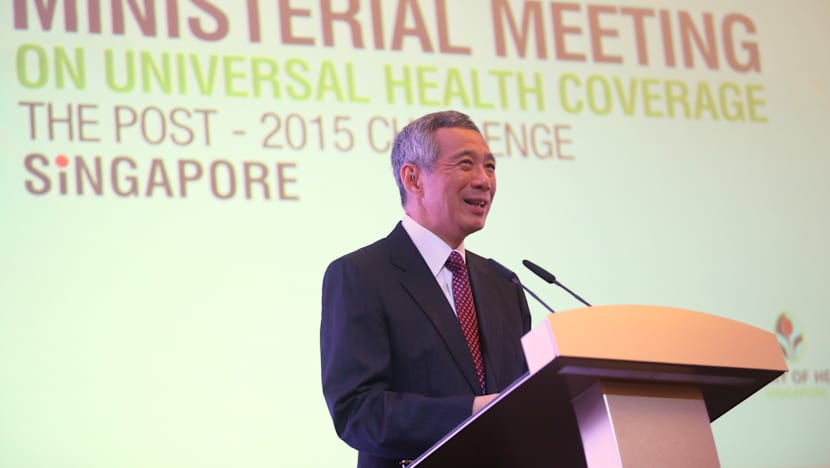
Prime Minister Lee Hsien Loong speaking at the Ministerial Meeting on Universal Health Coverage. Photo: Ernest Chua


SINGAPORE — Healthcare can turn into an emotional and political issue, where it becomes tempting to make promises of providing lower healthcare costs, said Prime Minister Lee Hsien Loong today (Feb 10).
“Healthcare is always an emotional and political issue (in) any way - tempting to make promises and say we will do more, we will do better and cost less, maybe even for free,” said Mr Lee in his opening address at the Ministerial Meeting on Universal Health Coverage.
“And so it is important for the Government to present people with the full facts and the trade-offs because every dollar that we spend on healthcare is one dollar taken from taxpayers and one dollar less to be spent somewhere, whether it’s on education... on housing, on defence or on the personal needs of our people,” he added.
Mr Lee also noted that maintaining good healthcare is a continual and evolving challenge, which is why Singapore has made various changes to its healthcare system,





This includes replacing MediShield with the universal and compulsory medical insurance MediShield Life, which will cover everybody regardless of age or pre-existing conditions.
“It is still a catastrophic insurance system, with deductibles and co-payment, but one which offers better protection and covers a wider range of conditions,” said Mr Lee. He added that the new scheme will also provide better protection from growing bill sizes.
Insurance premiums will be higher under this scheme, so the Government is subsidising the premiums to keep them affordable, especially for the lower income, said Mr Lee.
“But because the premiums are going to be higher than before, it is necessary to make MediShield Life compulsory, because with higher premiums, there will be more temptation for people to opt out...,” he said.
Mr Lee also noted that another shift in the healthcare system has been to provide more comprehensive support for outpatient treatment. For instance, the authorities have implemented a means-tested subsidy scheme for outpatient treatment — the Community Health Assist Scheme or CHAS — to subsidise treatment for lower- and middle-income Singaporeans at private GPs.
The authorities are also “right-siting” services so patients can receive better and more affordable care in their communities, said Mr Lee.
This includes providing improved access to GPs and polyclinics, building community hospitals and structuring subsidies to encourage patients to be treated appropriately instead of turning to acute care.
Mr Lee added that Singaporeans are also encouraged to take better care of their health. The authorities have been encouraging an active lifestyle within communities and promoting health campaigns to raise awareness of the risks of unhealthy lifestyles, among other things.
The two-day ministerial meeting involves health ministers, senior officials and experts from Asia, Oceania, the Middle East, Europe and America and will include four panel discussion sessions on issues that impact the implementation of universal healthcare coverage.




