Help for low-income families to rent electric homecare beds
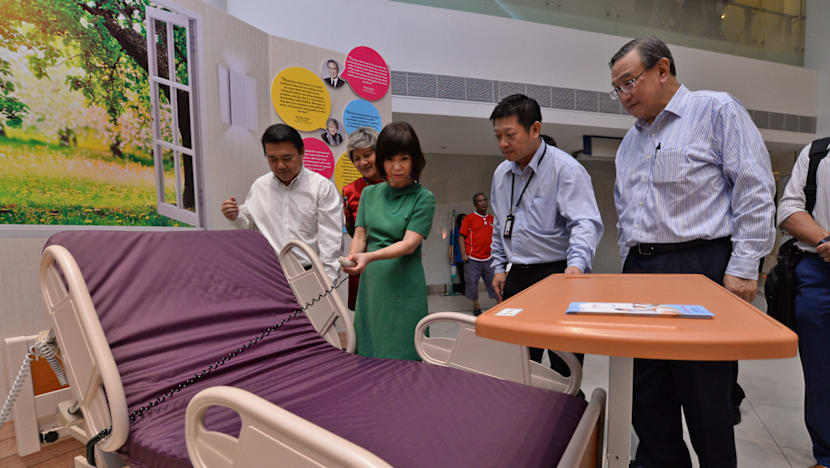
Dr Amy Khor (in green), Senior Minister of State for Health, testing the hospital bed that is to be sold by HomeCare Enterprises. Photo: Robin Choo


SINGAPORE — Low-income families with members who require homecare equipment can now rent electric homecare bed sets — modelled after beds at public hospitals here — for S$50 a week.
The bed sets, which are also available for sale at S$1,500 a piece or S$1,580 when bundled with a mattress, were introduced today (Dec 2) at the launch of HomeCare Enterprise (HCE), a not-for-profit social enterprise aimed at providing affordable and quality homecare equipment and services, catering especially to low-income families.
With the help of hospital assistance schemes, the rental could drop to as low as S$10 a week for Changi General Hospital (CGH) patients in “C”-class wards.
The electric homecare bed sets, which are modular and can be packed into flat boxes for transport, were customised based on feedback from patients, caregivers and nurses, said CGH Chief Executive Officer Lee Chien Earn.





Like a typical hospital bed, it can be lowered and raised at various angles, and comes with detachable siderails and head- and foot-boards.
Costs are kept low by working directly with an in-house manufacturer at a hospital in Taiwan, said HCE general manager Benjamin Cheam.
Such beds would typically set families back by S$2,400, he added.
Those interested in buying the electric bed sets can call the HCE at 68503393 or email them at contactus [at] hce.com.sg.
Other ideas that the HCE — which is supported by Changi Health Fund, the charitable arm of regional health system Eastern Health Alliance — is looking into include assisted bathing facilities and affordable adult diapers.
These areas have been identified based on feedback from low-income families, said HCE board member Elim Chew.
“We were told that adult patients in needy families get by with one diaper a day,” she said.
HCE hopes to facilitate the development of a network for low-income caregivers here, said Dr Lee.
To that end, CGH will also be enhancing its training programme for caregivers, such as including more hands-on and “teach back” sessions, where trained caregivers can teach others.
“As more patients opt to go home, hospital staff are given less time to train (their caregivers). We hope to catalyse a network and community for caregivers, very much like what you have among mothers and parents in Singapore, especially for the lower income who may not have easy access to the Internet to address their queries,” said Dr Lee.