







Historians weigh in on how best to commemorate founding fathers
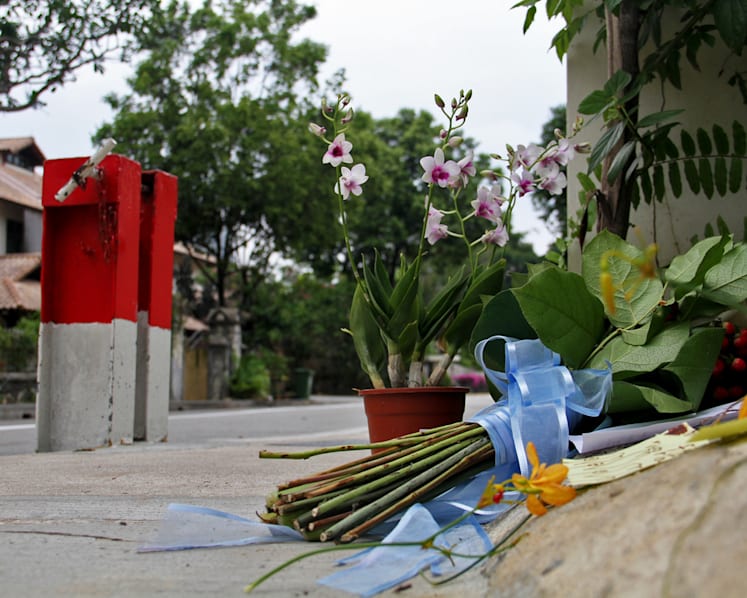
Flowers and messages left near Mr Lee Kuan Yew's residence at Oxley Road. Photo: Robin Choo


SINGAPORE — A memorial park that integrates history and nature, an interactive multimedia gallery or a museum reliving the post-war and pre-independence periods with artefacts donated by the public were among the suggestions mooted by historians and other experts for the proposed memorial commemorating Singapore’s founding fathers.
On Monday, Prime Minister Lee Hsien Loong said in Parliament that a committee would be set up to gather views from the public and conceptualise the memorial, as he responded to calls from Members of Parliament to honour the late Mr Lee Kuan Yew.
Writing on Facebook yesterday, Emeritus Senior Minister Goh Chok Tong urged members of the public to contribute ideas and chimed in with a suggestion of his own: A “Founders Memorial Park” to “trace the making of a nation, capturing its trials and tribulations”.
Speaking to TODAY, Assistant Professor Goh Geok Yian of Nanyang Technological University’s School of Humanities and Social Sciences said she liked the idea of a memorial park.





“Singapore’s reputation as a garden city constitutes an important part of our founding leaders’ legacy,” she said. Asst Prof Goh suggested locating the memorial near the Singapore river, as “this is where the story of Singapore began”. She added: “There can also be a board for visitors to pin their notes of thanks.”
Associate Professor Derek Heng, head of studies for history at Yale-NUS College, said a permanent gallery showcasing tactile artefacts that “bring to life the challenges and sensorial experiences of the 1950s and 1960s” would be a good way to educate the younger generation.
Displays should “focus on the time and the movement, and not so much the individual”, he said.
In addition to materials already available in Singapore’s museums and the National Archives, a call for donations can also be made to members of the public who lived through Singapore’s founding years, he added.
Also calling for a gallery, Asst Prof Yeo Kang Shua of the Singapore University of Technology and Design noted that it should be curated with a dual objective of commemorating the pioneer leaders and educating the young.
“We will need more than physical structures to engage the current generation,” said Asst Prof Yeo, who is also honorary secretary of the Singapore Heritage Society.
To ensure that the gallery is meaningful to Singaporeans, its content must be regularly refreshed and should offer different narratives of Singapore’s road to independence, he said.
Dr Kevin Tan, president of the International Council of Monuments and Sites Singapore, noted that having a founders’ memorial could run into the tricky territory of determining who the country’s founders are.
“The only way to avoid this is to have an abstract memorial (that includes) all those who fought for the independence of Singapore,” he suggested.
Despite the Prime Minister reiterating on Monday his parents’ wish for their house on Oxley Road to be demolished, Assoc Prof Heng felt the property should be acquired by the state to house the gallery-cum-memorial, given its vast historical significance.
While he noted the late Mr Lee’s concerns about the “artificiality of a historic home”, Prof Heng said the flooring and furniture of the house are reminiscent of the period. “If retained and preserved, (the house) would make a wonderful heritage preservation project,” he said.
The Prime Minister had said the Government would not make any immediate decision on whether the home would be demolished, because Mr Lee’s daughter, Dr Lee Wei Ling, will continue to live there. He also revealed that Cabinet ministers had tried hard to change his mind about razing the property, but to no avail.
Mr Goh said he was also among those who thought Mr Lee’s house should be preserved as a national heritage. He wrote in his Facebook post: “But he was totally against it and had his wish recorded in Cabinet. He could not be persuaded. He was a rational man.” Nevertheless, having a memorial park will be more meaningful, said Mr Goh.




