







How TTSH’s nurses innovate to deliver enhanced patient care
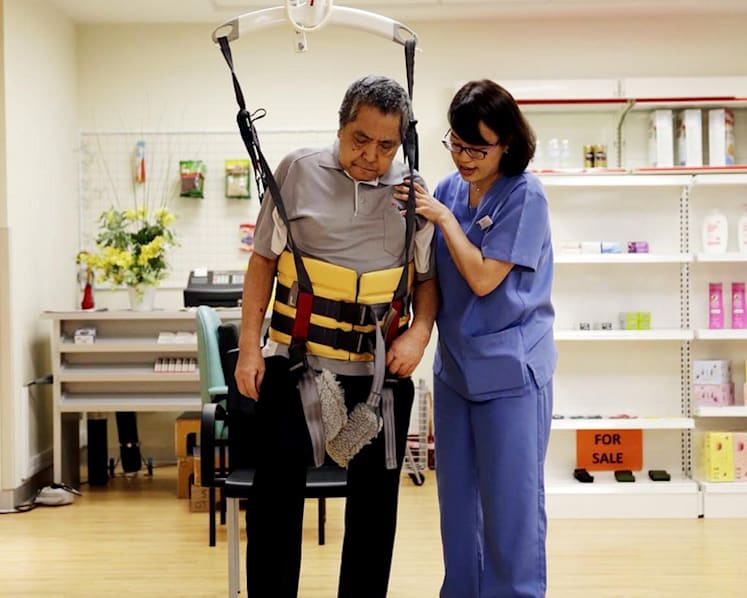
The ceiling hoist at St. Andrew’s Community Hospital Day Rehabilitation Centre helps patients practise walking and climbing stairs, with less aid from therapists. PHOTO: WEE TECK HIAN


SINGAPORE — In 2010, nurses at Tan Tock Seng Hospital (TTSH) spent 10 per cent of their time on direct patient care, and the rest on other duties such as administration and paper work. Last year, the figure rose to 35 per cent, thanks to new technologies that were first tested in the surgical ward on the hospital’s 11th floor.
The 36-bed ward, which doubles up as TTSH’s “innovation hub”, is not only the place where new inventions such as wearable devices that continuously track vital signs like blood pressure and heart rate, are trialled before being implemented hospital-wide. It also has seen several of its own “light-bulb moments”, which have resulted in a ‘dropbox’ for surplus medication and disposable cutlery wipes, among other inventions.
Such new inventions form an important part of TTSH’s innovation journey, which started in 2008, to help its nursing workforce become more productive through automation and job redesign.
“Singapore is world-renowned for being at the forefront of clinical technology, but innovation in non-clinical fields is slower to pick up,” said chief nurse Yong Keng Kwang.





Innovation is not always about avant-garde technology, he stressed.
For instance, every ward in TTSH now has a dropbox for nurses to deposit unused medication according to type (such as oral, IV, enteral, topical), rather than having to return it personally to the pharmacies.
At the end of the day, healthcare officers will collect all the contents of the box, thus eliminating paperwork and giving nurses another four minutes to spend on each patient.
Another innovation took place in 2012, when the hospital launched a S$36 million project to renovate its wards, such that each smaller ward of five beds would have its own nurse’s station. However, there is still one central nurses’ station in each ward, as in the past.
The revamped layout allows nurses to see their patients better and respond promptly to their needs, often without the need for bell calls.
All wards also feature an automated medication-dispensing cabinet synced with a database of patients’ medical records.
TTSH is now piloting a tracking device among patients in ward 11C, which relays patients’ vital-sign information at five-minute intervals to the nurses’ station. Nurses will receive mobile alerts when the patients under their care display signs of abnormality.
The ward is also experimenting with giving patients designated sets of cutlery, mugs and water flasks.
To enhance hygiene, a local wet towel product firm, Freshening, has been engaged to manufacture “cutlery wipes”.
“We realise some patients have specific habits, so it is more hygienic for them to have their own sets (of cutlery), which they can bring home after they are discharged ... They are easily cleaned with the wipes,” said nurse clinician Lim Mei Ling.
Mr Yong stressed that innovations must be centred on the patient. “We don’t just innovate for the sake of glamorous technology,” he said.
To encourage nurses to offer new ideas, a nursing innovation fund was set up in 2014, which offers up to S$1,000 for each idea. TTSH nurses have come up with 88 innovation projects using the fund, so far.
There have been hits and misses, said Mr Yong, noting that some ideas were applicable only in specific wards.
While the innovation journey is far from complete, nurses said they have seen some of its benefits over the years.
Staff nurse Nur Fazilah Rahim said she is now able to spend more time with patients and their family members. “We can update relatives on patients’ conditions more completely. We have even learnt to call them by their preferred names, something we didn’t take note of in the past.”




