







Explainer: What factors decide life and death in a flight emergency? Takeaways from Japan Airlines 'miracle', other mishaps
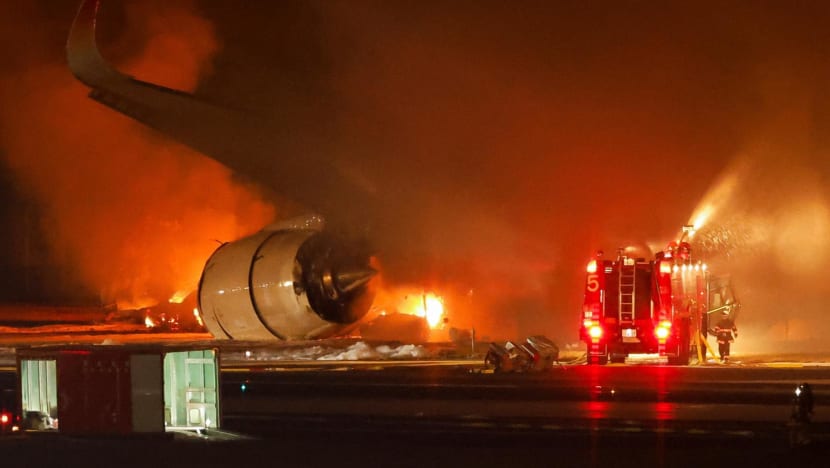
Firefighters fighting a blaze on Japan Airlines' A350 airplane at Haneda International Airport in Tokyo, Japan on Jan 2, 2024.


SINGAPORE — The prompt evacuation of all 379 passengers and crew from a blazing Japan Airlines (JAL) Airbus that collided into a smaller turboprop upon landing at Haneda airport in Tokyo, Japan has been described as miraculous, given the disastrous outcomes of other similar airplane accidents.
Analysts and survivors of the Jan 2 incident have praised the flight crew in ensuring that everyone got out of the plane safely in 18 minutes, while others pointed to the materials of the Airbus A350 aircraft as a factor in the survivability of people on board.
This incident aside, wrong judgement calls during emergencies and lack of passenger cooperation can sometimes lead to less fortunate outcomes.
TODAY speaks to aviation experts and looks at past aircraft accidents to identify key safety takeaways from these cases.
AUTHORITY AND COMMAND





When Singapore Airlines' flight SQ368 to Milan made a U-turn to Changi Airport in June 2016 due to engine troubles, its right wing burst into flames upon landing.
A former crew member Siti Noor Mastura recalled in an interview in 2019 that chaos had erupted among passengers, with some demanding that the plane doors be opened immediately.
However, the crew members stood their ground and listened to the captain’s orders not to open the doors.
Firefighters had deemed that it was not safe to do so at that point because the tarmac and bottom of the plane were coated with fuel.
“If we’d opened our doors, it would’ve been a disaster,” she told CNA Insider at the time.
Everyone on board disembarked safely, after firefighters brought the fire under control within five minutes of it starting.
KNOWING AND ABIDING BY SAFETY PROTOCOLS
Mr Gary Ho, a senior lecturer of aviation management at Temasek Polytechnic, said that passengers' cooperation and their compliance with crew instructions as well as instructions in the flight safety video “will save the most lives”.
When an Air China flight made an emergency landing in Changi Airport in September last year due to engine fire and its passengers had to be evacuated, a video circulating showed a passenger evacuating while carrying a luggage.
Although no fatalities arose from that relatively small fire incident, nine of the 146 passengers suffered minor injuries due to abrasions and smoke inhalation.
In contrast, observers noted how none of the passengers of JAL flight 516 took any carry-on luggage with them when evacuating.
Mr Alfred Chua, editor of Asia air transport at trade media FlightGlobal, told TODAY that while he "can't speak for what exactly happened in the (Air China) aircraft", he has the impression based on media reports and circulated videos that the evacuation then "might not have been as orderly" as in the JAL flight.
Experts who spoke to TODAY stressed the importance of passengers leaving their cabin luggage behind and not doing anything that may eat up precious seconds or impede the movement of others on board.
Mr Chua said that it is understandable human nature to try and grab important belongings when evacuating from an emergency situation such as from a burning house.
However, the situation in an aircraft would involve a much tighter space with hundreds more people, he added. A slight delay due to people taking their luggages, or tripping over when taking videos of the incident, can easily cause panic, a stampede situation and possibly fatalities.
CRITICAL DECISION-MAKING UNDER PRESSURE
Making the right decisions under the pressure of an emergency can help to avert fatalities, as past incidents have shown.
When US Airways' flight 1549 was hit by a flock of birds shortly after taking off from New York's LaGuardia Airport in January 2009, causing damage to its engines, the pilots were given clearance to return to the airport.
Instead, they decided to ditch it in the Hudson River because they determined that the aircraft would not make it back safely to the airport.
Investigators later credited the pilots' good decision-making and teamwork as critical factors behind the survival of all onboard during the incident that has since been dubbed "the Miracle on the Hudson".
The pilots' quick decision-making was all the more remarkable given that just four minutes passed from the time the birds damaged the engines to the safe emergency landing.
In the case of JL516, Mr Ho of Temasek Polytechnic noted from videos how the crew members “were very calm and prepared”. Media reports quoting JAL officials also showed how the 12 crew members made critical decisions on the ground that saved lives even though smoke could already be seen in the cabin by the time the plane came to a stop.
First, cabin attendants called out to passengers to remain calm. Second, they quickly assessed the situation and deemed that just three of the eight emergency escape doors were available for evacuation.
They then used short, direct commands, as they were trained to do, such as "leave your luggage" and "not this door", officials said.
Emergency protocol stipulates that the pilots have to give permission to open any emergency exit.
While the captain stood by two exits near the front and gave the go-ahead for evacuation, he could not do so for the exit near the back because the plane intercom system was no longer functioning.
The crew at the back deemed that it was urgent for the passengers to disembark from the back door and opened it regardless, as they were trained to do.
They used megaphones to give instructions to the passengers.
The airline said that all 367 passengers evacuated by 6.05pm Japan time, 18 minutes after the collision. The flames soon spread throughout the aircraft.
DANGER OF HUMAN ERROR
Human error in making decisions may lead to catastrophic results.
In the JL516 case on Tuesday, the Japanese authorities said that the Airbus was cleared to land, but the smaller aircraft on the ground had apparently not been cleared for take-off.
The circumstances surrounding the crash and how the two planes ended up on the same runway are still unclear since investigations have just begun.
Experts said that airplane accidents are typically the result of the failure of multiple safety guardrails.
In another case of Saudi Arabian Airlines' flight 163 in 1980, the United States-based Flight Safety Foundation referred to it as probably “the most well-known example” of a technically survivable incident that ultimately ended up in tragedy.
The foundation is an independent and non-profit organisation engaged in research, auditing and advocacy in the field of aviation safety.
It told TODAY: “After inflight indications of a fire in a cargo compartment, (flight 163) returned to land safely but was then engulfed in flames before anyone evacuated.”
A post-incident report by the aviation authority in Saudi Arabia identified bad decisions by the captain such as not stopping immediately at the runway and initiating an emergency evacuation, but instead wasting “critical time in taxiing the aircraft clear of the runway”, among others.
All 301 passengers and crew members died, largely due to inhalation of harmful smoke.
AIRCRAFT DESIGN
Human behaviour aside, the airline industry has made changes over the years to aircraft design to delay the spread of fire and facilitate human flow in an aircraft.
For example, the US Federal Aviation Administration (FAA) in 1984 made it mandatory for aircraft seat cushions to comply with more stringent flammability tests, a standard that the international aviation community later adopted.
It found that new seat cushion material used since then “did a better job retarding burning and provided 40 to 60 seconds of additional time for aircraft evacuation” under test or research conditions.
Other improvements over the years included the installation of floor proximity lighting in 1986 that could improve evacuation rate by 20 per cent when there is significant smoke in the cabin and widening passageways to allow for faster human flow, FAA added.
The Flight Safety Foundation similarly said: "Other important factors (in aircraft design to improve survivability) are the required floor path lighting, the strength of passenger and crew seats, and improved access to over wing exits."
In the JAL case, Mr Ho noted that the A350-900 plane was made mainly of carbon composites, unlike older aircraft.
“The strength of the carbon fibre material probably helped the aircraft to remain intact upon impact and then continued to help insulate passengers inside and reducing the amount of smoke in the cabin,” he said.
“The lack of heat and dense smoke would have helped to reduce panic and allowed the crew to evacuate the passengers safely.”
At the end of the day, experts pointed to the critical role that passengers themselves play in ensuring their own safety and reminded them that steps can be taken even before an emergency occurs.
“It also helps to be prepared in advance for landing, per crew instructions, which entails keeping aisles clear, putting tray tables in the upright and locked position, and having all carry-ons stowed as appropriate,” the Flight Safety Foundation said.
Mr Chua of FlightGlobal said that even ensuring one's seatbelt is fastened can make a difference in other situations that do not involve a burning aircraft, such as during turbulence or a bumpy emergency landing.
"Passengers who have had injuries are often the ones who don't wear their seatbelts," he added.
Mr Ho of Temasek Polytechnic said that better aircraft design and technology can go a long way in helping those on board buy precious time, but they can only do just that.
“A strong safety culture in the airline, responsible passengers who value life over material things, and familiarity with safety protocol and procedures by both crew and passengers will be the main things that save lives,” he added.




