Singapore manufacturers urged to expand into Batam, Bintan and Karimun amid Indonesia's industrial push
Indonesia is developing more industrial parks to support manufacturing activities, while improving port connectivity between the two countries.
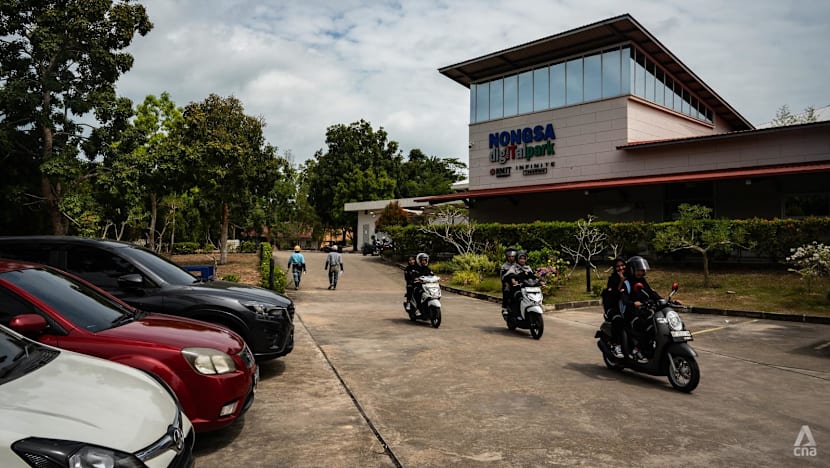
The Nongsa Digital Park aims to serve as a "digital bridge" between Indonesia and Singapore. (Photo: CNA/Wisnu Agung Prasetyo)

This audio is generated by an AI tool.






SINGAPORE: The Singapore Manufacturing Federation (SMF) has urged more medical device and electronics firms to expand into the Batam, Bintan and Karimun (BBK) region.
This comes as Indonesia develops more industrial parks to support manufacturing and enhances port connectivity between the two countries.
Singapore has long been one of the largest foreign investors in Indonesia’s Riau Islands province, where the BBK region is located, and has been Batam’s top foreign investor since 2023.
In the first half of last year, investments from Singapore totalled S$617.3 million (US$481.6 million), accounting for 69 per cent of Batam’s foreign direct investment.
At a seminar on investing in the region on Tuesday (Mar 24), SMF said manufacturers should carefully weigh key considerations before venturing abroad.
Its vice president Melvin Tan noted that grid reliability, for instance, varies across different areas.
“So it's up to the developer or the manufacturer to understand what are the limitations and constraints for their power and their energy requirements,” he added.
WEIGHING EXPANSION CHALLENGES
The BBK region is a 40- to 90-minute ferry ride from Singapore.
Located in Indonesia’s Riau Archipelago, the free trade zone forms part of the Singapore-Johor-Riau Islands Growth Triangle, an economic partnership proposed in 1989 by then-Deputy Prime Minister Goh Chok Tong.
The initiative aimed to combine Singapore’s management expertise, technology and infrastructure with the labour, land and natural resources of Johor and the Riau Islands.
Since then, the plan has evolved but remains relevant today, especially with new initiatives such as the Johor-Singapore Special Economic Zone (SEZ).
The BBK region is now home to at least five SEZs focused on key industries such as healthcare, electronics and aviation.
These zones offer tax incentives, expedited permits and licensing, as well as dedicated infrastructure to attract foreign investors.
Companies operating there span sectors including manufacturing, logistics, information technology and data centres.
The Singapore-BBK partnership employs a "twinning strategy" – with headquarters and research and development facilities in Singapore to leverage its connectivity, talent pool and strong intellectual property laws.
Larger-scale manufacturing and digital operations are placed in BBK, where land, labour and utilities are more cost-efficient.


BUILDING ECONOMIC RESILIENCE
Recycling firm Redux, for instance, is looking to expand its capacity by up to five times, by tapping industrial parks and available space in the BBK region.
Its business development director Jeff Seah told CNA’s Singapore Tonight that the expansion is commercially viable given significantly lower land and labour costs compared with Singapore.
“Being in the recycling industry, we need large spaces. BBK has more industrial land. It also has lower costs and strong support for industrial growth,” he added.
“Importantly, because of the close proximity, we can stay connected.”
To boost mobility in the region, Indonesia has introduced visa-free entry to BBK for 13 nationalities, including all ASEAN citizens and Singapore permanent residents.
It has also issued regulations to streamline licensing and make it easier for companies to invest.
Association of Small and Medium Enterprises (ASME) president Ang Yuit said such factors make the region “a very strong contender” for businesses looking to expand while remaining within an hour’s travel from Singapore.
“If you look at the land cost, that alone is a big factor, especially for businesses that require a lot of land,” said Mr Ang, who was also on the CNA programme.
“Of course, infrastructure development is an area that, from a business-to-business perspective, you've got to assess for yourself.”