







National Youth Council aims to be enabler for causes of the young
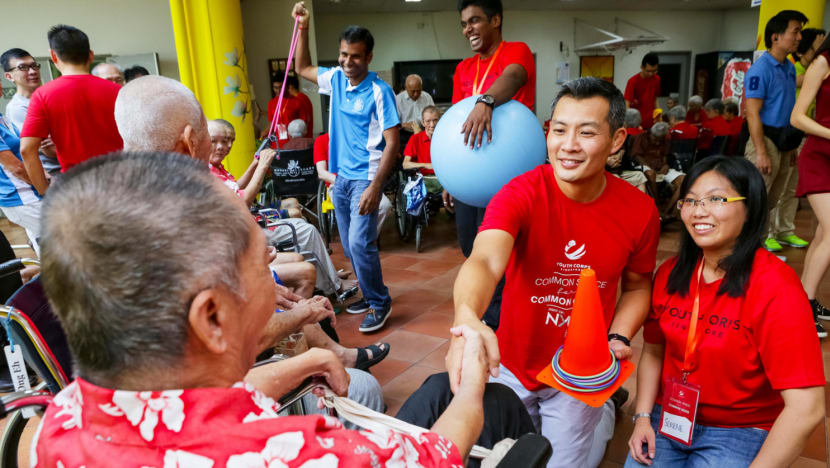
National Youth Council CEO David Chua with youth volunteers at the Moral Home for the Aged Sick, as part of Youth Corps Singapore’s Common Space for Common Good initiative, launched to encourage youths to use more common spaces to serve diverse community needs. Photo: National Youth Council


SINGAPORE — For years, the National Youth Council (NYC) — Singapore’s national body for youth affairs — was seen by many as an entity that mostly organised feel-good activities and programmes for youths here.
But this is an image that the NYC is seeking to shed, following its restructuring as an autonomous body under the Ministry of Culture, Community and Youth one-and-a-half years ago, said its chief executive officer David Chua. The plan is for the council to become an enabler for youth issues — be it funding and facilitating their passion projects, or speaking up for them.
Speaking to TODAY before Youth Month kicks off on Friday, the 41-year-old former colonel in the Singapore Armed Forces said many have labelled youths today as the strawberry generation — a reference to how they are easily bruised under pressure.
“(We) need to stop putting out the narrative that our youths are strawberries,” said Mr Chua, a father of four. “It also doesn’t quite help that the overarching narratives in the country are skewed towards bread and butter issues, academic performance. There are already a lot of burdens weighing down on the young person today ... It’s quite a tricky landscape to navigate.”





He wants the NYC to help youths maximise their capabilities by giving them opportunities, or by becoming a friend and partner to them. “We need to give them the support and encouragement at the appropriate times — sometimes you need to admonish them, and that’s okay,” he added.
In June 2014, then Culture, Community and Youth Minister Lawrence Wong announced that the NYC was to be restructured as an autonomous body to take on larger responsibilities. Till then, the NYC, which was founded in 1989, had been a division under the People’s Association.
Now, the council houses two institutions: Outward Bound Singapore (OBS) and Youth Corps Singapore. It was announced in April that from 2020, all Secondary 3 students will go through a five-day OBS expedition-based camp to immerse students in authentic and challenging situations.
Mr Chua noted that youths are broadly defined as those aged 15 to 35, but this is a range that is “too big to just look as one band”. Instead, the NYC will now target its engagement and programmes at three age bands — 15 to 18, 19 to 24 and 25 to 35. “(The NYC) for a period of time, (was) running the flagship programmes ... not trying to understand the psyche of the person behind it,” he said, adding that the programmes then sometimes came across as “one size fits all”.
As the formal education system is a big influence on those in the youngest age band, the NYC will work with the Education Ministry on “forging shared experiences” for these youths, such as through the OBS camps.
For those aged between 19 and 24, they tend to face more “turbulence and turmoil” as they try to figure out issues such as their future direction, and manage influences from everywhere, noted Mr Chua.
He wants the NYC to be able to provide platforms and opportunities, through the Youth Expedition Project and Youth Corps, for them to volunteer and work on the causes that they believe in. Meanwhile, reaching out to those in the oldest age band is a challenge the NYC has to find ways to overcome, he acknowledged.
Traditionally, the council has “not gone much into that space”, and the NYC is still “thinking through” how best to engage them, Mr Chua said.
For now, it will try to match the interests of these older youths with projects, and work with corporates.
These youths can also tap the S$100 million National Youth Fund for their ground-up initiatives.
The research arm within the NYC has been expanded to collect data, speak to those on the ground, and research the behavioural science of youths in each age band.
A longitudinal study — a first ever here — will be conducted next year on youths aged 15 and above, and is expected to last at least six to nine years. The research will try to understand youths’ hopes and aspirations, their relationships with their families and peers, and the uncertainties they face, said Mr Chua.
Certain programmes, such as the Singapore Youth Conference and the Singapore Youth Awards, are still undergoing a review.
Asked about criticisms that the NYC is just a feel-good organisation, he acknowledged that the council cannot be “everything to everyone”. But for the youths whom the NYC manages to reach out to, he wants the council to push their boundaries and, in turn, for them to help other youths, too.
“I recognise that the NYC can’t engage all 1.1 million (youths),” Mr Chua said, noting that only about 150,000 attend its programmes every year. “The real good indicator for me is to see more ground-up initiatives — youths taking action, being confident enough to step out, and even failing and trying again ... So, when I start running out of money in my National Youth Fund, that’s a good sign,” he added.




