







Neighbours, families are key agents in anti-terror gameplan
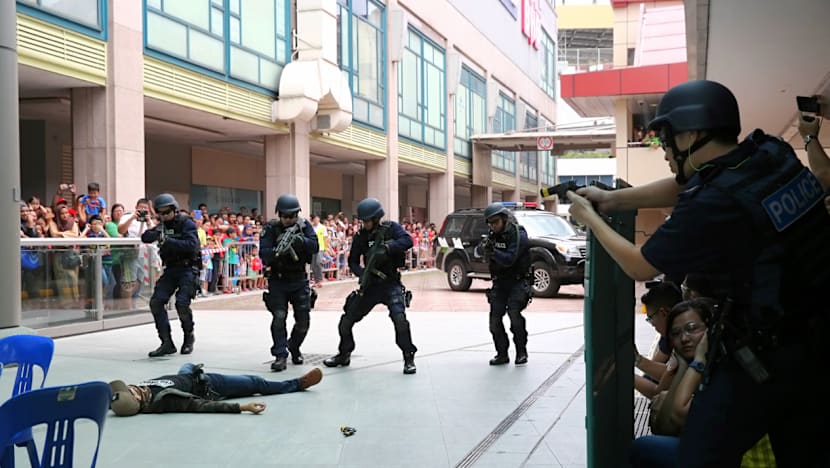
Police take down a gunman in a counter terrorism scenario during the Keat Hong Emergency Preparedness Day held at the concourse area of Lot One Shoppers' Mall and next to Choa Chu Kang mrt station on March 5, 2017. Residents could also watch demonstrations of improvised first aid skills, CPR administration and learn how to extinguish fire with fire extinguishers. Photo: Nuria Ling/TODAY


SINGAPORE — Boosting communication among neighbours and within families must be a centrepiece in Singapore’s strategy against terror.
This theme came up several times on Friday (April 7) during a panel discussion during the Singapore Police Force’s Workplan Seminar this year, which saw three panellists discuss the importance of community cohesion and the individual’s responsibility in fighting terrorism.
Mr Shaik Mohd M K Mohideen, who has been volunteering with Sembawang’s Citizens on Patrol team for the last two decades, said that chatting with residents has helped him uncover some suspicious incidents in the neighbourhood, which were then reported to the police.
Foreign workers who serve in the estates must also be roped in as the eyes and ears on the ground, Mr Shaik said. “We cannot be thinking that the police will take care of everything. As Singaporeans, we must do our part,” he added, urging parents in the audience to start by educating their children on the importance of being vigilant.





About 1,000 police officers and invited guests attended the seminar at the Singapore Expo.
Agreeing, Ms Betty Ong, who survived a terrorist attack at the Erawan Shrine in Bangkok, Thailand in August 2015, said that she regularly talks to others about her personal experience, to reinforce the point that an attack can strike when one least expects it.
“We cannot have a ‘cannot care less’ attitude about it anymore,” the 70-year-old said.
On the point of being vigilant, behavioural scientist David Chan from the Singapore Management University — the third panellist — suggested that the authorities here have run into a “paradox of success”.
This means that because the authorities “are so successful at being good”, there is a danger that members of the public may become complacent and they would run to the authorities for problem-solving, and the people “begin to see security as one that is not really my problem”, Professor Chan said.
While Singaporeans are generally aware of the terror risk that the country faces, some are still not as proactive or vigilant in guarding against it, Professor Chan said, while responding to questions from the media on the security scare at Hougang MRT Station over the last weekend.
Reporters had commented that it was still the train operator, SBS Transit, that picked up on the unattended suitcase via security cameras, while commuters there appeared less proactive.
This could be attributed to a psychological phenomenon known as a “diffusion of responsibility”, Prof Chan said. “If you are walking alone on the street and see somebody needing help, the likelihood of you helping is very high... But if you are on a very crowded street, the likelihood of you helping and the speed at which you help becomes much slower... When there are more people, it becomes more ambiguous, you are not sure whether you should do it, don’t know if you are doing the right thing.”
He added: “So it’s not that Singaporeans or foreigners here just don’t help, don’t care, or are not alert. Sometimes it’s just the human behaviour that we need to figure out.”




