







New centre ‘to prepare for avalanche of social issues’
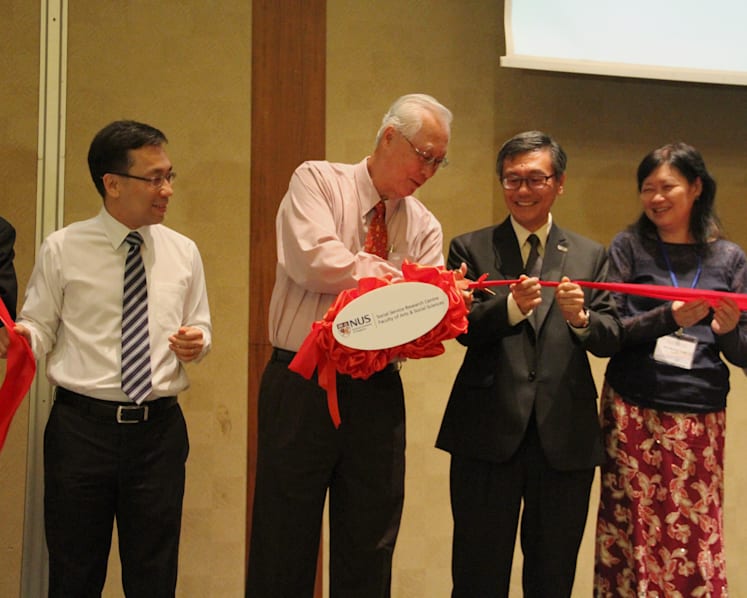
Guest-of-honour Emeritus Senior Minister Goh Chok Tong at the ribbon cutting ceremony of the official launch of Social Service Research Centre in NUS. Photo: Jaslin Goh/TODAY


SINGAPORE — As social service agencies and policymakers deal with pressing problems on the ground, a research centre has been launched to help fill the gap in areas such as innovation and transform social services in Singapore.
The Social Service Research Centre (SSR) will provide a platform for strategic research in the area, serve as a test-bed for pilot programmes, and facilitate research partnerships between government agencies, sector organisations or professionals and academia, among others.
It was set up by the National University of Singapore (NUS).
Speaking at the official launch of the SSR today (April 24), Emeritus Senior Minister Goh Chok Tong identified three key drivers of social changes here: Changes in demography, technology and social expectations.





These changes can interact to produce “complex, and potentially disruptive outcomes”, he said.
“I can see an avalanche of social issues coming ... The social challenges of Singaporeans in the next 50 years will be drastically different from those in the past 50. We need to think ahead of the curve and evolve a new social service infrastructure.”
Mr Goh added: “Social service agencies are busy fighting fires on the ground. National policy is, by design, slow. Policymakers and practitioners often have other more pressing problems to deal with and may not accord rigorous research on long-term social problems priority.”
An institution such as the SSR fills the gap to provide innovation, reflection and experimentation to think ahead to transform social services, said Mr Goh in his address to about 250 policymakers, international and local academics, students and social service practitioners at the NUSS Kent Ridge Guild House.
The SSR will receive about S$3.3 million in funding over five years, NUS said today. Among other things, the centre will focus on the issue of low-wage workers and their families. One of its major projects will be a longitudinal study of 1,500 low-income families who are in debt. Starting next month, the study will be carried out in collaboration with the Methodist Welfare Services, Care Corner Singapore and Thye Hua Kwan Moral Charities.
NUS Associate Professor Irene Ng, the centre’s director, said the SSR has also been in contact with voluntary welfare organisations to identify trends and needs, as well as conduct research with them.
“When we think about social service, we can’t only think about social, we also need to interact with other domains in people’s lives, such as employment (and) health. The SSR helps to do the research, gives them the findings ... so other people can have the access to the information and
findings and use them,” she said.
Also held today was an inaugural conference, Transforming Social Services: Innovation, Evaluation, Impact, where international experts pointed out the importance of using research to evaluate the effectiveness of programmes.
Dr James Riccio, director of the Low-Wage Workers and Communities policy area at MDRC, is currently the principal investigator for the evaluation of a pilot project that tries to reduce two-generation poverty in New York with monetary rewards. The MDRC is a non-profit social research organisation in the United States.
There were mixed results from the evaluation, which Dr Riccio said underscored the importance to test rigorously what seemed like good ideas for the social service sector. “There are many innovations that often don’t live up to their promise and the goal is to learn from them and try to build on those lessons,” he added.




