







Standard prefixed number for police, WhatsApp spoofing safeguards as efforts ramp up against scams
Government officials impersonation scams more than doubled in 2025 from the year before and saw the highest average amount lost per case.


This audio is generated by an AI tool.


SINGAPORE: Calls by police officers to members of the public will soon bear a standard prefixed number as Singapore authorities clamp down on impersonation scams, Minister of State for Home Affairs Goh Pei Ming said on Friday (Feb 27).
Messaging platform WhatsApp will also be made to implement tighter anti-scam measures to combat spoofing attempts, said Mr Goh.
“Despite the overall decrease in scam cases and losses last year, more Singaporeans fell prey to government officials impersonation scams,” he said during the debate on the Ministry of Home Affairs’ (MHA) budget for the year ahead.
Annual statistics released by the Singapore Police Force (SPF) earlier this week showed that the number of scam cases in Singapore fell 27.6 per cent last year – the first time there has been a decrease since the SPF began reporting scam statistics separately in 2023.





Mr Goh noted that government officials impersonation scams in 2025 more than doubled from the year before.
It was among the top five most reported scam types in 2025, and also saw the highest average amount lost per case at more than S$72,000 (US$57,000), he added.
IDENTIFYING REAL OFFICIALS
In his speech, Mr Goh said that MHA will help people identify legitimate calls from government agencies.
“The SPF is working with Open Government Product (OGP) and Infocomm Media Development Authority (IMDA) to introduce a single, easily recognisable prefixed number which all SPF officers will use to call members of the public,” he said.
If a person receives a phone call from an unknown number, and the caller claims to be a police officer, it is likely a scam, he added.
Mr Goh said that Minister of State for Digital Development and Information Jasmin Lau will be sharing more details about this new measure and its implementation across all government agencies.
Mr Goh added that MHA will require online platforms to put in place more anti-scam measures moving forward, in response to questions from MP Wan Rizal (PAP-Jalan Besar).
“Similar to Apple and Google, we will soon require WhatsApp to implement measures against the spoofing of ‘gov.sg’ and Singapore government agencies,” he said.

Spoofing refers to a technique cybercriminals use to disguise themselves as a known or trusted source.
In November last year, the SPF ordered Apple and Google to take steps to prevent government impersonation scam messages on iMessage and Google Messages respectively.
The mandated measures include preventing accounts and group chats from displaying names that spoof "gov.sg" or government agencies, or filtering messages from accounts and group chats with such names.
Apple and Google must also ensure that the profile names of unknown senders are not displayed, or displayed less prominently than their phone numbers.
ANTI-DRUGS EFFORTS
On Friday, Senior Minister of State for Home Affairs Faishal Ibrahim said that the global drug situation is getting more challenging, and Singapore is vulnerable to these developments.
The country has dealt with drugs with tough laws and robust enforcement, upstream preventive education, as well as rehabilitation and reintegration programmes for abusers.
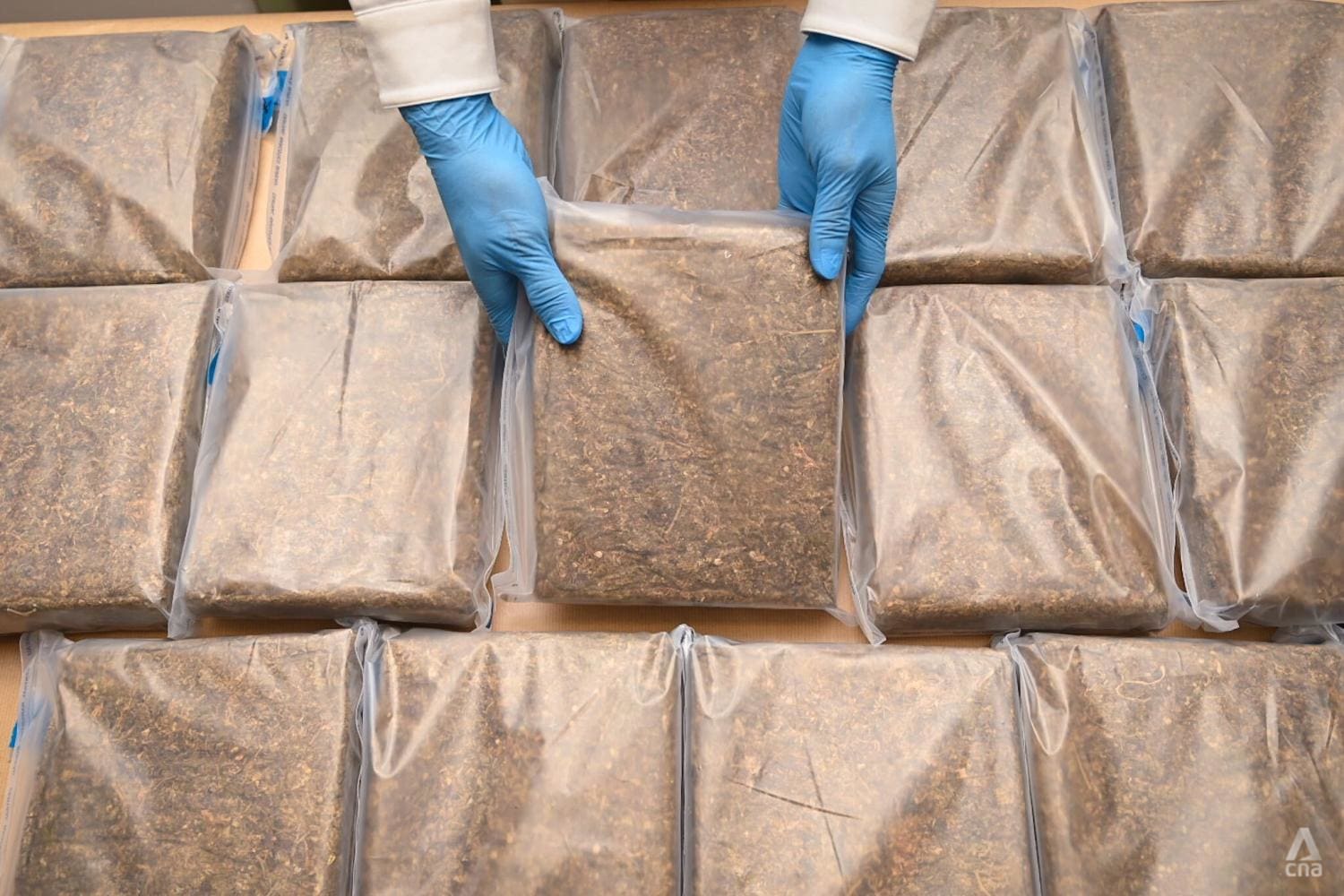
“We will be amending the Misuse of Drugs Act this year to enhance investigative and enforcement levers against drug-related activities,” he said.
“We will introduce a presumption clause for hair test results. This means that if a controlled drug is found in a person’s hair, they will be presumed to have abused it.”
This will give the Central Narcotics Bureau a stronger tool for enforcement, since hair tests can detect abuse over a longer period.
Preventive drug education efforts in Singapore have also shown encouraging outcomes, said Dr Faishal.
The 2025 National Drug Perception Survey found that attitudes towards drugs among youths have turned more conservative as more youths perceive that drug abuse is harmful, he said.
Of the respondents, 87.7 per cent held conservative views, compared to 83.2 per cent in 2023.
There is also strong support for Singapore’s drug-related laws, with 92.7 per cent of youth respondents and 96.3 per cent of adult respondents feeling that Singapore should continue to maintain tough laws to keep drugs out of the country, said Dr Faishal.




