







Re-schooling race horses requires hard work, dedication and time, say experts
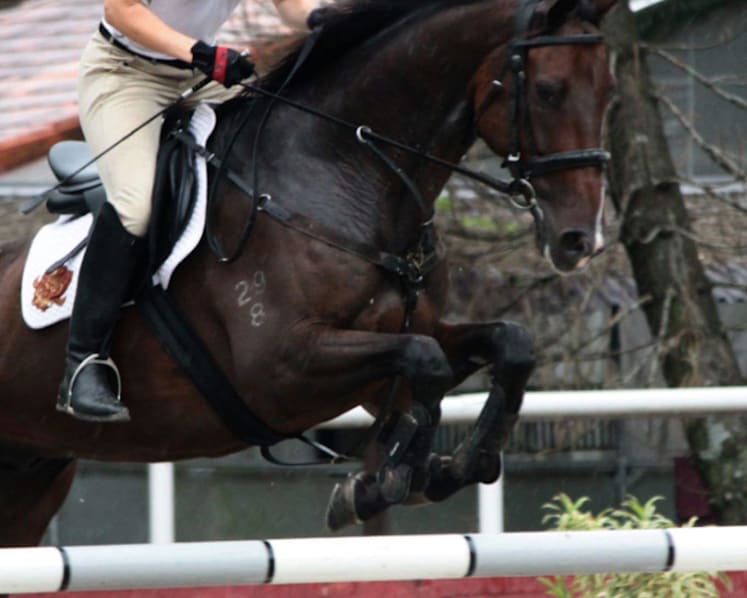
When Mr Percy was taken off the race track to be re-schooled, he was easily distracted but he was successfully retrained after 18 months. PHOTO: Amelie Villeneuve-Moore


SINGAPORE — When he was first taken off the race track to be re-schooled for riding, Mr Percy, then a six-year-old thoroughbred, was easily distracted and often “tensed up” during training sessions.
“He would just take off in the middle of lessons, particularly if there were any stimuli we would typically expect in a race, like the sound of bells or other horses running around,” said Ms Amelie Villeneuve-Moore, who has been riding Mr Percy at the Singapore Polo Club (SPC) since September 2014.
Mr Percy is one of three former race horses that has been rehomed at the SPC for a variety of equine disciplines, such as dressage, show jumping and leisure riding.
Horses’ racing careers are typically short-lived, ranging from two to six years, depending on their track record and whether injuries have rendered them unsuitable for racing, said horse riding coaches interviewed by TODAY.





This means race horses, which can live up to 30 to 40 years of age, are relegated from the race track as early as when they are four.
The question of what happens to former race horses has come up due to an ongoing trial of Gallop Stable, which is accused of failing to provide adequate veterinary attention to a former race horse, causing her “unnecessary suffering”.
Gallop Stable’s defence is that it had continued to care for the thoroughbred mare named Sharpy despite her pre-existing conditions which led veterinarians to recommend that Sharpy be euthanised.
In Singapore, many retired race horses are donated to riding clubs, while others may be sent to countries such as Malaysia, Australia or New Zealand for retirement or breeding, said Mr Predrag Marjanovic, livery and estate manager at Bukit Timah Saddle Club (BTSC).
Some may also be exported to neighbouring countries to continue their racing career, said a spokesperson from the Singapore Turf Club, who added that there are about 1,300 horses registered for racing in Singapore currently.
Those deemed unsuitable for riding due to injury, among other reasons, may be returned to their owners or euthanised. The club put down 10 such horses last year.
“A race horse may be put down if it suffers a catastrophic injury during racing and the club’s vets jointly assess it is a humane decision to ... end its suffering,” said the Singapore Turf Club.
Most riding clubs here are careful about putting down horses, said SPC’s lead riding instructor Daniel Sitranen. Only when two veterinarians recommend putting a horse down will the club consider the option, he added. “As horse lovers, we will usually go all out to save the horse ... (Euthanasia) is only if the horse is really, really sick,” said Mr Sitranen.
Coaches and riders interviewed by TODAY noted that re-schooling race horses is hard work, which can take anywhere between nine months and two years, because these animals have highly-strung temperament and “baggage” from their past careers.
Re-schooling typically involves trainers walking the horses, adjusting their feed and “communicating” with them.
Race horses are used to a diet high in sugar and protein, said Mr Sitranen, but proportions of these components must be adjusted when they are retired from racing, so that they do not get “overly excited”.
Only after at least six months will these horses be tried out for riding, and even then, by more experienced riders first, said Mr Sitranen.
“Sometimes, they are never suitable for riding by novices.”
Mr Percy, for instance, was successfully re-schooled after 18 months of “understanding (his) personality”, said Ms Villeneuve-Moore.
“In the beginning, he was unpredictable and tensed. He was also grumpy in the stable, which is not a great sign ... You couldn’t quite get him to do good dressage or jumping, because he was not paying attention to anything other than running around like a lunatic,” she said.
Ms Elana Sterley, who owns Datchet House, a thoroughbred stabled at Bukit Timah Saddle Club, likens rehoming ex-race horses to raising young children.
“It takes a lot of dedication and you need to be very patient. Spending time with them on the ground is also very important to set boundaries and develop trust,” she said.
“Each horse is different, and some bring with them a lot of baggage from their previous lives. Retraining requires some trial and error.”
Still, race horses have “fantastic work ethic” and athletic foundation for them to excel in a second career, she said. “Many can still lead a happy, active life for many years post-racing,” she added.
According to the Agri-Food & Veterinary Authority of Singapore (AVA), one does not need a licence to own horses in Singapore.
An Animal Exhibition Licence is required if the horses are used “solely for public display or interaction”, including horse riding.
“Nevertheless, like other pet owners, horse owners have to provide their pets with adequate accommodation and shelter, as well as adequate food and water. If the horse is unwell, the owner must arrange for the horse to receive veterinary attention,” said the AVA.
Any person found to have failed in his or her duty of care can be fined up to S$10,000 and/or jailed up to 12 months. A horse-riding club can be fined up to S$40,000 for failing to care for horses under its charge and the person who committed the offence can also be jailed up to two years.




