







Fires involving active mobility devices down 26.9% in 2025; total number of fires up slightly: SCDF
The overall number of fires rose 3 per cent to 2,050 last year.
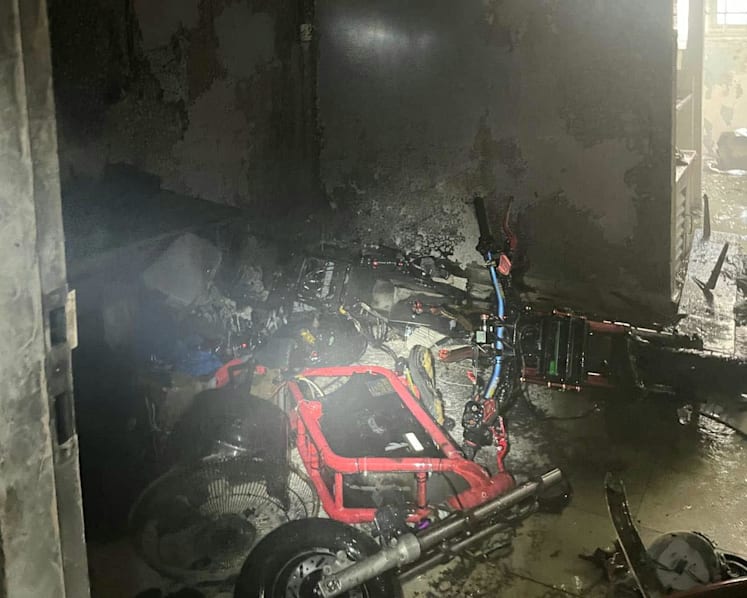
The battery pack of a personal mobility device was the likely source of a fire that scorched the living room of a flat on Jalan Bukit Merah on Aug 13, 2025. (Photo: Facebook/Singapore Civil Defence Force)

This audio is generated by an AI tool.


SINGAPORE: The number of fires involving active mobility devices (AMDs) fell by 26.9 per cent in 2025, according to annual statistics released by the Singapore Civil Defence Force (SCDF) on Wednesday (Feb 11).
Last year saw 49 such fires, down from 67 in 2024.
The overall number of fires rose 3 per cent to 2,050 last year, SCDF's emergency medical services, fire and enforcement statistics for 2025 showed.
Unattended cooking and electrical fires remained the two most common types of fires in homes.
There were 94 fire injuries and six fatalities in 2025.
"Despite the overall decrease in fires involving AMDs, it remains an area of concern," SCDF said, adding that such fires are especially concerning in residential areas as they spread rapidly in confined spaces.
AMDs include power-assisted bicycles (PABs), personal mobility devices (PMDs) and personal mobility aids (PMAs).
Fires involving PABs and PMAs both decreased in 2025, with PAB fires falling 61.3 per cent to 12 cases and PMA fires falling 45.5 per cent to 6 cases.
However, fires involving PMDs rose to 31 cases last year, up 24 per cent.
SCDF said it will continue efforts to educate the public on dangers related to AMD fires and disseminate fire safety advisories through social media.
These include reminders not to leave batteries or devices unattended when charging for prolonged periods or overnight, and to refrain from purchasing or using non-original batteries.





FIRE STATISTICS FOR 2025
Of the 2,050 fire calls that SCDF responded to last year, 1,051 were regarding fires in residential premises, marking an increase of 8.6 per cent from 2024.
Fires caused by unattended cooking accounted for the greatest proportion of fires in residential premises, with 318 cases in 2025. Despite the 5.1 per cent decrease from 335 the previous year, it was still the top cause of fires in residential buildings.
There were 304 fires with an electrical origin, a 1.5 per cent increase from the 299 cases in 2024.
"Most of these fires were caused by faults in electrical wiring or electrical appliances, or due to overloading of electrical sockets," SCDF said.
Of the 304 fires of electrical origin, 34 involved AMDs in residential premises, a 22.7 per cent decrease from 2024.
As for fires in non-residential buildings, there were 471 cases in 2025, marking a 13.5 per cent increase from the previous year.
Non-residential buildings comprise commercial premises, industrial premises and social and communal premises.
Of these, fires with an electrical origin accounted for 43.5 per cent cases.
SCDF will continue to work with the National Fire and Emergency Preparedness Council, building owners and fire safety managers to organise fire safety outreach programmes to "raise the level of fire-safety awareness among building owners and occupants", it said.
"Regular enforcement checks will also be conducted at these premises to ensure compliance with fire safety regulations," said SCDF.
Fire calls at non-building premises also fell last year, dropping to 528 cases in 2025. This is a 13 per cent decrease from 2024.
Vehicle fires remained the largest share of non-building fires, though the number of such fires decreased by 12.3 per cent to 193 cases in 2025.
In Singapore, vehicle fires are primarily caused by ignition sources, such as overheating and electrical faults within the engine compartment, said SCDF.
Vehicle fires involving electric vehicles (EVs) remained low. Of the 226 vehicle fires in 2025, only four involved EVs. The primary cause of fires involving EVs was electrical faults involving the battery.
Vegetation fires, meanwhile, decreased by 39.4 per cent to 109 cases last year. Fires from discarded items rose to 107 cases, up 10.3 per cent from 2024.
MORE EMERGENCY CALLS IN 2025
SCDF responded to 257,158 Emergency Medical Services (EMS) calls last year, a 4.8 per cent increase from 2024.
Of these, 239,855 were emergency calls, 11,064 were non-emergency calls and 6,239 were false alarms.
Of the emergency calls, 78.6 per cent were related to medical issues, 16.9 per cent involved trauma cases and the remaining 4.5 per cent were regarding road traffic accidents.
All three types of calls saw increases, with medical-related calls rising 3.5 per cent to 188,474, trauma calls rising 9.1 per cent to 40,644 and road traffic accident calls rising 12.3 per cent to 10,737.
Nearly half of all EMS calls received involved seniors aged 65 and above.
"In the next five years, the number of EMS calls is expected to continue trending upwards, largely due to an expected increase in demand from an ageing population," SCDF said.
Both non-emergency calls and false alarm calls rose last year, by 3.1 per cent and 9.2 per cent respectively.
SCDF reminded the public to call NurseFirst, a medical triage helpline, for non-life-threatening medical conditions. The hotline, operated by Woodlands Hospital, provides medical advice on a caller’s condition and guides them on where to seek medical help.
"This would allow the 995 hotline to be reserved for critical and life-threatening medical emergencies," it said.

FIRE ENFORCEMENT CHECKS
SCDF conducted 14,750 fire safety enforcement checks in 2025.
Compared to 2024, the number of Fire Hazard Abatement Notices (FHANs) issued increased by 3.5 per cent to 2,668 last year.
The most common reason for FHAN issuance was the non-maintenance of firefighting equipment, accounting for 28.7 per cent of all FHANs issued.
The number of notices of offence (NOOs) issued also increased in 2025, rising 13.9 per cent to 1,209.
The most common reason why NOOs were issued was carrying out fire safety works without approval, accounting for 41.4 per cent of all NOOs issued.
The number of court actions taken decreased last year to 82, a 23.4 per cent drop.




