







Security tight at court during Bangladeshis’ sentencing
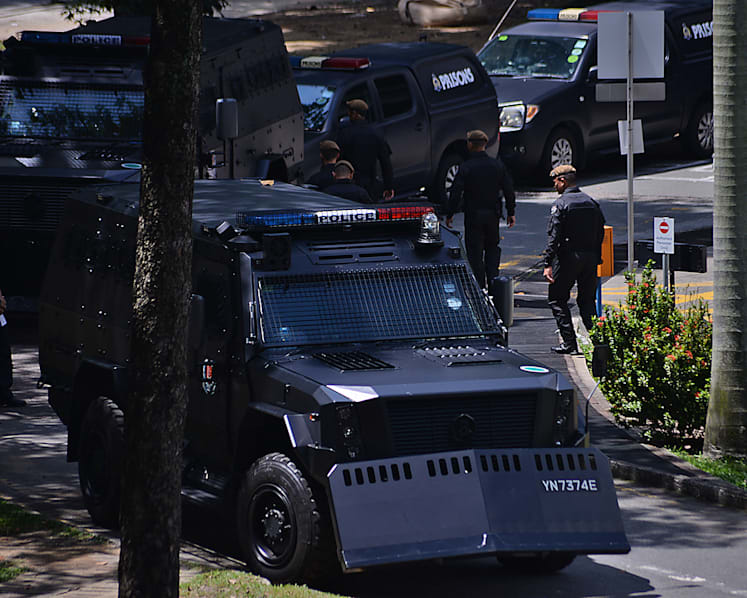
Gurkha police officers, who were escorting the four Bangladeshis who pleaded guilty for terrorist financing, mounting the police armoured vehicles at the State Courts on July 12, 2016. Photo: Robin Choo/TODAY


SINGAPORE — Nothing was left to chance when the four Bangladeshi men who, on Tuesday (July 12) were sentenced to between two and five years jail for terrorism financing, arrived at the State Court for their hearing.
The four — Rahman Mizanur, 31; Miah Rubel, 26; Md Jabath Kysar Haje Norul Islam Sowdager, 30; and Sohel Hawlader Ismail Hawlader, 29 — arrived in a convoy of three armoured vehicles a little before noon.
Inside the courtroom, security was tightened as well. In addition to the normal security guards present, 11 Gurkha officers were assigned to guard the four men, with four of the Gurkha officers being inside the dock itself with the men.
Dressed in purple prison garb, the four Bangladeshis were handcuffed and their feet were similarly restrained.





For security purposes, the local and international reporters present, a dozen of them, were asked to sit a distance away from the men.
During the court session, the four men were grim, especially when the sentences were delivered.
The longest mitigation plea came from the ringleader of the group, Rahman Mizanur, who was the only one who spoke in English. In his plea, he cited his heart condition and the fact that he was the sole breadwinner. “My whole life no one guide me. Whole life I suffer,” he said.
He said he had wanted to learn more about religion but had been misled by his friends and the media and that he missed his family.
“This is my very big mistake. I am very very sorry for this mistake and wrong activities. I am very remorseful.
“I have a new daughter and I want to see her. I promise you, I won’t involve (sic) in any other terrorism activities.”
He received the longest sentence of 60 months imprisonment, with the district judge noting that as the ringleader and mastermind, a stiffer punishment was warranted for Rahman.
The other three men spoke through a female Bengali translator to express their remorse and promised not to repeat their actions.
Miah Rubel, who was the treasurer of the group and who later became deputy leader after Rahman was arrested, promised that he would not be involved in any kind of fighting in future. “Your honour, I promise that I will live with my elderly parents and serve them.” Miah received a sentence of 30 months.
Md Jabath, who was sentenced to 30 months, asked for leniency and to be sent back to Bangladesh to serve his sentence. “For this mistake, I will be sentenced to a long imprisonment in Bangladesh. Your honour please be lenient and forgive me.”
Sohel, who received the shortest sentence of 24 months, also had the shortest plea. He said: “I am remorseful and promise I won’t do this type of offence again. Please send me back to Bangladesh to my family.”
In delivering the sentences on the men, the district judge noted that terrorism was a clear and present danger. Terrorism financing and any act in support of terror must be condemned and deterred, said the judge. Stiff punishments must be imposed to deter present offenders and like-minded persons from embarking in such activity, the judge added.
The sentences for all four men were backdated to May 27, when they were first produced in court. All four men received the full sentences that the prosecution had asked for.
Rahman had founded the Islamic State in Bangladesh after failed attempts to obtain visas to Turkey and Algeria, through which he had hoped to travel to join the Islamic State of Iraq and Syria. Each member had sworn an oath to follow ISIS leader Abu Bakr al-Baghdadi till their death, and held specific roles and responsibilities, the court was told.
Rahman then made repeated calls for funds for purchasing arms and weapons for fighting. Everyone agreed that they would contribute part of their salaries to the cause, the court heard. Charges against the men stated amounts ranging from S$60 to S$1,360.
In January, the Ministry of Home Affairs revealed that 27 Bangladeshi construction workers here were arrested after they were found to be contemplating waging armed jihad overseas. All of them have been deported.




