







Select Committee to resume work when Parliament reconvenes in May
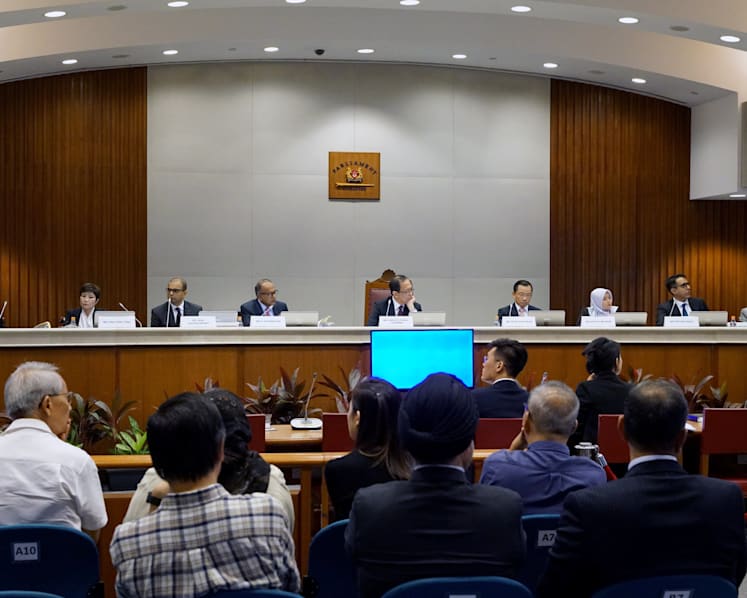
The Public Hearings for Select Committee on Deliberate Online Falsehoods on March 14. Photo: Ministry of Communications and Information


SINGAPORE — Wrapping up eight intense days of public hearings on Thursday (March 29), the Select Committee studying deliberate online falsehoods will resume its work when Parliament reconvenes in May to mull over the evidence and work on its report.
The 10-member committee chaired by Deputy Speaker of Parliament Charles Chong heard from 65 witnesses including local and overseas experts, as well as technology and media giants such as Facebook, Twitter and Google.
The hearings began on March 14 and Mr Chong noted “extensive involvement and robust engagement” with witnesses, which also included community groups, civil society members such as freelance journalist Kirsten Han and human rights group Maruah, students and other members of the public.
The duration of oral evidence varied from mere minutes to several hours for witnesses, with Facebook’s Vice President of Public Policy for the Asia-Pacific Simon Milner and historian Thum Ping Tjin being grilled for the longest durations by Law and Home Affairs Minister K Shanmugam.





There was also “one protestor”, quipped Mr Chong in his closing remarks. He was referring to an incident on Thursday afternoon when blogger and political activist Han Hui Hui was carried out of the room after causing disruption.
“It reflects our sincerity to consult widely and engage deeply on the issue, to properly understand the problem and recommend solutions that would best serve Singapore and Singaporeans,” said Mr Chong.
The committee heard first-hand how deliberate online falsehoods are a real and serious problem and how they can harm national security, racial and religious harmony, public institutions and democratic processes, he said.
Digital technologies have made it easier, cheaper and more profitable to create and to spread falsehoods, while technology and people’s tendencies when it comes to learning things and solving problems have made it hard to counter false information, he said.
Several witnesses also said there is “no one silver bullet” and the complex problem has be addressed with a whole suite of different measures – from public education, media literacy, fact checking and quality journalism, to technology and legislation, added Mr Chong.
Other experts testified on how state actors have used organised disinformation campaigns to undermine the sovereignty and security of target states, while online falsehoods have been used to manipulate electorates and to exploit racial and religious fault-lines in societies. He also spoke about the “drip-drip effect” of falsehoods that can undermine public trust in the longer term.
Tech companies and social media giants had an “extensive exchange” with the committee on issues such as the limits of what they are willing and able to do to curb the spread of egregious online falsehoods, said Mr Chong. Facebook’s Mr Milner, for instance, was questioned by Mr Shanmugam on the company’s failure to tell users when it found out about political data firm Cambridge Analytica’s misuse of data in 2015.
LAWS AND FREE SPEECH
Mr Chong said a recurring theme was the importance of free speech. There were some who argued that free speech does not extend to the deliberate spread of falsehoods, and how the online world is not a rational and egalitarian marketplace of ideas.
“On the other hand, we also heard views from some civil society members against any limits to any form of expression, even if they are demonstrably false and harmful,” said Mr Chong.
Local rights groups Maruah and the Community Action Network opposed new laws against fake news, arguing that existing legislation already deals with deliberate online falsehoods. Others said measures to tackle online falsehoods could create a chilling effect and stifle public discourse.
After their sessions with the committee, Ms Han and Community Action Network’s Mr Jolovan Wham took issue with the summary of their evidence posted on Parliament’s website.
Mr Wham called it a “gross misrepresentation” of its views while Ms Han said it was inaccurate and would be working on a formal complaint for her portion of the summary. The committee has yet to respond to media queries on the matter.
The need for legislation was another theme, said Mr Chong. Some witnesses proposed new legislation on the basis that current laws were limited in scope, speed and adaptability.
“We heard specific proposals on the contours of new legislation, including take-downs, rights of response and demonetisation, as well as the need for judicial oversight and due process,” he said.
Hong Kong-based Singaporean academic Cherian George also cautioned that legislation could “backfire” and be misused by opportunists who want to suppress the views of others, while others questioned if all-encompassing legislation was too blunt a tool.
Law students, historian Thum Ping Tjin, consultancy Black Dot’s managing director Nicholas Fang and Singapore University of Technology and Design’s Professor of Media & Communication Lim Sun Sun gave oral evidence on the last day of hearing.
Prof Lim noted in her written submissions that there should be public education efforts to explain how others could derive commercial and political gains from spreading online falsehoods. There should also be a greater push for industry self-regulation by the technology companies.
Mr Fang called for a multi-pronged approach that includes education and government-led efforts to raise awareness of the issue. The former journalist suggested separating the news functions in media companies here from the rest of the companies’ business.
The Select Committee, made up of eight People’s Action Party Members of Parliament (MPs), opposition MP Pritam Singh and Nominated MP Chia Yong Yong, received a total of 170 written representations. The number includes late submissions received up until March 22.
Along the way, sparks also flew between the committee and international non-governmental organisation Human Rights Watch (HRW). The committee said separately on Thursday it had yet to receive HRW’s reply to its invitation to give oral evidence on Tuesday (Mar 27).
Earlier, the Ministry of Law had criticised HRW’s no-show as “disappointing, but not surprising” and said its choice not to come to Singapore to defend its report, “Kill the Chicken to Scare the Monkeys”: Suppression of Free Expression and Assembly in Singapore, had shown “it cannot be taken seriously as a commentator or interlocutor on issues relating to Singapore”.
In reply, HRW said its letter last October inviting four senior members of Singapore’s government, including Prime Minister Lee Hsien Loong and Mr Shanmugam, to respond to its findings was met with no response. It claimed the purpose of the hearing “was not to... get our input into dealing with ‘deliberate online falsehoods’ in a manner consistent with international standards, but to engage in ridiculous and irrelevant arguments aimed to discredit our report and HRW”.
The Ministry noted HRW’s lack of explanation for being unable to attend the hearing through video-conferencing, and said its lack of enthusiasm in wanting to defend its report was obvious.
In his closing remarks, Mr Chong thanked everyone who has given written submissions and provided oral evidence. “The evidence we have received have given us much to think about,” he said.




