Singapore must retain ability to say 'no' even if it means paying a price: Vivian Balakrishnan
If Singapore cannot take difficult stands, it will lose its relevance and independence, says the Foreign Affairs Minister.

This audio is generated by an AI tool.


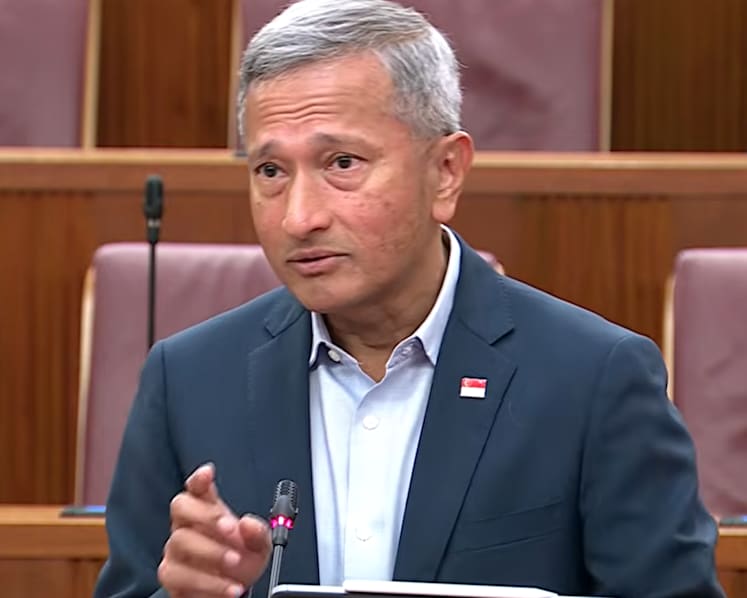
SINGAPORE: Singapore must hold on to its ability to say "no" – even at a cost – or risk losing its relevance on the world stage, Foreign Affairs Minister Vivian Balakrishnan said on Friday (Feb 27).
Speaking in parliament as he laid out his ministry's priorities for the year, Dr Balakrishnan said Singapore will not shy away from staking out positions that may put it at odds with more powerful partners.
"If we ever lose that ability to say no, then that is the day that Singapore loses its relevance, indeed, our independence," he said.
Singapore will work with any country where interests align, but will not choose a dominant power, Dr Balakrishnan said. Doing so would undermine the nation's sovereignty and reduce it to a vassal state.
"We want to be useful, but not made use of," he said. "We are successful because of our domestic unity, our economic relevance and vitality, and our defence capability.
"We may be small, but we have agency, we have resilience, and we have the resources and the will to back this up."





The minister said Singapore would face more strategic dilemmas in an increasingly turbulent world, and that its interests would not always align with great powers, neighbours or other key partners.
“On some issues, we will have to say 'no', to say 'no' courteously, respectfully and constructively," he said, adding that this was not about choosing sides, but about protecting Singapore’s national interests over the long term.
He pointed to several examples of Singapore taking principled stands: calling out violations of international law, including Russia’s invasion of Ukraine and the US’ actions in Venezuela.
"We spoke out about the need to preserve a rules-based trading system, including the principle of Most Favoured Nation in the WTO. We expressed categorically our disappointment with US tariffs that violate this principle, because trade is our lifeblood," he said.
On the Israel-Gaza conflict, he said Singapore had condemned the Oct 7, 2023 attack on Israel while also stating that Israel’s military response had breached international humanitarian law.
On navigating relations with the US and China, Dr Balakrishnan said Singapore wants to work with both where interests coincide.
"The reality is that all countries, including Singapore, will have to find creative ways to work with both the US and China, because they are the major powers, and they are relevant to our future."


FOREIGN POLICY BEGINS AT HOME
On the domestic front, Dr Balakrishnan warned that "geopolitical contestation has become a tussle for the hearts and minds".
"We do not necessarily have to agree on all our foreign policy stances, but we must agree that these are matters to be discussed and decided by Singaporeans alone," he said, adding that foreign actors will attempt to seed narratives, spread misinformation and deepen divisions.
He pointed out that Singapore has already seen such information campaigns during last year’s General Election, when voters were urged to cast ballots along religious lines.
"We must be aware and we must exercise caution because we have a diverse population, and never, never presume that we are immune to the polarisation and fractures in societies elsewhere," he said.
Domestic unity, economic relevance and the ability to defend itself are Singapore's three prerequisites for success, he added.
"As long as we understand that we are all in this together, as long as we can inoculate ourselves from foreign influence, as long as we can disagree maturely and ultimately still forge a domestic consensus, we will continue to thrive, and we cannot be bought or bullied by anyone."
Dr Balakrishnan ended his speech by quoting founding Prime Minister Lee Kuan Yew, who cautioned that Singapore can never take its relevance for granted.
“Small countries perform no vital or irreplaceable function in the international system,” the late Mr Lee had said.