For some people, home is where the office lies
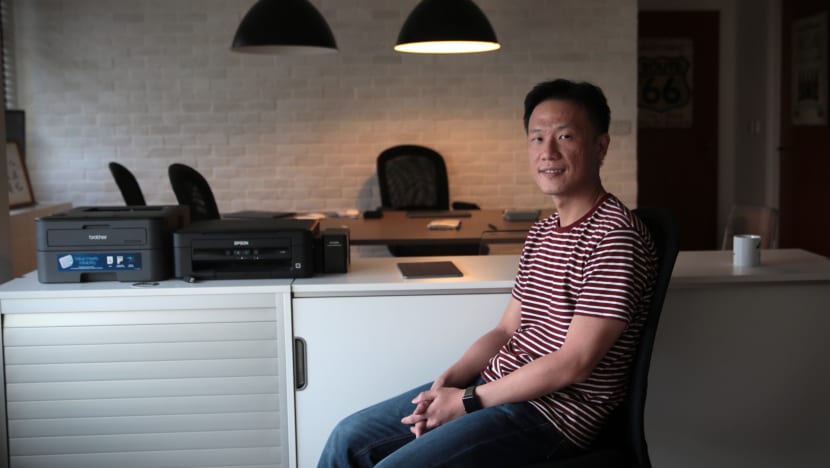
Mr Lai Weichang, founder of a tuition website, has chosen to set up shop in the comfort of his HDB home.


SINGAPORE — In Mr Lai Weichang’s Punggol flat, there is no sofa, no dining table, and no toys strewn across the living room, even though he has a two-year-old son.
Instead, the sparsely furnished living room of the four-room flat has five “workstations”. Three surround a conference table and two more sit against a long wall.
The only embellishment is a tiltable screen that is mounted high on the wall to facilitate presentations.
There is no signage on the door to indicate that the 37-year-old’s tech start-up, a tuition website ManyTutors, reside within the Housing and Development Board (HDB) Build-To-Order flat. Yet this is where he has been operating his business — quietly — for the last five years.





While some businesses are turning to co-working spaces, others have opted to set up shop in the comfort of their homes, turning the traditional template of a HDB flat on its head.
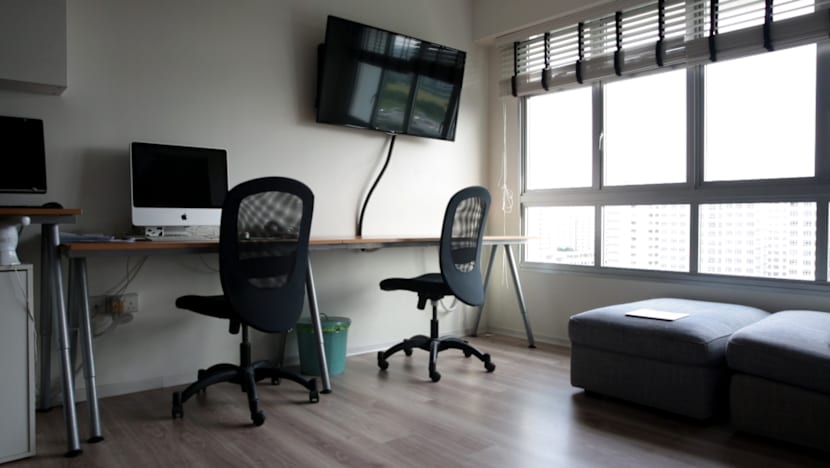
(Above) In Mr Lai Weichang’s Punggol four-room flat, there are five "workstations" in the sparsely furnished living room. Photo: Jason Quah/TODAY
Since 2015, more than 50,000 homeowners have applied to the HDB for the permit to operate small-scale businesses of an administrative nature under the Home Office Scheme, which allows them to host two non-resident co-workers.
There is no data, however, on how many people work out of their homes, since the HDB has another scheme called the Home-Based Small-Scale Business Scheme, which allows homeowners to run small-scale businesses out of their residences, provided they do not hire workers and “do not affect the character, ambience, and environment of the residential estate”. Homeowners operating under this second scheme do not need to apply for a permit or notify HDB.
Both schemes were introduced in 2003 to encourage entrepreneurship and allow HDB owners to supplement their household income.
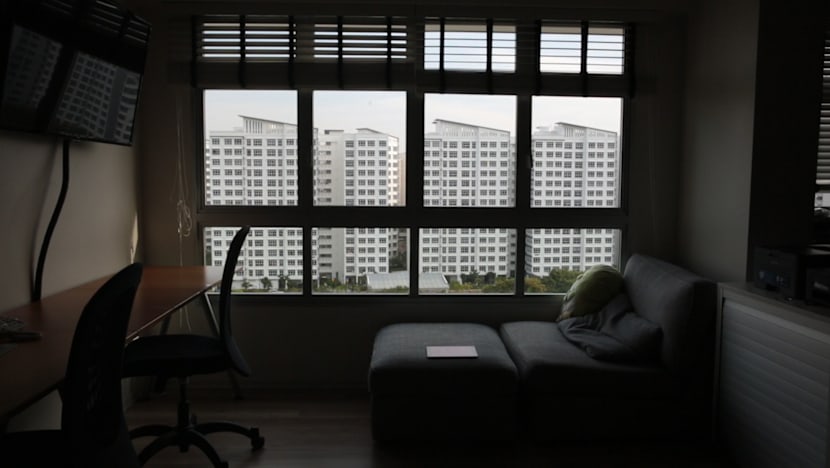
(Above) Working from home allows Mr Lai Weichang to save on rental fees for an office space. Photo: Jason Quah/TODAY
The Urban Redevelopment Authority governs two similar schemes for private residences, the Home Office Scheme (licensed) and Home-Based Business scheme (no registration required). It told TODAY that between 2015 and 2017, close to 1,800 homeowners registered to use their private homes as an office. Only 864 did so in the first year of its Home Office Scheme’s launch in 2003.
Despite some disamenities such as a loss of some personal space and how they might not be able to invite their clients to their “office”, the pros far outweigh the cons, these homeowners told TODAY.
CONDUCIVE FOR START-UPS
For Mr Lai, he started out running different businesses at an industrial area along Genting Lane, before moving to a rental unit in a run-down shopping centre, and then to a shophouse. Now, with his home office, he saves about S$2,000 a month in rental.
Though the screams and laugher of his neighbours’ children playing with scooters along the common corridor can sometimes be heard, he and his co-workers will tune it out by playing soft music in the background.
Being based in Punggol also gives him access to a ready source of experienced workers — mostly young mothers living in his neighbourhood who could take on part-time jobs.
“Big companies may find it difficult to hire mothers who just gave birth, as they want to be close to their homes and not go to an industrial area far away. Our value proposition to them is that we are small, we are serious, and they can join us three days a week, a couple of hours each time,” the entrepreneur said.
He hires them as part-time accountants and administrators to tally the ledgers and coordinate tutor-student match requests on his site, which has more than 40,000 active tutors and matches more than 1,500 tuition jobs monthly.
Another perk is that Mr Lai can pick his son up from the nearby childcare centre punctually by 7pm daily, since he does not have to travel to and from work.
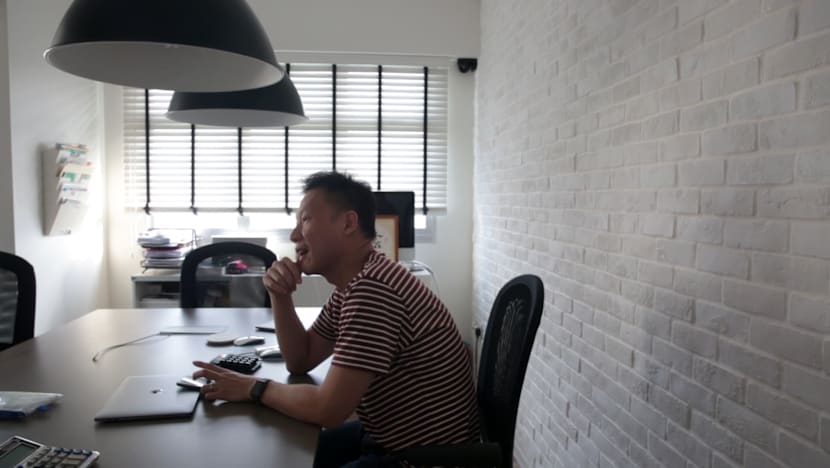
(Above) Working from home is no reason to be sloppy: Mr Lai Weichang ensures that he looks presentable for work every day. Photo: Jason Quah/TODAY
To stay productive, Mr Lai keeps a 20-minute ritual where he prepares to “go to work” every day. He dresses himself in an attire “that is accepted at a normal office”, heads out of his home for breakfast before returning to his flat to start work at 10am.
But with his staff strength now grown to five-strong, he has had to take up space at a co-working space on Ayer Rajah Crescent near one-north, because the HDB Home Office Scheme allows him to hire only two employees. The team now hosts some clients at this office space, which is offered by one of ManyTutors’ venture capitalists at a nominal fee.
Both co-working and home office models work for Mr Lai as the “location is not important for what we are doing”, he said. “We are doing software development.”
A BEDROOM PROJECT
For 24-year-old Hakim Samat, his bedroom is where he plys his trade.
The canvas-bag maker who sews some 20 to 25 custom-made bags every month does not need to apply for a permit from HDB to operate his small-scale business.
His “office” consists of a bunk bed, a second-hand Juki-brand industrial sewing machine, a tall metal rack storing his stash of canvas cloth, a worktable where he usually cuts his cloth, his wardrobe, and a recreation corner where he plays his computer games.
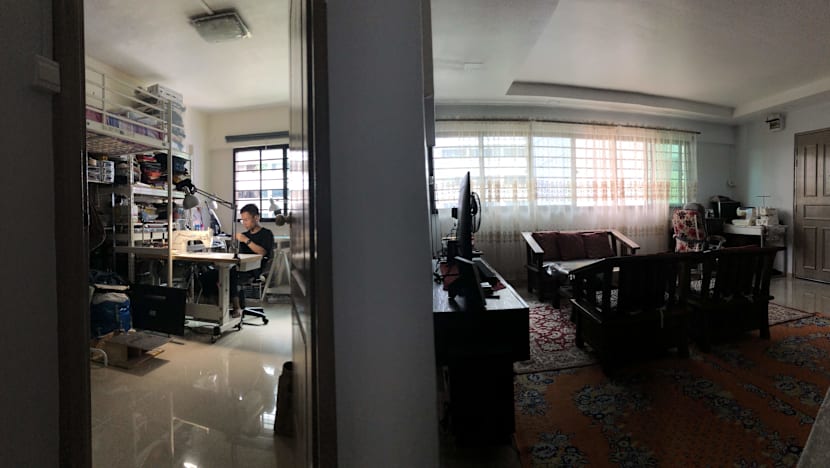
(Above) Bag maker Hakim Samat's bedroom is where he sews some 20 to 25 custom-made bags every month. Photo: Wong Pei Ting/TODAY
Mr Hakim previously worked as a leather crafter in his friend’s business. He quit that job late last year to focus on his bag-making business, which he started on the sideline to earn spare cash in his polytechnic days more than seven years ago.
Selling under the brand Unusual Felines, he has seen his monthly sales grow from between S$400 and S$500, to between S$1,200 and S$1,500. Pointing out that he can make up to just two bags a day, he said: “I will get overwhelmed soon.”
Eventually, if his business does take off like he hopes it will, he will have to move his operations into a shophouse or a warehouse — but this corner at home where he gets to tinker with his sewing machine will remain.
For now, though, he is willing to put up with this increasingly “dusty and cramp” space to make his dream come true.