







S’pore can’t take sides, has to be ‘principled’ to stay relevant to the world: Chan Chun Sing
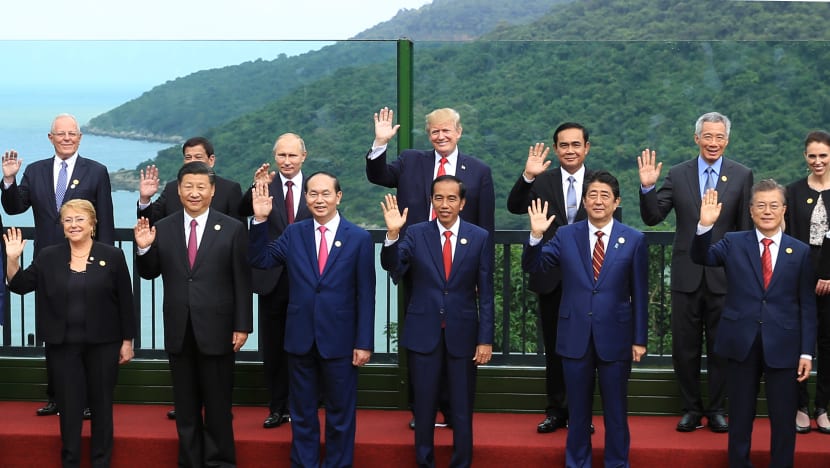
Singapore Prime Minister Lee Hsien Loong (back row, second from right) and other world leaders at the Asia-Pacific Economic Cooperation (Apec) Economic Leaders’ Meeting in Danang, Vietnam, Nov 11, 2017. In an interdependent world, a small state such as Singapore must stay relevant to the world and cannot take sides, Trade and Industry Minister Chan Chun Sing says.


SINGAPORE — To stay relevant to the rest of the world, Singapore must be principled and neutral as a small state in order for it to be taken seriously, Trade and Industry Minister Chan Chun Sing said on Monday (May 14).
Instead of choosing sides, Singapore needs to have a deep understanding of the different interests, institutions and individuals shaping global developments, he reiterated in Parliament on the first day of the debate on the President’s Address.
Talking about how Singapore believes in a rule-based, connected and interdependent world, he said: “Our task is not in choosing sides. Small states, more than any others, must be principled. If others ever attach a price to our stand and position, no one will take us seriously ever again.”
He pointed out that Singapore’s “principled stand and neutrality” are reasons why Singapore was chosen to host the historic meetings between China and Taiwan in 1993 and 2015, as well as the upcoming summit between the United States and North Korea next month.





Being a small country with an open economy, there is a need for a diversity of talent, “both local and global”, to work shoulder-to-shoulder with each other, to cross-pollinate ideas and bring out the best in each other, he said.
“What is clear is that no one deals with Singapore for our domestic markets or resources alone. Instead, they leverage upon us as a platform to reach the region and the world.
“Such dynamism is what keeps Singapore a vibrant, exceptional place to do business, and this is the vital ingredient for our economic future,” he added.
“I have always aspire that we will one day build a global network of more than three million Singaporeans, 30 million friends of Singapore, and perhaps 300 million fans of Singapore.”
On the country’s dealings with the superpowers, such as China, Mr Chan said that there is partnership with the Chinese to explore third-country markets as they venture abroad, but “this does not mean that we become more Chinese or... replicate the western model for them”.
Singapore needs to contribute to the partnership as a multiracial and multicultural society, “capable of developing unique solutions to our shared challenges, having learnt from both the East and the West”, he added.
It is also useful to recognise China as “a fast-evolving giant” that is “not monolithic”, with varying interests across its security, economic and social dimensions, as well as across provinces and layers of government, so that Singapore can provide more relevant ideas to China “for mutual benefit”, Mr Chan said.
As for the US, Singapore must act as an “established gateway” or “launch pad” for American companies looking to expand into the region, and not just deepen collaboration with them in areas such as smart-city solutions and e-commerce.




