







Surgical fee benchmarks reintroduced after 11 years to keep private doctors' fees in check



SINGAPORE — As part of efforts to stem rising healthcare costs, a committee appointed by the Ministry of Health (MOH) released on Tuesday (Nov 13) the benchmarks for surgeons’ fees at private hospitals and clinics for 222 common procedures.
The benchmarked fees, published on MOH's website, are reintroduced 11 years after the Singapore Medical Association (SMA) was ordered to remove its fee guidelines by the competition authorities.
The latest charges take into account last year's transaction data, surgical fee distribution by episode and doctor, fee ranges stipulated in the SMA’s 2006 guideline, as well as technical factors of each medical procedure, such as advancements in technology that allowed new procedures to become viable alternatives.
The Fee Benchmarks Advisory Committee said that in some instances, fees had gone up “significantly without a corresponding underlying reason for the growth”.





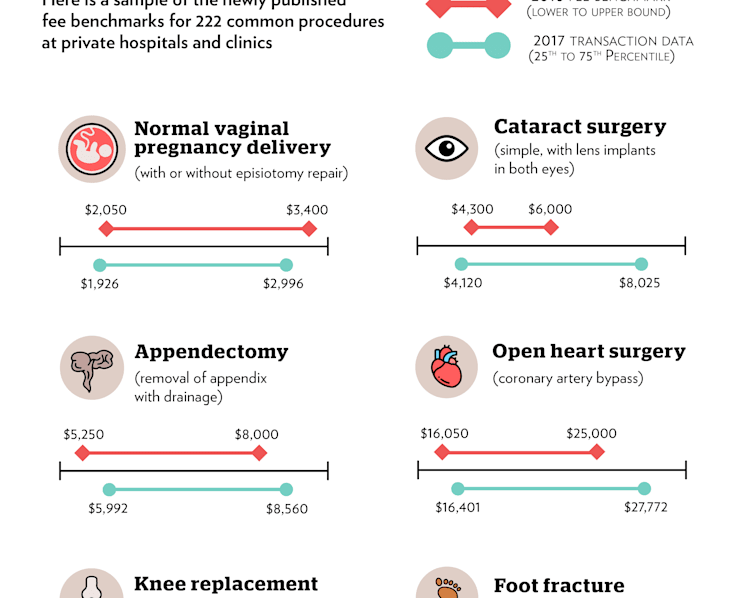
This means that the latest charges on MOH's website could be lower than last year's bills for some procedures such as open heart surgery and foot fracture surgery.
For example, most who needed a simple foot fracture surgery last year incurred surgical fees of between S$4,280 and S$6,420, but the committee evaluated that reasonable rates should have been between S$4,000 and S$5,350.
Most patients who went through an open heart surgery last year paid between S$16,401 and S$27,772, but the committee has ruled that a reasonable range should be between S$16,050 and S$25,000.
However, in cases where the fee increase was not significant or where there was an underlying rationale for growth, the lower range of the fees was set at around the 25th percentile of the 2017 fees, and the higher range set at around the 75th percentile, the committee said.
Examples of these include simple cataract surgeries with lens implants in both eyes, which typically cost between S$4,120 and S$8,025 last year, but the guideline is set at S$4,300 to S$6,000.
Similarly, while most simple knee replacement surgeries cost between S$7,747 and S$13,215 last year, the committee established that a reasonable range is between S$8,250 and S$10,700.
The recommendations by the 13-member committee headed by cardiologist Lim Yean Teng were submitted last Monday and accepted by the MOH in full last Friday.
Members in the committee included medical practitioners as well as individuals not from the medical industry, such as diplomat Zainul Abidin Rasheed, and Mr Karthikeyan Krishnamurthy, who is both vice-president of the National Trade Union Congress Central Committee and vice-president of the Consumer Association of Singapore (Case) Central Committee.
IMPROVING PRICE TRANSPARENCY
Although the fee guide is not mandatory, at a press briefing on Monday, an MOH spokesperson said that the ministry expects the fee benchmarks to improve price transparency and “influence reasonable fee charging”. Patients are encouraged to use them when discussing with doctors their treatment, the complexity of their condition and the costs.
Speaking to reporters after the briefing, Dr Lam Pin Min, Senior Minister of State for Health, and committee chair Dr Lim explained that there were “various reasons” behind the ministry’s decision not to make it compulsory.
Given that the complexity of surgical procedures usually vary from one patient to another, Dr Lam said that the benchmark acts as a baseline for doctors to explain the charges to their patients.
Agreeing, Dr Lim said that the guidelines should be treated as a “basic (tool patients can) build upon to ask questions”.
He also stressed that charging above the benchmark does not necessarily constitute over-charging, and that the doctors might have good reasons to quote a high fee, such as for underlying problems related to kidney or heart disease.
“Ultimately, the effectiveness of the fee benchmark depends on how well it is accepted and utilised. We believe that as long as all stakeholders make use of it, it will limit rising healthcare costs,” Dr Lim said.
Healthcare costs have been rising in recent years, with average private inpatient bills growing at 9 per cent a year compared to 4.9 per cent a year in the public sector between 2007 and 2017, the committee noted in its report.
It added that the rapidly increasing hospital bills had contributed to rising healthcare expenditure: Healthcare and hospitalisation inflation were higher than general inflation during that period, at 2.6 per cent and 3.8 per cent versus 2.3 per cent. National healthcare spending grew S$11.4 billion in 2011 to S$20.7 billion in 2016.
Asked about the issue of the guidelines leading to higher fees — when specialists find their rates lower than their peers and raise their fees towards the middle range of the benchmarks, for example — a committee spokesperson said that similarly, doctors charging on the higher end will probably adjust their rates to bring it closer to the median.
This will lead to prices converging towards the middle ground. “The narrower range we have over the long term is probably a better thing,” he said.
Seeing that the surgeon’s fee is a “significant singular element” in a patient’s hospital bill, the spokesperson added: “We hope that the surgeon’s component would be a little more consistent (and) would not be a case where it suddenly balloons to the extent that your bill is increased by 70 per cent, for example,” he said.
Dr Lam said that the impact of the fee benchmarks will be monitored for the next three to five years before more changes are made. The committee may look into other components such as consultation fees and anaesthetic fees next.
TIMELINE OF EVENTS LEADING UP TO MOH’S FEE BENCHMARK
1987: Following public complaints of overcharging, the SMA issued its first edition of medical fees guidelines to provide guidance to private-sector doctors
2007: SMA’s fee guidelines were withdrawn due to anti-competitive concerns, which were confirmed by the Competition Commission of Singapore in 2010
2016: An industry-led Health Insurance Task Force submits its report, recommending that fee benchmarks be focused on professional fees, given the urgency to manage rising healthcare costs
2017: The MOH announced that it will introduce fee benchmarks in 2018 to give all stakeholders a reference for the reasonable fee ranges of common surgical procedures
Jan 21, 2018: MOH appointed an independent committee to develop an approach to set reasonable fee benchmarks for medical procedures and services
More information on the fee guidelines can be found here.




