







Energy transition a 'race against time', not a competition between countries: Teo Chee Hean
The Temasek chairman said climate adaptation is now a "core priority" alongside mitigation efforts.
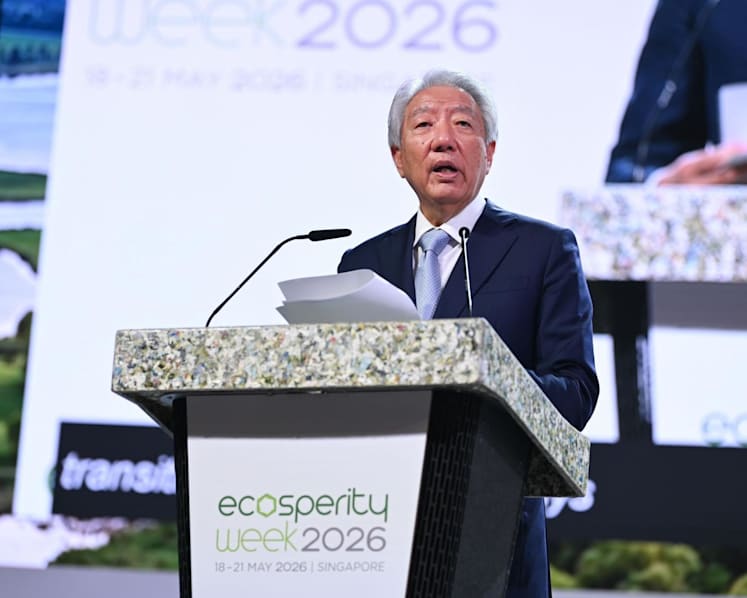
Mr Teo Chee Hean, chairman of Temasek Holdings, delivers the opening address at Ecosperity Week 2026 on May 19, 2026. (Photo: CNA/Liew Zhi Xin)

This audio is generated by an AI tool.


SINGAPORE: The world’s energy transition is “a race against time” rather than a competition between countries, Temasek Holdings chairman Teo Chee Hean said on Tuesday (May 19) as he urged Asia to chart its own path towards resilience and sustainable growth.
Speaking at the Marina Bay Sands Expo and Convention Centre, Mr Teo, who is also senior adviser in the Prime Minister’s Office, said in his opening remarks to global policymakers and business leaders at Ecosperity Week 2026 that the current operating environment was one of “profound global uncertainty”.
Amid growing concerns over supply chain disruptions of fossil fuels, the Temasek chairman said that renewables are important for energy security, and called on regional countries to work together to advance their sustainability measures.
In order to achieve such progress at the speed and scale required, there needs to be mutual trust, since countries are grappling with concerns over national security, supply chain vulnerabilities and strategic dependence, Mr Teo said.





Addressing these issues openly and constructively will be key to deeper regional cooperation. “After all, the defining challenge of our time is not competition between countries," he said.
"The real race is against time, and not against each other ... Nature sets the timetable, but we can shape the trajectory of our response."
In his speech at Ecosperity, Mr Teo underscored the urgency of climate action amid rising global emissions during a period of geopolitical conflicts.
"Climate change does not recognise borders, nor does it pause for conflict. If anything, conflicts make the transition harder, which is why cooperation matters even more," Mr Teo said.
The success of the transition will depend not on individual technologies alone, but on how well different systems work together, he added.
Mr Teo's speech came after Temasek Holdings CEO Dilhan Pillay said during the event's opening dinner on Monday night that the state investor was unlikely to meet its interim 2030 climate target due in part to a more fragmented global environment.
Pointing to signs of a structural shift in global energy systems, Mr Teo on Tuesday noted that renewables overtook coal’s share of the global electricity mix for the first time in 2025. Renewable energy also accounts for 85 per cent of global electricity generation capacity expansion.
Mr Teo outlined three priority areas where he hoped there could be accelerated progress: electrification, sustainable digital infrastructure and climate adaptation.
Electrification remains central to decarbonisation efforts across industries, but is also increasing dependence on electricity grids, supply chains, and critical minerals.
On sustainable digital infrastructure, Mr Teo noted that the rapid expansion of artificial intelligence has raised critical questions about energy, water use and system efficiency, but that it has the potential to unlock significant gains in energy efficiency, industrial productivity, and resilience.
At the same time, climate adaptation is now a "core priority" alongside mitigation efforts and will be critical to bring long-term economic stability and continuity, said Mr Teo.
"We have to assume that at the present rate at which we are dealing with mitigation, it will not be enough," said Mr Teo.
ASIA'S IMPORTANCE
Nowhere would the interplay be more decisive than Asia, Mr Teo reiterated.
Asia Pacific is home to around 60 per cent of the world's population and accounts for around half of global emissions.
"It is also where much of the world's future demand, industrial expansion, and infrastructure growth will take place.
"How Asia delegates this transition will shape global outcomes in a more contested and uncertain world. Asia must define its own path by strengthening resilience, deepening self-reliance, and advancing sustainability."
Mr Teo said the region’s transition would progress unevenly, as countries vary in their starting points, resources and national priorities.
But an interconnected regional ecosystem is already emerging, with China driving electrification at scale, India rapidly expanding renewable energy capacity, and South Korea and Japan supplying critical battery components.
Meanwhile, Southeast Asia is experiencing strong growth in energy demand fuelled by industrialisation, electrification and the digital economy, and is seeking sustainable solutions.
The green economy in this region is scaling at pace, with the market presently valued at about US$290 billion (S$371 billion) and projected to reach US$430 billion by 2030, Bain and Co stated in its Southeast Asia’s Green Economy Report 2026 which was released on Monday.
"These elements require a system that links resources, technology, manufacturing, and markets. If brought together effectively, this system can strengthen resilience, reduce vulnerabilities, and accelerate sustainable growth," said Mr Teo.
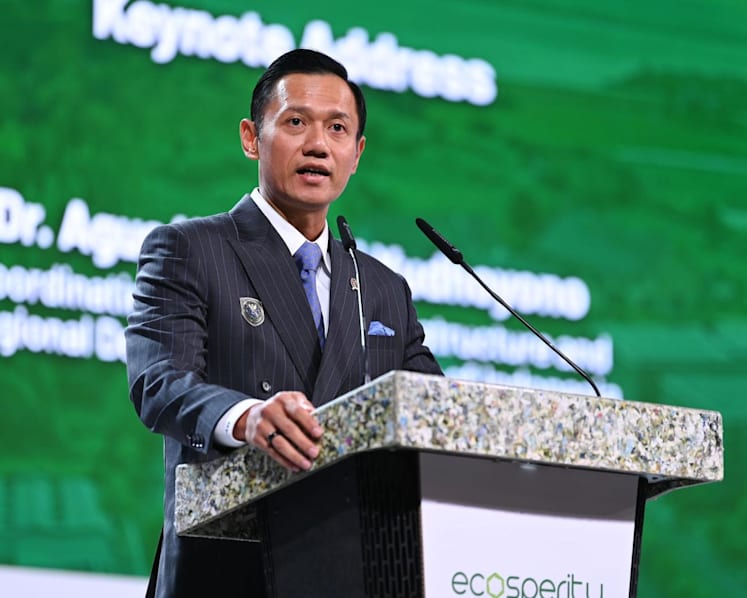
Following Mr Teo's remarks at Ecosperity, Indonesia's Coordinating Ministry for Infrastructure and Regional Development Agus Harimurti Yudhoyono gave a keynote speech in which he also spoke on how sustainability measures add resilience amid geopolitical conflicts.
He gave the example of Indonesia's nickel industry, which supplies about 60 per cent of the world’s mined nickel.
The conflict in the Middle East, including the disruptions around the Strait of Hormuz, has reportedly driven up the prices of sulphur, which is a key input in nickel production.
Much of the country's nickel processing still depends on captive coal, Dr Yudhoyono noted. "We are addressing this issue, the transition to cleaner processing energy is a priority, from solar and wind to geothermal, where geography allows."
The minister said that Indonesia’s geothermal resources could help power its domestic nickel industry. He noted that the country sits on one of the world’s largest geothermal reserves but has only tapped a fraction of its potential.
He added: "This is not just industrial policy for us, this is energy security, the conviction that a country which holds the materials of the next era should not remain a passive supplier in someone else's supply chain."




