







Transforming economy an ‘urgent’ task, helps to ensure 'strong and sustainable revenues'
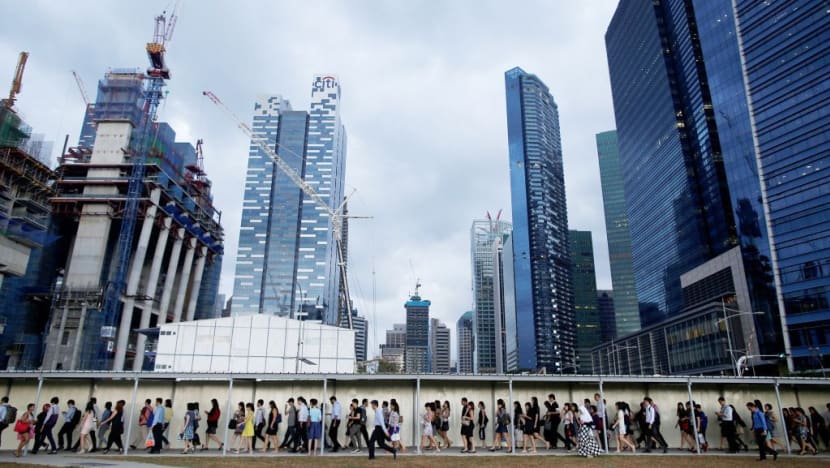
Reuters file photo


SINGAPORE — Wrapping up the Budget debate in Parliament, Finance Minister Heng Swee Keat reminded the House on Thursday (March 1) that the most critical challenge facing the country is the transformation of its economy.
While the increase in the Goods and Services Tax (GST) that is set to happen in the future has received the most attention, the focus should be on supporting businesses in this “urgent” economic transformation and preparing workers for the jobs of tomorrow. This is to brace for structural changes in the global economy and technological advances that are set to disrupt the status quo.
“Growing our economy is not only the best way of ensuring strong and sustainable revenues, it is also the most important way for our people to realise their aspirations,” Mr Heng said.
Over the years, the Government’s schemes have built awareness about productivity and innovation, he pointed out.





In 2016, about 85 per cent of small- and medium-sized enterprises (SMEs) which see S$1 million to S$10 million in revenues a year reported that they adopted productivity measures such as automation, digitalisation and improving worker skills. This is based on an annual survey by the Singapore Chinese Chamber of Commerce and Industry. Last year, the figure rose to almost 93 per cent.
Mr Heng also noted that Singaporean firms have been developing know-how to move into higher-value markets. Or companies in traditional industries have been changing processes and products to keep business fresh.
One example is a firm that started as a sawmiller in 1977 and has grown to become the first company in Singapore to commercialise wooden pallets that have RFID (radio frequency identification) tags, both in the market here and overseas.
For new businesses, about S$1.85 billion was invested in the start-up scene, 10 times more the amount invested compared to five years ago.
These efforts have not gone unnoticed.
“This year, Singapore climbed three places in the Bloomberg Innovation Index, to become ranked as the third most innovative economy globally,” Mr Heng said.
“Google has substantial operations in Singapore, with more than 1,000 staff in functions such as engineering and research and development. Just yesterday, in collaboration with NTU (Nanyang Technological University), Alibaba opened in Singapore its first joint research institute outside China, to undertake research on artificial intelligence.
“These are encouraging signs of progress, and we must build on this momentum.”
‘FOSTERING PERVASIVE INNOVATION’
Moving ahead, one of the strategies is to position Singapore as “a global-Asia node of technology, innovation, and enterprise”.
This means fostering pervasive innovation throughout the economy, building deeper capabilities in businesses and people, and forging stronger partnerships at home and abroad, in order to “ride on the region’s growth together”, he added.
The Government’s Industry Transformation Maps for various economic sectors will also come into play.
“I urge all stakeholders — businesses, trade associations and chambers, the Labour Movement, and Government agencies — to double down on transformation efforts, and to communicate the importance and urgency of transformation to their members,” he said.
However, even as the push is on for firms to transform themselves through a comprehensive range of targeted support, Government grants are meant to “catalyse companies’ transformation and should not become permanent support”, Mr Heng cautioned.
This will be the case for the Wage Credit Scheme, where the Government co-funds 40 per cent of wage increases to help companies free up resources to improve productivity. It has been extended three more years until 2020, as part of a S$1.8 billion boost for businesses over the next three years
Mr Heng said on Thursday that this is a “transition scheme” that will “taper down”.
SUPPORTING WORKERS
Apart from backing businesses, efforts to help workers will not let up.
Mr Heng told the House that the Government must continue to invest in its workers to ensure that they are equipped with relevant skills to take advantage of new opportunities.
For those who are self-employed by choice, their concerns and challenges, for instance in legal protection, social security and skills development, has not gone unheard and the aim is to better address these issues.
Following the Budget statement, a tripartite workgroup — which was formed last year to study of the challenges faced by freelance workers — came up with seven key recommendations to better protect freelancers, including one to help boost their Central Provident Fund’s Medisave savings.
Mr Heng said that the Manpower Ministry has accepted the recommendations and will elaborate on their strategies at the upcoming Committee of Supply debate.
Making a clarion call for all Singaporeans to contribute to the growth of the economy, Mr Heng called on workers, businesses and trade associations to step up and “do better together”.
“This is not the first time that we are making a major push to transform and upgrade our economy. All of us have a part to play... Let us have confidence, keep our eyes on the horizon, and move forward together.”




