From Greenland to trade wars: The new Trump-era reality investors must navigate
Analysts say Trump's frequent policy reversals require investors to rethink traditional portfolio strategies.
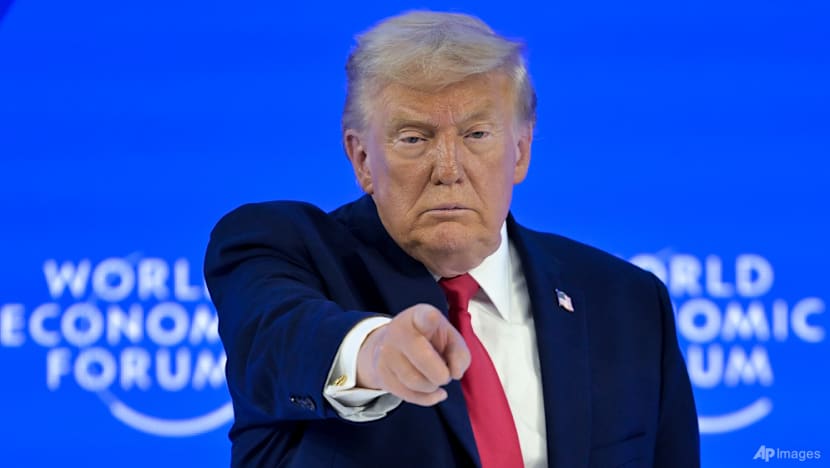
US President Donald Trump gestures after his special address during the 56th annual meeting of the World Economic Forum, WEF, in Davos, Switzerland, on Jan 21, 2026. (Photo: AP/Gian Ehrenzeller)

This audio is generated by an AI tool.


SINGAPORE: The Greenland-tariff-threat-that-wasn't exemplifies the challenge now facing global investors – how to build portfolios resilient enough to withstand US President Donald Trump's constant policy turbulence.
Asian markets tracked gains on Wall Street on Thursday (Jan 22) after Mr Trump walked back his threat to impose new tariffs on European allies, including Germany, France and Denmark, who had pushed back against his grab for Greenland.
But analysts say such episodes are becoming more frequent, requiring investors to rethink their approach to portfolio management.
"The latest rebound is largely a relief rally," said Mr James Ooi, a market strategist at Tiger Brokers. "The prior sell-off was driven by Trump’s tariff threats toward European allies, and the rebound reflects the market unwinding fears linked to the Greenland episode."





However, Mr Ooi believes markets may be too optimistic about the trajectory ahead.
"Markets appear to be underpricing tariff risk, despite the likelihood of recurring tariff threats," he said, adding that investors should be prepared for elevated volatility.
Mr Jude Lin, deputy CEO of Wrise Private Singapore, holds a similar view. "There is a growing risk that tariffs are currently underpriced, especially given the broadly optimistic market tone," he said.
The quick recovery this week shows that investors have grown accustomed to letting policy shocks fade away. "While this behaviour has worked so far, it does leave markets vulnerable should policy actions become more sustained or less reversible," Mr Lin said.
Analysts said geopolitical risks are likely to remain elevated this year, leading to continued market volatility.
Trump's unpredictability has "not yet become a fully known or discounted risk", said Mr Ooi.
IS TRUMP'S BARK WORSE THAN HIS BITE?
The assumption that the US president usually backs down from his threats emerged last year, with an increasing number of investors betting that his rhetoric is harsher than his actual policies.
"(This is) why market pullbacks have become shallower and relief rallies quicker than expected," said Mr Ooi.
But he cautioned against assuming that the so-called "Trump Always Chickens Out (TACO)" pattern will emerge. "Over-reliance on this belief could hurt investors if Trump unexpectedly follows through on his threats."
Mr Ooi suggested it would be more prudent to hold back when outcomes remain uncertain, and invest when the dust has settled.
Investors are generally becoming desensitised to tariff threats, said Mr Barnabas Gan, head of market research at RHB Bank. He said a buy-on-dips strategy may still be preferred for risk assets, though investors may place "insurance bets" on safe haven assets in the coming weeks.
Wrise's Mr Lin said markets have increasingly treated policy shocks as tactical trading opportunities rather than structural threats.
"However, while the 'buy-the-dip' approach has worked in many instances, investors should remain mindful that not all policy risks will necessarily reverse quickly, especially if geopolitical considerations intensify," he said.
DIVERSIFY TO MANAGE RISK
Given the geopolitical risks and market volatility, building a well-diversified multi-asset portfolio is crucial, said Mr Abhilash Narayan, investment strategist at HSBC Private Bank and Premier Wealth.
He advised investors to look beyond the traditional 60 per cent stocks and 40 per cent bonds portfolio, and consider allocating to asset classes with low correlation.
"We view gold, hedge funds, private market assets and volatility strategies as key pieces of the puzzle," he said.
No asset class acts as the perfect hedge, so investors should "diversify their diversifiers" to build more resilient portfolios, Mr Narayan said.
Mr Lin said gold is likely to benefit in the current environment, acting as a hedge against volatility and currency debasement.
For equities, he said Singapore banks remain attractive, with solid balance sheets, recurring income streams and relatively defensive characteristics in the uncertain macroeconomic and policy environment.
Tiger Brokers' Mr Ooi said gold, bonds and defensive sectors such as utilities, consumer staples and real estate investment trusts are generally viewed as more resilient asset allocations.
"They tend to outperform during periods of market volatility and abrupt policy reversals," he said.