







Uber offering rides with child car seats in pilot
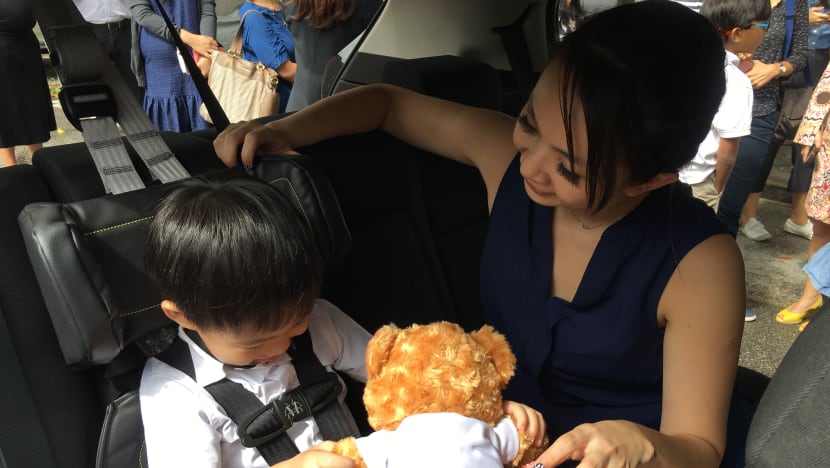
Ms Sandra Goh, 36, and her son, Vayeus Pang, 3, demonstrating a folding car seat that will be used in 100 UberX private-hire cars from Thursday (June 15) as part of a trial. Photo: Kenneth Cheng/TODAY


SINGAPORE — Three months after Grab unveiled a child booster seat for its GrabCar fleet, Uber is following suit with a new car seat as it guns for a slice of the family segment amid stiff competition.
Announcing the move on Wednesday (June 14), Uber said its car seat is meant to safely strap up children with a height of 1.45m and below, who weigh between 10kg and 25kg, and who are aged from one to 10 years.
The seats will be launched in a pilot involving 100 UberX cars from today, Uber Singapore general manager Warren Tseng told a press briefing. The ride-hailing platform will ramp this up to “a few hundred” in the next few months.
Such journeys will cost an extra S$5 for passengers, who can swipe to the Extra Seats feature in the Uber app when booking a ride to request a car seat.





The cost of the seats — which retail for more than S$400 each — will be borne by drivers at a “special rate”, Mr Tseng said. Its features include side impact protection, a moveable headrest and adjustable shoulder straps, and the seat takes about a minute to deploy.
Previously, parents who wished to travel in a Uber vehicle with young children would have to bring their own child restraint. Some drivers also provide child seats of their own accord.
Drivers complete an online training component, undergo a half-day training session and are certified to secure the seat safely by a child passenger safety technician.
One such driver is Mr Antaeus Lim, 30, who said that drivers who opted in to provide the service pay S$99 for the seat, and he was doing so in four instalments.
Once or twice daily, he encounters families with young children who book rides, but has had to turn them down on the spot because the children were of a height that required a child restraint. Under the Road Traffic Act, children less than 1.35m tall must use a child restraint while riding in a private-hire car.
Saying that there was a “gap” in the market for families travelling with younger children, Mr Tseng told TODAY that while the firm did not rule out extending the seat to its entire UberX fleet eventually, it was not “something ... needed for the market” on that scale.
In March, Grab announced that all its GrabCar vehicles would be outfitted with a child booster seat, enlarging its GrabFamily service, which was introduced in August last year. The seat caters to children aged four to seven, who weigh between 15kg and 36kg.
In an update on Wednesday, Grab said it was working with product experts to design a car seat compliant with safety standards for children aged between 1.5 and 3 years. This will be tailored “specifically for (its) needs in ride-hailing”, and will be light, portable and easy to deploy.
The ride-hailing platform said that since March, the number of GrabCar vehicles equipped with car seats has tripled to more than 3,000 at present. Its GrabFamily rides have also doubled since. The most popular destinations among this segment are the Singapore Zoo, Universal Studios and Gardens by the Bay, said Grab.




