







‘Singapore is our home’, says UltraGreen.ai CEO after firm’s strong SGX debut
Listing on the local bourse gives the medtech firm credibility, chief executive Ravinder Sajwan told CNA’s Clara Lee.
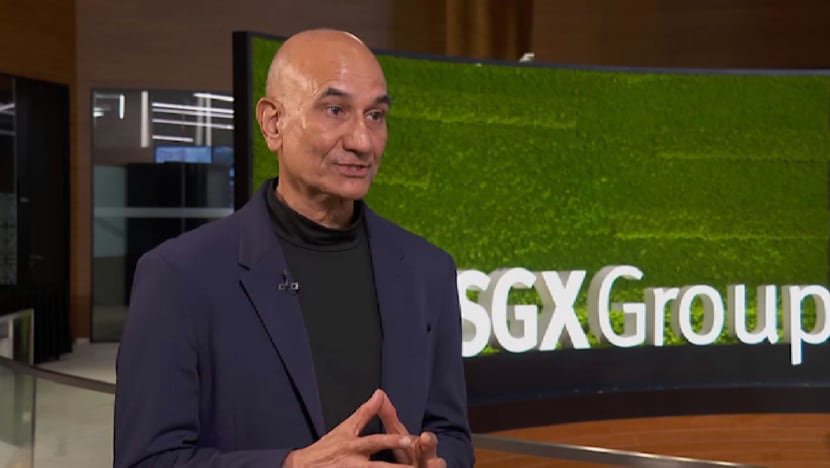
UltraGreen.ai CEO Ravinder Sajwan speaking to CNA in an interview.

This audio is generated by an AI tool.


SINGAPORE: Fresh off a strong market debut on the Singapore Exchange (SGX), medtech firm UltraGreen.ai is well-positioned to use Singapore as its base as it seeks to grow in Asia, said its CEO.
Speaking to CNA on Wednesday (Dec 3), the day of its initial public offering (IPO), Mr Ravinder Sajwan said Singapore was the natural place for UltraGreen to go public.
“We have large growth segments in Asia we want to launch, and having a company based in Singapore gives us credibility from a local perspective,” he said.
“I personally am a PR (permanent resident) in Singapore. Our family office is Singapore-owned. So our strategy was, Singapore is our home - we wanted to do it here.”





The firm, which specialises in supplying fluorescence-guided surgery tools and indocyanine green (ICG) dyes, surged as much as 10 per cent above its IPO price of US$1.45, opening at around US$1.60.
The company raised about US$400 million, making it Singapore’s largest non-REIT (real estate investment trust) IPO since 2017 and valuing it at around US$1.7 billion.
“We call ourselves UltraGreen because we have taken your blood, turned it green and applied AI to it,” Mr Sajwan said.
KEEPING SURGEONS AT THE CENTRE
Mr Sajwan said the company’s growth has come from working in partnership with surgeons.
“Most top fluorescent guided surgeons in the world work with us … They do a lot of clinical work to tell us how this product performs in different applications, we use that data then to decide what markets to go after.”
Surgeons also shape UltraGreen’s software development.
“They will also tell us what is missing in the market … that allows us to then decide what we need to fill the gaps with in software,” said Mr Sajwan.
“Surgeons give us great clinical data. Then we have software which goes in and adds more precision to it, and you create adoption that way.”
This strategy has paid off, despite the healthcare sector’s generally slow adoption of new products, he added.
The company has grown from selling 20,000 vials of ICG dye in 2016 to around 1 million last year.
UltraGreen is also building an artificial intelligence-powered platform to help analyse real-time data during procedures.


TURNING BLOOD “GREEN”
ICG dye helps surgeons to visualise blood flow, tissue and even tumours in real time.
While it is a “very simple molecule”, it is “extremely complex” to manufacture, said Mr Sajwan.
It was invented by photography firm Kodak in 1959 to process black-and-white images.
“The unique thing about ICG is that it binds to the blood plasma, so if you inject it in the human body … it will bind to blood plasma, and this blood plasma carries the ICG everywhere your blood flows.”
When surgeons illuminate the dye with a near-infrared camera, “it will excite the green dye, and your blood turns green”.
This allows doctors to tell apart healthy tissue from unhealthy tissue and see how fast blood is moving, making surgeries safer.
Alongside the dye, UltraGreen has also developed its own low-cost imaging hardware, which Mr Sajwan said is designed to remove a major barrier to adoption in Asia.
Traditional imaging systems can cost up to US$500,000, Mr Sajwan added.
“We took a different approach. We developed our own camera, an extremely low-cost device which allows us to give the product literally for free so people can use the dye, get it adopted, see the clinical benefits, and that allows us to expand in Asia.”
“That allows us to operate outside of (the) surgical theatre in smaller clinics.”
FUTURE NASDAQ LISTING?
Asked if the company would pursue a listing on United States-based NASDAQ in the future, especially as Singapore and the US exchange recently streamlined dual-listing rules, Mr Sajwan said that doing so would require “meaningful value” first.
“The question becomes, at what point does it become relevant in NASDAQ? If you notice companies in NASDAQ, they tend to be very tech-heavy, which means you've got to have a lot of data,” he noted.
Mr Sajwan said this led to the company’s strategy of aiming to succeed in Singapore and building a data platform, before it eventually decides whether to list on NASDAQ.
“But we're very flexible, because we don't need the money and we have enough cash we generate every year to build our business without actually having to do another listing for a while if we don't want to,” he added.
SGX GAINING MOMENTUM
Last month, SGX announced a partnership with NASDAQ to make it easier for companies to pursue dual listings. If the tie-up is successful, issuers will only need to submit one set of offering documents to list on both exchanges.
Analysts say this will help to build the positive momentum already being seen in the local bourse.
UltraGreen’s choice to anchor in Singapore also comes as SGX enjoys one of its busiest years in recent memory.
More than 30 companies are currently in the pipeline to list on the bourse, SGX said in August.
A Deloitte survey found Singapore led Southeast Asia in post-IPO proceeds this year, raising US$1.6 billion, boosted by major REIT listings.




