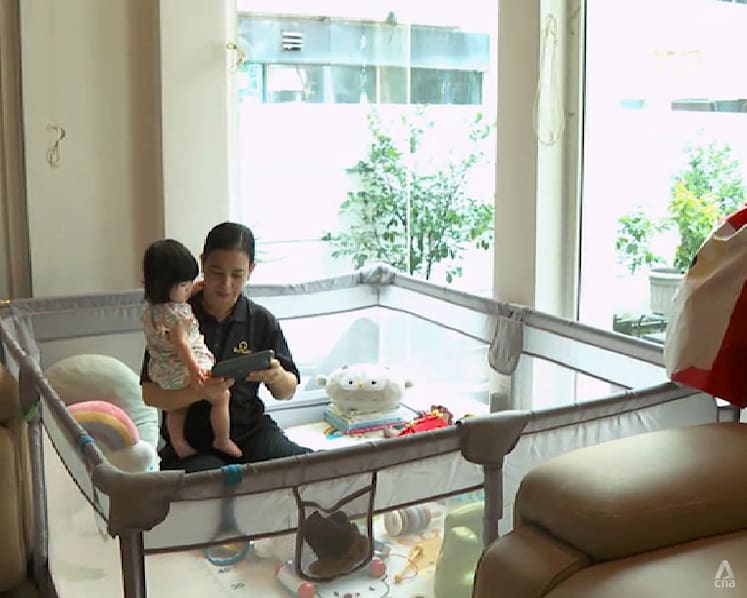
Infant carers, waiters, cabin crew among jobs opening to work permit holders from more countries
Teacher aides and F&B stall assistants are also among the roles that can be filled by work permit holders from more countries.
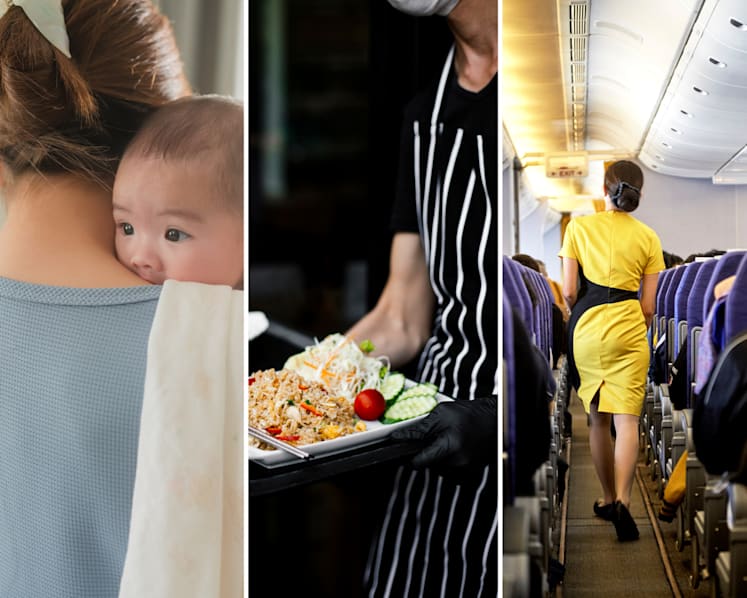
Infant carers, waiters and cabin crew are among the jobs that will be added to the non-traditional sources occupation list. (Photos: iStock)

This audio is generated by an AI tool.


SINGAPORE: Eight occupations in social services, food services and air transport will open to work permit holders from more countries from September, Manpower Minister Tan See Leng announced on Tuesday (Mar 3).
The eight occupations are: babysitters or infant caregivers, educarers and teacher aides in social services; food preparers like butchers and fishmongers, food or drink stall assistants, kitchen assistants and waiters in food services; and cabin crew.
They will be added to a list of manufacturing and services jobs that can be filled by workers from what Singapore considers non-traditional sources, namely: Bangladesh, Bhutan, Cambodia, India, Laos, Myanmar, Philippines, Sri Lanka and Thailand.
This will allow businesses to hire higher-quality workers from these sources in specific non-professional, manager, executive and technician (PMET) roles with not enough locals, said Dr Tan.





Singapore’s typical sources of labour for manufacturing and services are Malaysia, China, Hong Kong, Macau, South Korea and Taiwan.
An MOM spokesperson said the move will help firms hold on to foreign workers displaced by an upcoming increase in the S Pass qualifying salary, but who cannot be hired on a work permit due to source country restrictions.
The S Pass, which is open to foreign workers across all nationalities, will have its qualifying salary raised from S$3,300 (US$2,600) to S$3,600 from 2027 for new applications, and 2028 for renewals.
The qualifying salary and hiring levy are benchmarked to the top one-third of local associate professional and technician wages.
By around 2030, the S Pass qualifying salary is expected to reach S$4,000 to S$4,500, said MOM.
The Employment Pass qualifying salary, which is based on the top one-third of local PMET wages, will also increase from S$5,600 to S$6,000 from 2027 for new applications, and 2028 for renewals.
The S Pass is held by a mix of foreign workers who do not meet the Employment Pass criteria and lower-skilled workers who do not qualify for a work permit, according to the MOM spokesperson, who spoke at a briefing on the ministry’s spending plans.
Raising the S Pass qualifying salary makes it more targeted towards associate professionals and technicians, restoring it as a “targeted relief valve” for the Employment Pass.
At the same time, there are skilled workers on the S Pass that Singapore does not want to lose when it raises the qualifying salary, said the MOM spokesperson.
By widening the occupations that can be filled from non-traditional sources, employers will have a chance to retain these workers on work permits, the spokesperson said.
"MEANINGFUL WIN FOR THE SECTOR"
The Restaurant Association of Singapore (RAS) said in a statement on Tuesday that it welcomes MOM's decision to expand the list of non-traditional sources (NTS) for work permit holders.
It added that the move was a timely step that gives food and beverage operators access to a broader and more diverse talent pool.
"We see this policy as a meaningful win for the sector - one that provides much-needed manpower flexibility while upholding our commitment to fair wages," the RAS spokesperson said.
The association said, however, that several challenges remain, such as for operators who have already maximised their non-traditional sources sub-quota of 8 per cent.
RAS also noted that the overall Dependency Ratio Ceiling (DRC) – the total number of foreign workers a company is permitted to hire – remains unchanged.
"The constraint lies specifically in the ability to shift workers between the S Pass and NTS sub-quotas, which are governed separately within the overall DRC," the spokesperson said.
"RAS would therefore encourage MOM to consider providing greater flexibility in how these two sub-quotas are balanced – for instance, allowing companies to utilise headroom from an underutilised S Pass sub-quota towards their NTS allocation."
MOM introduced the list of non-traditional sources for work permit holders in 2023 to make it easier for firms to fill certain jobs that have pressing manpower needs and low take-up by locals, and which are harder to automate.
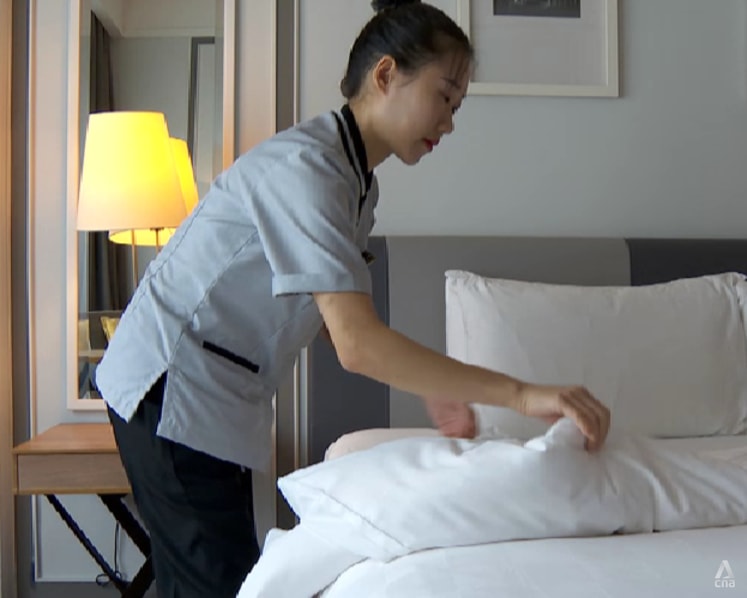
Occupations that are already on the list include manufacturing roles, hotel housekeepers and porters, cooks, food processing workers and heavy vehicle drivers.
Employers seeking to hire workers from these sources must offer a fixed monthly salary of at least S$2,000 and keep such work permit holders within a sub-dependency ratio ceiling of 8 per cent.
This is to safeguard local wages and ensure that employers hire higher-quality workers, said the ministry.