







World will pass S’pore by if businesses do not unite, transform, build ‘real capabilities’: Chan
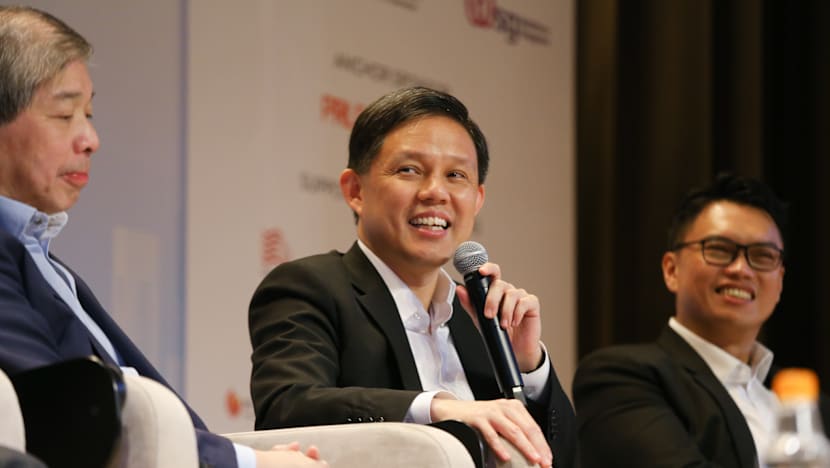
Trade and Industry Minister Chan Chun Sing addressing about 300 participants from businesses, the labour movement and the Government at the Future Economy Conference and Exhibition at the NTUC Centre on Oct 22, 2018.


SINGAPORE — In the face of threats to the global economic system, Trade and Industry Minister Chan Chun Sing has called on businesses here to band together and build “real capabilities”, or risk the world passing them by. This is particularly for those saddled with slower growth.
Firms coming together to seek new solutions and capabilities will get “specific, targeted” help from the Government as long as they have “demonstrated the hunger… to change”, said Mr Chan during a panel discussion on Monday (Oct 22) at a conference on the future economy.
“If 30 companies from the same sector come together and say that ‘I want to look for a new solution for this, I want to build this new capability, can the Government help me?’
“My promise to (them) is that I’ll make sure that (government agency) Enterprise Singapore assigns one officer to manage this group of companies.”





This will be an added layer of help, on top of advice from officers on the generic help schemes for small- and medium-sized enterprises (SMEs), and other businesses.
Mr Chan stressed that just as broad-based policy measures will continue to be important moving ahead, so will “sector-specific” measures as well.
He was addressing about 300 participants from businesses, the labour movement and the Government at the Future Economy Conference and Exhibition at the NTUC Centre. The event was organised by the Singapore Business Federation and the National Trades Union Congress, in partnership with the Government and 17 trade associations and chambers.
Speaking on external economic challenges, Mr Chan said that the ongoing multibillion-dollar trade war between the United States and China shows no signs of dissipating in the short term.
Therefore, Singapore must prepare for the long haul in the event that the global trading system fragments, turns protectionist or isolationist.
This will shift global value and production chains, which could throw up challenges, as well as opportunities. While some industries will be hit and may move their operations out of Singapore, new jobs in production, services and other areas could be created as firms diversify their portfolios.
As disruption and technological change speeds along, some businesses will need to be lifted out of the sectors experiencing slower growth, and redeploy their land, labour and capital to more productive industries.
This entails businesses being prepared to change fundamentally and to retrain their workers, said Mr Chan.
Businesses growing at an average pace will have to transform, too.
For the most productive firms enjoying higher levels of growth, helping them expand their market shares will be key. “Their productivity is very high, but if the market doesn’t expand as fast, it means that they need fewer people to get the same output or outcome,” said Mr Chan.
As a result, excess labour will be displaced, pushing them into less productive sectors performing at average or below-average levels. Until these markets are enlarged, national labour productivity could decline, he added.
Taking stock of the progress of the Industry Transformation Maps, Mr Chan said that banking and finance, as well as supply chain and logistics, are some of the sectors which have done relatively well. The latter, for instance, has tapped new technology to re-engineer many of its processes.
In the sectors that have fared well, Mr Chan said there was a strong trade association and chamber that took the lead to bring various players together to promote innovation, pin down problems and seek solutions, for example.
Firms experiencing slower growth should look into such solutions, he added.
When seeking to transform, these companies should not just focus on areas to reduce costs, but look at how to “come together and build real capabilities” that can allow them to command a price premium. That way, they can compete not on price, but capabilities and networks, said Mr Chan.
Sectors ahead of the transformation curve also had strong labour management relations, he added.
Also important were ground-up contributions on the specific needs and problems, which allowed SMEs, for instance, to leverage technologies across functions such as human resources, invoicing and accounting, said Mr Chan.
Singapore does not need to “aim to be a champion as an economy”, he added. “But if each and every sector is a little champion in their own sector, then being a champion economy is inevitable.”




