





COP27: Indonesia receives plaudits for deforestation action, but globally, trees keep falling
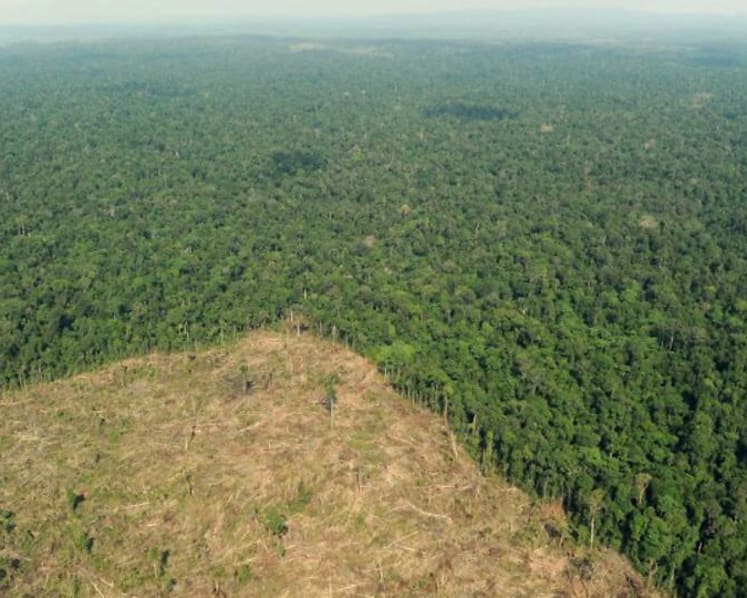
An aerial photograph shows logged areas in the forest close to the Bukit Tigapuluh wildlife reserve in Indonesia's eastern Sumatra. (Photo: AFP/ ROMEO GACAD)


SHARM EL-SHEIKH, Egypt: Indonesia has received affirmation of its attempts to rein in previously rampant deforestation, as ministers convened at the United Nations climate summit in Egypt.
At a panel discussion on Indonesia’s efforts to make its forest and land use segment a net carbon sink by 2030, officials labelled the country a leading light for the rest of the world to follow on a complex and critical issue.
“Indonesia has been trying very hard. Our deforestation rates have dropped significantly,” said Dr Siti Nurbaya, the country’s minister for environment and forestry.
Last year, Indonesia was a rare success story, recording a 25 per cent drop in deforestation rates, similar to its neighbour, Malaysia, making Southeast Asia the only region in the world on track to end the harmful practice by 2030.





Forests are crucial tools in efforts to slow down the onset of climate change. It is estimated that they absorb nearly one-third of all carbon emissions. But their effectiveness is still being compromised by human activity.
Indonesia updated its climate targets ahead of COP26 in Glasgow last year, to target a pathway to a low carbon economy and for its most polluting sector - forestry and land use - to reach emissions peak by 2030.
“The promise being made at the moment with nature is a really big promise,” Zac Goldsmith, the UK Minister for Asia, Energy, Climate and Environment told the panel, which was convened on Wednesday (Nov 9).
“We rely, all of us around the world, on Indonesia's success. Indonesia is doing a global service of protecting these extraordinary natural treasures. If Indonesia fails, we all fail and if Indonesia succeeds, we have a chance globally to succeed,” he said.
“Our hope is that Indonesia will be a guiding star on tropical forests for other countries,” said Anne Beathe Tvinnereim, Norway’s Minister for International Development.
Related:

Egypt's ancient wonders face their toughest test yet - human-induced climate change

Ancient sites are increasingly being exposed to the damaging impacts of climate change. (Photo: CNA)
LUXOR, Egypt: Along the dusty west bank of the Nile River in Luxor, the riches of human history pepper a barren landscape.
The tombs and temples and other traces of an ancient civilisation have been slowly re-discovered and brought back to the light.
When they were built, millennia ago, these structures were meant to last for eternity. But amid a human-induced climate change crisis, even the strongest foundations may not survive.
Within a century, these wonders - that continue to provide crucial insights into the past - could be widely lost. That is a warning from one of the country’s preeminent Egyptologists, just as world leaders convene in Sharm el-Sheikh for the UN climate change conference.

“In 100 years, in my opinion, if we do not control climate change and try to accommodate the need for tourism and the preservation of antiquities, all these tombs will be completely finished,” Zahi Hawass, the former Minister of State for Antiquities Affairs, told CNA.
“The tombs of the Valley of the Kings will collapse completely. And all of us will be sorry.”
The climate factors impacting antiquity sites throughout Egypt are varied and the impact is being felt right now.
High temperatures, strong winds and prolonged heat waves outside of normal weather patterns take a toll on stonework, reducing colour and inducing cracks.
Flash floods from rare but dangerous heavy rain outbursts can eat away at highly vulnerable mud structures and open tombs.
The flow of the Nile River is inconsistent and losing its seasonal pulse due to the construction of dams, while a population explosion has meant intensive agriculture has spread, houses without proper sewage infrastructure have expanded close to antiquity sites and air pollution has increased.
“We had a really bad summer with high temperatures which affected the monuments and the antiquities itself. And it wasn't like this before, because of the pollution and the population,” said Hisham el-Leithy, the under secretary of state for Documentation of Egyptian Antiquities.
"We're trying our best in order to prevent or to work on this issue,” he said.

The biggest impact may come from underground where rising water tables in some areas threaten to undermine the foundations of ancient sites. Programs with international assistance have been run at several important locations to lower local groundwater levels and install drainage networks.
At the Colossi of Memnon, two giant statues in front of the ruined Mortuary Temple of Amenhotep III in Luxor, such works are ongoing. The site is surrounded by agriculture fields, which exacerbate pressures on the delicate stonework.
“There has been a great deal of change in the Nile Valley, in that the fields are constantly irrigated. With water comes salt. Salt eats the stones. And with water comes vegetation and it invades,” said Hourig Sourouzian, the conservation project director.
She says that without intervention, temple complexes like these would simply vanish.
“It is necessary. If we had left the temple, it would disappear one day due to the action of these enemies. Abandonment is the enemy to any monument.
“Egypt is rich. This is a great civilisation. It is full of monuments to conserve. We should save anything we can,” she said.

At the same time, rising sea levels and saline intrusion are issues for ancient structures in Lower Egypt, closer to the Mediterranean Sea, that need constant attention.
Restoration and mitigation works are common throughout antiquity sights. The availability of new technologies is offering hope that these efforts will be effective.
“It is expensive, but we have to. We cannot leave our monuments suffering from things like this without attention, without interfering in this issue,” el-Leithy said

ANCIENT HARMONY
Ancient Egyptian civilisation was built upon the foundations of nature; finding harmony despite extremes to survive and prosper.
They are lessons that can still be applied today, experts say, amid the steep challenges posed by climate change.
“You can look at the art and craft and the harmony in the Karnak temples in Luxor temples here. And you see the architecture follows mathematical proportions, arithmetic and what you call the golden ratio,” explained Egyptologist Ahmed Seddik.
“Those are ratios inspired by nature. So, this oneness, this harmony, when you are in harmony with nature, nature protects you. When you are working against nature, nature will destroy you.

“The (ancient) Egyptians succeeded because they were in harmony with nature. And the pharaohs claimed success because they moved their nations from the way of harm with the aim of harmony. When you had a term of turmoil and the kingdom collapsed, it's because they steered the way that was not in harmony with nature,” he said.
Cairo-based geoarchaeologist Fekri Hassan agreed that Egyptian history can be a useful guide to dealing with climate change now.
“The emergence of humanity depended on climate change. And we had to struggle with climate change from day one. How we coped with climate change and existed under all kinds of severe climatic conditions was to take action as soon as we can,” he said.
“The problem today is that the distance between observing climate change and taking action has become so long and protracted, that we may not be able to act in time.”

Hawass pleaded for world leaders to consider the priceless value of Egyptian antiquities as they negotiate at COP27 in Sharm el-Sheikh.
“If you lose your past, you lose your future. And therefore, this is the future not only of Egypt, but the future of the whole of the world,” he said.
“It is the duty of the whole world to cooperate together for the protection of the Egyptian monuments and understand that climate change could be a very bad factor to destroy these monuments.”
Global deforestation decreased by only 6.3 per cent in 2021, a modest improvement that fell short of international goals, according to the Forest Declaration Assessment.
At COP26, 145 countries signed a pledge to halt and reverse forest loss and land degradation by 2030 as a tool to combat climate change. That would mean a necessary 10 per cent annual decrease in deforestation and the restoration of 350 million hectares of forest land.
The progress has been slow since then. Both nations and private companies have fallen short on their commitments so far.
Goldsmith said that the pledge still carried weight and was an important commitment that the UK would continue to pursue, despite Indonesia initially being one of the countries to express concerns about its wording and requirements.
“I think it was an amazing declaration. And it was unprecedented. Our job now as the UK is to ensure that those promises aren’t just paper promises. We all will be ruthlessly held to account,” he said.
Others are less glowing about the pledge, especially with a lack of perceived action since.
“Glasgow was what I call an empty promise. You sort of duped developing countries to make pledges about stopping deforestation, with promises of finance that have not materialised,” said Kevin Conrad, the Special Envoy of Climate Change for Papua New Guinea and executive director of the Coalition for Rainforest Nations.
“It’s a difficult situation for, again, developing countries when they're trying to do the right thing. They're actually doing the right thing, but yet they're doing it themselves.
“And these are some of the poorest countries that have done the most in terms of reductions, but they've done it without compensation,” he said.
He wants to see the voices of indigenous peoples and local communities amplified further at the COP and in ongoing climate conversations, given their critical role in protecting forested lands. Funding that is promised to such groups remains difficult to access and is often funnelled through other organisations.

Data is increasingly proving useful for policymaking but also shows how the problem of deforestation improves in one part of the world, it can simultaneously worsen elsewhere.
Dr Sassan Saatchi, the founder of CTrees and a NASA research scientist, explained to CNA that while Indonesia has cleaned up its palm oil industry, a massive cause of deforestation, analysis shows the issue has simply now moved to Africa.
“Southeast Asia is in okay shape. But some of the impacts, especially the palm oil plantations, are having leakage to other continents,” he said.
Dr Saatchi said that data from CTrees, which aims to track carbon in every tree on the planet, shows that deforestation has basically continued as usual since Glasgow. But he expressed hope that the situation may improve in Brazil soon, given the recent change of government.
“Another culprit for this whole forest cover change is degradation through fire and other things. Part of it is because of human activities and part of it, because of climate change. Now, the goal is actually to reduce this," he said.
Earlier at COP27, Singapore joined a group of more than two dozen other countries that said they would ensure they hold each other accountable for a pledge to end deforestation by 2030.
Forests and Climate Leaders’ Partnership (FCLP) builds upon the agreement made in Glasgow and aims to “scale ambition and to find innovative solutions to ongoing problems”.
“Singapore is delighted to be part of the Forest and Climate Leaders’ Partnership, to work with like-minded partners on innovative and environmentally robust solutions that would unlock the potential of the forestry sector for climate action, while reducing the loss of forests worldwide,” said Minister for Sustainability and the Environment Grace Fu.
It is expected that a stocktake will take place at next year’s COP in the United Arab Emirates, with countries urged to come forward with progress reports on deforestation.