Antisocial or self-contained? How JOMO or the 'joy of missing out' can cut both ways
You've heard of FOMO, but are you familiar with its distant cousin JOMO? Here's why intentionally "missing out" can work wonders for your mental well-being, and how to keep it from leading to isolation.
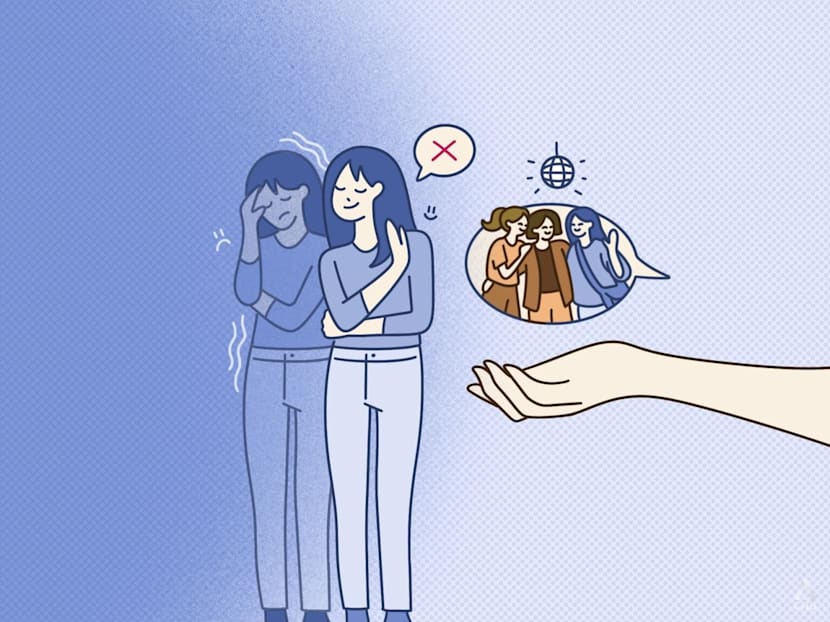
Choosing to opt out of social events can be healthy, if it's done for the right reasons. (Illustration: CNA/Nurjannah Suhaimi)

This audio is generated by an AI tool.
For Ms Kathy Seow, a 29-year-old senior content marketing specialist, the fear of missing out (FOMO) used to be a constant.
"When I was younger, I always felt like I was missing out when I saw peers sharing the latest gadgets or cafe spots," she said. Over time, it trapped her in a cycle of never saying no to offers and invitations – one she realised was unsustainable. "It didn't make me happier as a person."
Now, she has learnt to pause and ask herself a simple question: Do I actually like this, or do I just like the idea of it?
"I'm more intentional about what I spend time on and what I share online," she said. "Eventually, I also became more private about my digital presence."





Like Ms Seow, more people are beginning to step back from constant social engagement not out of apathy or antisociality, but a desire to protect their well-being and sense of self.
For some, this shift represents not simply avoiding FOMO, but a search for its antithesis: JOMO, or the joy of missing out.
WHAT JOMO IS (AND WHEN IT STOPS BEING HEALTHY)
Despite its casual use online, JOMO is not just about staying home, being introverted or distancing oneself from social life altogether. The key distinction lies in why someone is opting out and how it feels afterwards.
Dr Sanveen Kang, clinical psychologist and founder of Psych Connect, explained that JOMO is best understood as a conscious, values-based decision.
Drawing on the acceptance and commitment therapy (ACT) framework used in the practice of mindfulness, she described JOMO as a "toward move", a choice that aligns with personal values such as rest or authenticity.
In contrast, social avoidance for its own sake tends to be an "away move", motivated by anxiety and often followed by guilt or increased distress.
"One way to tell the difference is to look at the after-effect," Dr Kang said.
If opting out leads to a sense of calm, clarity and a fuller life, it is more likely to be healthy JOMO. If it results in shrinking confidence, heightened anxiety or a growing reluctance to re-engage despite wanting connection, social anxiety may be at play.
Ms Aarti Mundae, founder and lead psychotherapist at Incontact Counselling and Training, cautioned against conflating JOMO with introversion and social avoidance.
While introversion is about how someone naturally expends energy, JOMO is an active choice. "It helps us to decide where we want to be included and not be fearful of exclusion," she said.
However, Ms Mundae cautioned that JOMO can be misused to justify avoidance, particularly among those struggling with social anxiety or depression.
"If such people use JOMO to build maladaptive coping patterns of avoidance, it prevents them from addressing their social anxiety," she said, adding that prolonged disengagement can lead to isolation and difficulty reintegrating socially.
Ms Michelle Mah, a psychotherapist and mindfulness practitioner, said the distinction lies in nervous system response and intention.
As a trauma-informed practitioner, she often assesses whether someone is moving into rest or retreating into collapse. When it is healthy, it is a conscious choice rooted in self-awareness, not avoidance.
On the flip side, Ms Mah has supported clients who withdrew so deeply that they became isolated, which she described as a "protective freeze response" and a trauma-informed coping mechanism.
If opting out results in shrinking confidence, heightened anxiety or a growing reluctance to re-engage despite wanting connection, social anxiety may be at play.
WHY JOMO IS GAINING TRACTION
Most modern societies prize productivity and visibility, where "doing" is equated with productivity and worth while "being" is dismissed as inefficiency.
Ms Mundae framed it in this way: "You are constantly communicating and interacting. Additionally, there is a virtual world which means you can't eliminate or reduce the noise even after communication has finished at work or in a social situation."
In Singapore's meritocratic culture, which places strong emphasis on performance, comparison and measurable success, this pressure is amplified by social media, said Dr Kang. The constant highlight reel of others' milestones and achievements gives us the sense that others are always doing more, achieving more or moving ahead.
As such, JOMO has emerged as a protective response to prolonged overstimulation. Individuals can disengage from comparison and re-anchor themselves to fundamental values, well-being and a more sustainable sense of self-worth.
For Mr Tay Wai Kit, a 32-year-old PR consultant, this shift does not stem from burnout so much as a long-standing resistance to trend-chasing.
This resistance took shape in his teenage years, after witnessing family members adopt a FOMO-driven approach to money-making schemes. When he voiced his disapproval, he faced only pushback in return.
The experience has since made him more careful and selective about what he partakes in, even things like sports and hobbies. "We should find our own way (to live), without needing to catch up to what others are doing," he said.


HOW JOMO SUPPORTS MENTAL REGULATION
In running her practice The Curious Bonsai Therapy and Coaching, Ms Mah often works with corporate professionals or people running their own businesses.
"They are deeply capable on the outside but feel internally exhausted, dysregulated or stuck in old survival patterns," she observed.
In this sense, JOMO offers an antidote by teaching that rest, boundaries and self-trust are essential to a well-lived life.
"JOMO can support nervous system regulation," said Ms Mah. She explained that when one steps away from overstimulation, the body is able to move out of high alert into a more grounded state.
Saying "no" unapologetically and choosing stillness over constant stimulation can also strengthen interoception – the ability to notice and respond to the body’s internal cues – with positive effects on emotional regulation and resilience, Ms Mah said.
For publicist Edvarcl Heng, 45, choosing JOMO has given him back time to pursue what he enjoys, instead of what others think he should be doing.
He stepped back from his public-facing social media accounts in 2023 when his dog got sick.
When his beloved pet died in early 2025, Mr Heng eschewed returning to social media and instead sought to maintain a small friendship circle and prioritise in-person interactions.
"On a personal front, I only hang out with people I like and that has proven to be much more fruitful," he said.
Ms Seow reported a similar experience: "I get to spend more quality time with loved ones and less time online, which makes me less anxious and more present."
ENJOYING JOMO WITHOUT LOSING CONNECTION
A main concern about JOMO is how it might affect one's relationships, especially in workplaces, families or social circles.
Ms Seow acknowledged that becoming more selective about her time has led to a smaller social circle and fewer networking opportunities. "But I’m happier because I value quality over quantity now," she said.
While Mr Tay feels guilt at times for turning down invitations or cancelling on plans, he has made peace with it. "One can always try to make new plans as long as both parties want to commit to it," he said.
Mr Heng, too, has missed out on both personal and professional opportunities due to JOMO. However, he considers it to be a "fair exchange in value" to be able to have more in-person interactions with old friends and extra time to volunteer.
To maintain healthy connections while practising JOMO, Ms Mundae said clarity and context are key when saying no.
"It's important to share a context for excusing yourself from commitments and how that time allows you to be more effective and available for others when they need it," she said.
Dr Kang added that boundaries are easier to assert when they are framed around capacity, priorities or effectiveness and when calm, neutral language is used.
In work settings, this would sound something like: "To do this well, I’ll need…"
In family or social contexts, grounding boundaries in care and sustainability can be helpful, by using phrases such as: "I want to be present, and I also need…".
To ensure JOMO remains restorative rather than avoidant, Dr Kang suggested checking in regularly with oneself with these three questions:
- Am I choosing this because it aligns with my values, or because I'm trying to escape discomfort?
- Do I feel grounded and nourished, or more anxious and withdrawn afterwards?
- Is this choice expanding my life or shrinking it over time?
Ms Mundae also advised consistently creating authentic spaces and relationships that fill one's cup, such as spending time with people one feels safe being around, engaging in communities that offer mutual support and nurturing connections that allow for rest rather than performance.