A tough childhood dashed her dreams, but this 31-year-old is not letting others give up on theirs
Ms Sheila Manokaran's difficult family life growing up became a stumbling block to fulfilling her dreams but she's now working to help youths find their way.
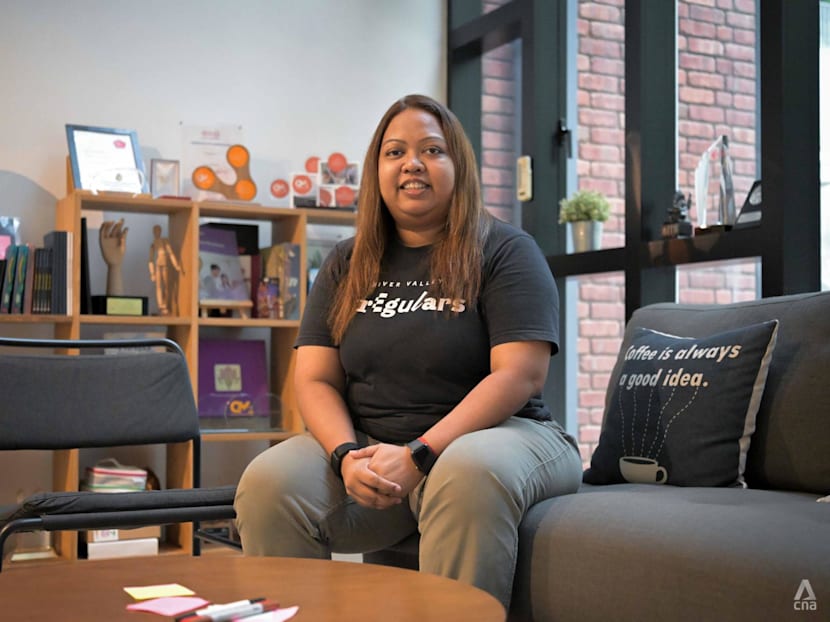
Co-founder of River Valley Irregulars Sheila Manokaran on Apr 24, 2026. (Photo: CNA/Lim Li Ting)

This audio is generated by an AI tool.


This article is written in partnership with the President's Challenge.
Ms Sheila Manokaran used to dream big, with hopes of becoming a doctor or a pilot, and possibly building a life overseas.
Despite her best efforts, however, she never realised her dreams and now she's all but given up on having lofty goals.
"Is it resentment? I don't think it is. I think it's fate," said the 31-year-old stoically.
One would expect that someone in her shoes, who endured a tough childhood and multiple setbacks, would be bitter with everyone and everything that held her back.
But instead of blaming the hand dealt to her, the co-founder of River Valley Irregulars has been constantly shrugging off every disappointment, instead choosing to channel her energy into helping others move forward.
River Valley Irregulars is an outfit that helps connect young people to organisations through an online platform and workshops to help them achieve their career goals.





The avid volunteer is a member of the Singapore Armed Forces (SAF) Volunteer Corps as a bridge watchkeeper in the Navy and supports the ITE alumni association, among other organisations.
And now at River Valley Irregulars, she helps youths build up their portfolios, gain the right mentorship and guidance to bag quality internship opportunities that some might not have easy access to.
Her efforts have not gone unnoticed, having been featured in news articles for her volunteerism and the accolades she has been given over the last decade.
She was also mentioned in a speech by Prime Minister Lawrence Wong celebrating the 10th anniversary of Youth Corps Singapore in 2024.
In it, PM Wong said: "I do not know how you find the time Sheila, to do everything."
And I, too, could not comprehend how.
More recently, Ms Manokaran was one of two guests on a new video series called "Kopi-C with President T".
The series features President Tharman Shanmugaratnam and Ms Jane Ittogi having informal, sit-down conversations with individuals who have bounced back from difficulty or who show how aspirations can be raised, as part of the President's Challenge.
The President's Challenge was refreshed in 2025 to focus on uplifting aspirations and achieving sustained social impact.
This year's President Challenge will support 62 new programmes across 60 organisations, which cover a variety of causes such as early intervention, second chances and support for persons with disabilities.
Ms Manokaran described her hour-long chat with Mr and Mrs Tharman, where they answered a range of questions from their favourite book to their biggest fears, as being extremely "raw".
"One of the hardest questions we had to answer was: 'What's the biggest challenge (I've faced)' … I was like: 'Wait, am I gonna tear in front of Mr and Mrs Tharman?'," she said.
PAYING OTHERS TO BE HER FRIEND
Over a two-hour conversation in early April at her office along River Valley Road, Ms Manokaran laid bare her life to me like a boulevard of broken dreams.
As a child, her mother would often punish her for being unable to complete her schoolwork correctly.
"I was a very way behind kind of kid. So I got a lot of beatings … to the extent that my grandma called the police on my mum for doing it," recalled Ms Manokaran against the background noise of rain beating down on the window panes behind us.
When the authorities asked the young Ms Manokaran if her mother beat her, she denied the abuse because "as a young child, you will just protect the ones that you love".
Upon starting primary school, she found it difficult to focus on her studies given the turmoil at home.


Her studies took another hit in Primary 3, when her family moved to Sengkang from Yishun and she had to transfer schools.
Being a mixed-race child – her father is Indian while her mother is of mixed Filipino heritage – in the 1990s, she stood out.
It didn't help that she studied Mandarin, instead of her father's mother tongue Tamil.
"I was the only Indian, non-Chinese, so I definitely raised a lot of eyebrows," she recalled.
She was also somehow placed in a class meant for top students when she transferred, leaving her struggling to keep up.
As her studies began to tank, her classmates ostracised her.
"I brought my piggy bank from home, (taking) all the five-cent coins … to buy friends," she said.
The coins were her earnings from selling food at her neighbourhood playground – an early attempt at independence that her father put a stop to when he learnt of it, saying it disconcerted him.
She was eventually put in the EM3 stream in primary school and while the stream was meant to help students who struggled academically, it came with public stigma.
"At school, with all these people who see you as not good enough … and then you go back to your home, where your parents already feel like you're a failure and disappointment," she said. "Relatives would make comments like: 'Don't mix around with her or you (will) become stupid'."
"Today, I do a lot of self-reflections and (wonder) how … did a kid like me go through all that? It really impacted me at a tender age."
A DIFFERENT PATHWAY
After her Primary School Leaving Examination, Ms Manokaran was placed in the Normal (Technical) stream, which focused on a more vocational pathway.
She worked hard, hoping to transfer out of her stream to the Normal (Academic) stream, so that she could eventually pursue a course in a polytechnic, only to realise that that would mean an extra year in secondary school before she could do so.

"I was like, what the hell, you do well to be punished to stay (in school) for another year," she said of the system then where Normal (Technical) students took their N-Level examinations in Secondary 4 and if they did well, would then move to the Normal (Academic) course for a year and complete the O-Level examinations.
Today, all students entering secondary school go through full subject-based banding, where they can take subjects at different levels and have classmates from different streams in the same form class, among other things.
She decided against that extra year but continued to study hard so she could earn bursary money and study awards to help her parents with household expenses – a key driver of tensions and conflict within the family.
She hoped that by easing their financial burden, the tension at home would be less fraught but her parents' arguments continued, often fuelled by alcohol.
"As much as life was kind of like hell … every season there were teachers who guided me through my life," Ms Manokaran said, recalling her form teacher who advised her to keep some of her bursary funds for herself for a rainy day.
What made her realise her potential was being made captain of her school's basketball team and having her first taste of leadership.
The trust placed in her gave her the confidence boost she needed to move forward – even though she encountered racist comments for doing so.
"I remember the coach said: 'You're so fat, your eyes so big, still cannot see the ball', and how some teammates questioned why an Indian became captain instead of a Chinese," she said, quoting their words in Mandarin.
"A child should not go through (such racism)."
Despite those cutting comments, she soldiered on and by the time she sat her N-level examinations, she ranked among the top five students in her school.
She went on to study chemical process technology at the Institute of Technical Education (ITE), and while this was not her first course of choice – her father insisted it was the best course to earn money – she still recalled her time there with pride.
In primary and secondary school, she was told repeatedly that students who performed poorly academically could not participate in certain activities.
For instance, a teacher told her she could not join her secondary school's student council as she was in the Normal (Technical) stream.
But in ITE, the possibilities for leadership roles were endless.
With this newfound freedom to pursue whatever activities she wanted, she joined ITE's student ambassador club and eventually became its president. Through this, she joined the National Youth Council, and participated in various leadership and youth events, meeting people from different backgrounds.
I learnt my strengths and weaknesses, and how to be a leader … I also finally had the ability to make a choice in my life (and not be confined) to a path set for me.
DREAMS THAT DIDN'T TAKE OFF
Just as she thought her life was headed in the right direction, she had to deal with the disappointment of missing the cut-off to get into a polytechnic course when she came up 0.02 points shy of the grade.
"I was the first president (of the student ambassadors club) in history to not make it to poly," she said. "I was so upset … like, why can't I just get (in)?"
"You know, all these expectations of you going to poly … and then not going … you just feel ashamed, like a failure."
However, with the support of the Singapore Indian Development Association (Sinda), she enrolled in a private diploma course. But an ITE teacher she was close to also encouraged her to study for her Higher Nitec at ITE concurrently.
Working part-time jobs for money while studying both courses was "hellish", she recalled. She eventually dropped the private diploma, completed her Higher Nitec and was accepted into Republic Polytechnic's diploma in aviation management.
There she developed a new dream – to learn to fly.
While she continued volunteering with various organisations such as Youth Corps Singapore and SAF Volunteer Corps, she saved up for a graduation trip to Perth, Australia.
Having learnt to fly a plane using a simulator during her polytechnic days, she stunned the principal of a pilot school in Australia when she could navigate a plane.


"She was like, come to the office, let's discuss if you can get into the school … and I realised I don't have this kind of money (to pay for the school fees). I'm not rich, I'm not lucky," she said, adding she would have had to fork out more than S$120,000.
She left the pilot school bawling.
"I remember driving on the road and telling my friends that I now know what it feels like to be poor without a dream … when you're poor, you don't get to dream. You just have to work and find a way," she said.
She also scrapped her dreams of studying overseas despite getting a partial scholarship to study at the University of Asia Pacific in Japan and a full ride to the University of Warwick, as she needed to help her family financially. At that time, her family was struggling and relied on donated meals to get by.
So instead, she went to a private university to study international business with financial support from the Lee Foundation. This allowed her to graduate a year earlier and secure a full-time job with a better salary than if she had only a diploma certificate.
Things started looking up in her last year of university in 2019, when she got the chance to go on an exchange programme in New York. While there, she interviewed with a health company that wanted to expand to Southeast Asia and received a verbal job offer, giving her a chance to fulfil her dream of living overseas.
But almost like a broken record, that high was met once again with crushing disappointment.
"I called my mother, wondering if I should take the job. She said it was my choice, but that my father was in the high dependency ward … (my family) had hid my father's health condition from me," she said.
His kidneys were failing and he needed surgery to remove them.
She gave up on that short-lived dream too and headed back to Singapore.
"Everything, every stage, I keep blaming it on the family. Because I wanted to do all this, but I was always pulled back because of you guys," she told me earnestly.
"Till today, I think about it, but I just move on."
KEEPING THE PEACE WITHIN
Back in Singapore, Ms Manokaran managed to find a job quickly. During her days at Youth Corps Singapore, she had met Mr Lee Han Shih, the founder of the Potato Productions group.
The group comprises several companies, including publisher Difference Engine and data publication Kontinentalist.
She considers him a mentor and important figure in her life, having guided and encouraged her to explore different paths.


"He asked a colleague to reach out to me, because he worried that if he asked me directly, he might hold me back (from my other ambitions)," she said with a laugh.
It was through her experience working for the group as its special projects coordinator, and later as its head of outreach and projects, that she decided to start River Valley Irregulars in February 2022.
Through events and workshops, she hopes to help youths gain the right mentorship and guidance to get internship opportunities, and for organisations to support interns the right way.
It's still a work in progress, she told me and this was made clear by the long list of events and ideas scribbled across a whiteboard wall in her office, which I visited two Fridays ago.
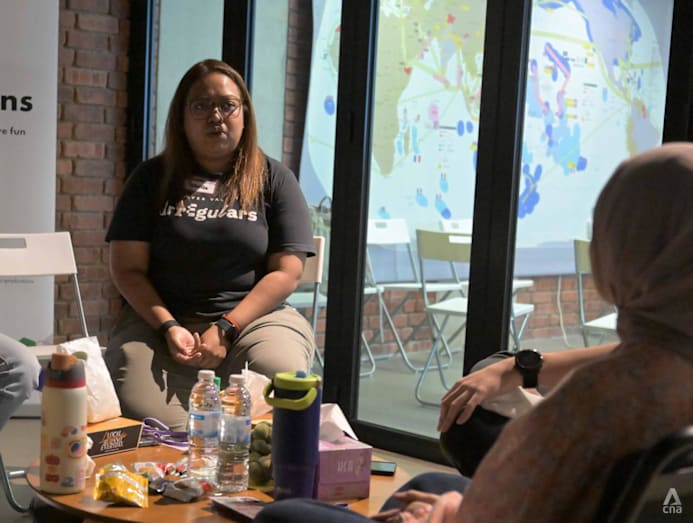
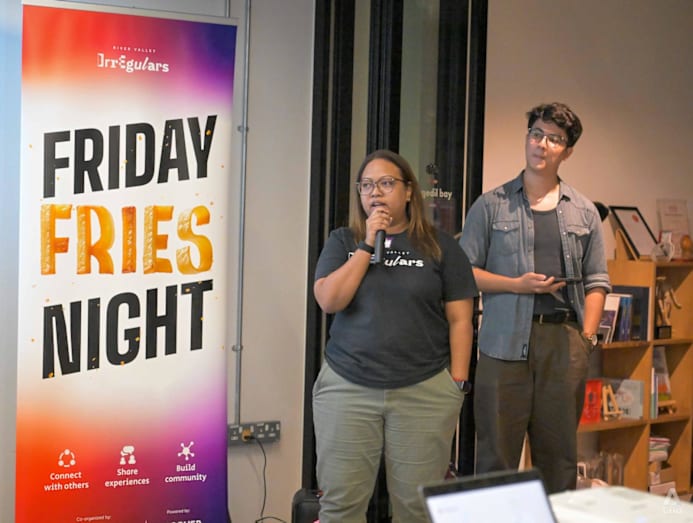
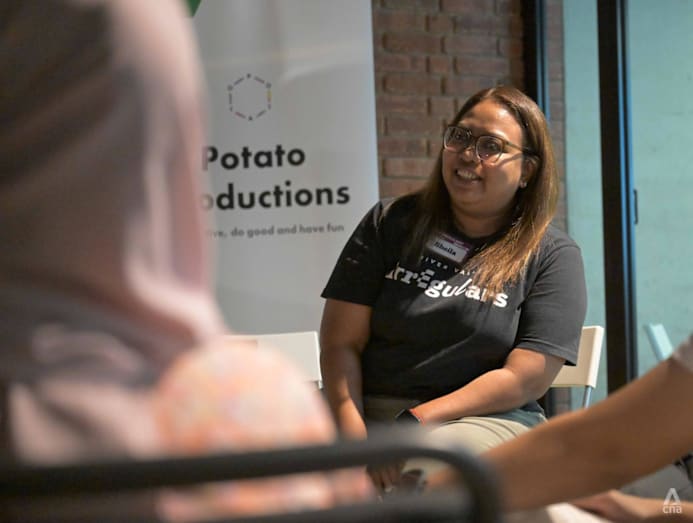
Her commitment to helping youths navigate their lives successfully was evident to me when I saw her in action at River Valley Irregulars' monthly Friday Fries night, where youths mingle with professionals in unique careers while munching on fries.
She knew most of the youths by name and made an effort to welcome any newcomers. It was apparent that her efforts worked, as there was not a single moment when the mood felt awkward.
At 10pm, after the three-hour-long event, she moved quickly around the office, peeling bluetack off the walls, pushing tables back into place and emptying a handful of pens from her pockets.
While her colleagues entertained some of the event's stragglers, she sorted out leftover food into packets for some of the youths to take home.
Looking at the leftovers, she muttered loudly: "No-shows."
Tomorrow, she told me, she would have to look into getting people to show up if they said they would, or find out the reasons for no-shows.
That was just one of many things she had planned for the next day, besides supporting a talk about mental health by a youth at River Valley Irregulars and other volunteering activities.
Given that her life in recent years has been less tumultuous and she is on the way to achieving what she set out to do career-wise, I asked Ms Manokaran if she had started to dream big again.
She replied that right now her mindset is not to let fears stop her from pursuing what she wants to do but these are activities she doesn't necessarily consider as "dreams".
This includes going skydiving two years ago and taking a spontaneous road trip to the Malaysia-Thailand border last year with her cousin.
She paused to give my question a little more thought, before replying that if she had to list her dream today it would be a simple one: To live a peaceful life where her family has nothing to worry about and to "get up the next day, go to work and be healthy".
At this moment, it seems Ms Manokaran might finally be living out her dream.
To watch the full episode of Kopi-C with President T, click here.