Should you let AI manage your money? Here's why I'm not convinced
Are you feeding your financial data to AI, hoping it'll come up with groundbreaking insights? Financial blogger Dawn Cher says that while you can use AI to support your thinking, it should never replace your judgment.
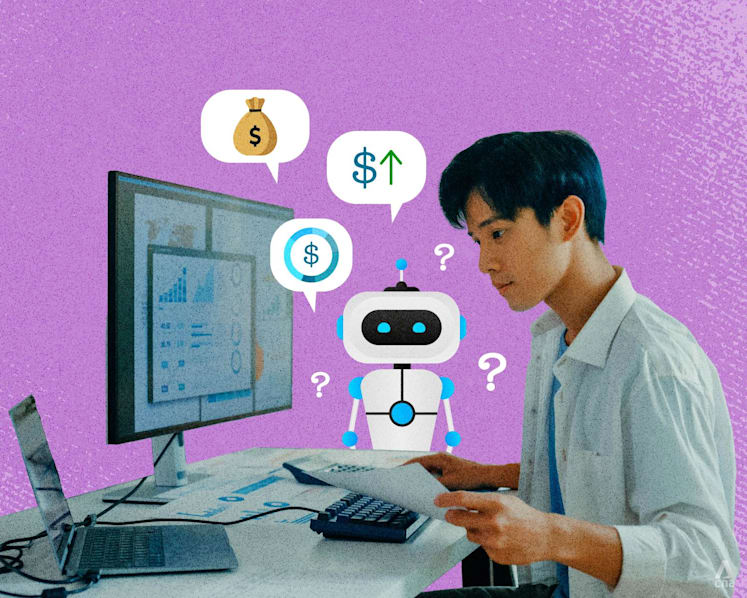
Artificial intelligence bots may sound authoritative and persuasive in offering financial advice, but plenty can go wrong. (Illustration: CNA/Nurjannah Suhaimi)

This audio is generated by an AI tool.


Recently, a colleague asked me if I've ever used artificial intelligence (AI) to manage my money, as she shared how her husband had started using ChatGPT to analyse and advise him on his spending.
He fed ChatGPT his expense data and asked it to analyse his personal spending patterns and tell him what to cut if he wanted to boost his savings by 20 per cent.
The answer? The AI chatbot told him to cut down on taking private-hire Grab rides and to eat out less often.
I laughed and said: "Isn't that what you, as his wife, could have already told him … without him even having to spend so much time inputting his expense data in the first place?"





The joke was harmless. But the question behind it wasn't.
What, exactly, are we outsourcing to AI when it comes to our money? And should we be telling AI everything about our financial lives?
ARE AI-GENERATED INSIGHTS ACTUALLY HELPFUL?
To be clear, I'm not dismissing AI.
These tools are impressive. They can sort data quickly, identify patterns and present information in ways that are easy to understand.
But when it comes to tracking expenses, I couldn't help but wonder whether AI is solving a problem that had already been addressed a few years ago.


Thanks to the development of digital banking and Singapore Financial Data Exchange (SGFinDex) – a platform that lets you see your financial information from different institutions in one place – most banking apps in Singapore can already categorise our spending automatically.
If you spend mostly with debit or your bank's credit card, your bank's app can show you what items you've spent on, classify your expenses into neat segments, and even show month-on-month comparisons to help you understand your spending patterns.
And when it comes to advice on how to save more, often the AI offers "insights" we already know: Cut back on ride-hailing. Reduce dining out. Watch your discretionary spending.
Most of us already know where our money goes and what we ought to do better. The harder part is adjusting habits when we're tired after work, when convenience feels justified, or when small indulgences feel earned.
Managing money isn't just about knowing the right thing to do.
Whether you use AI or your banking app, the advice means little if you don't do anything about it.
AI CAN'T MEASURE YOUR RISK TOLERANCE
The stakes rise significantly when AI moves from advising you on your budget to advising you on your investments.
Recently, CNA reported on the growing trend of investors turning to ChatGPT for stock market ideas. As one expert noted, just as not every analyst gets it right, neither does Gen AI. But because AI speaks with fluency and confidence, its clarity is often mistaken for competence.

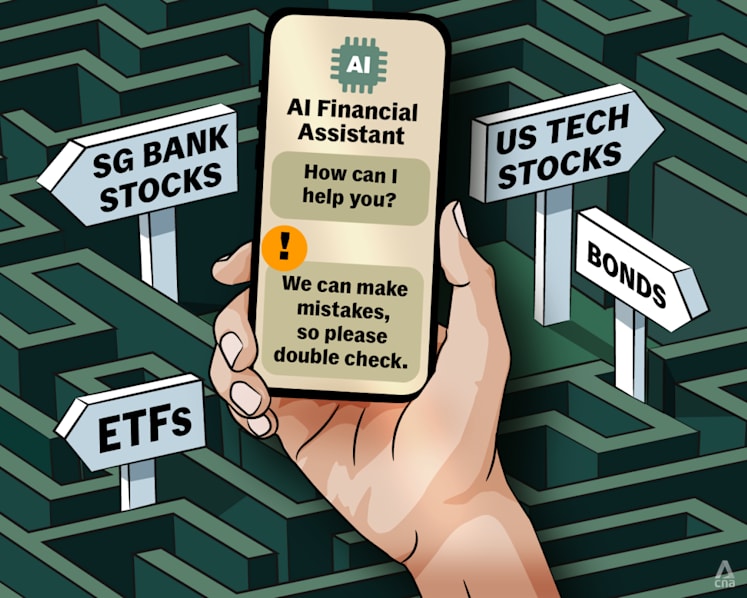
Recently, I was having lunch with a friend when she shared with me a list of stocks that she had asked ChatGPT for. She had prompted it to suggest companies that were "fundamentally sound" and likely to rise over the next few months.
As I scrolled through the names, a few red flags jumped out at me, such as weak cash flow, pricey valuations and tough industry conditions. Curious, she decided to allocate a small amount into what she jokingly called her "ChatGPT portfolio" as an experiment.
Months later, most of those stocks were down. One had fallen close to 80 per cent since the point at which she entered the market.
Meanwhile, the other stocks we had discussed during that same meeting (which were not from ChatGPT) did not experience anything close to that kind of collapse.
Yes, AI is excellent at generating lists. It can analyse market trends, summarise earnings reports and spot promising themes.
But investing is not just pattern recognition. Markets move in cycles. Cheap stocks can get cheaper. Smaller companies can be hard to exit when liquidity dries up. Management teams can say the right things while acting in their own interests.
And no algorithm, however smart, knows how you will react when a stock drops 20 per cent in a week.
Most importantly, it does not understand your risk tolerance.
No algorithm, however smart, knows how you will react when a stock drops 20 per cent in a week. Most importantly, it does not understand your risk tolerance.
It does not know how you will sleep at night if your portfolio halves in value. It does not sit with the consequences. It simply generates an answer and moves on.
So when things go south, who do you blame? And more importantly, what do you learn?
If you hand over your investment decisions entirely to AI, you may save time. But you are not building judgment. And without judgment, it is hard to become a better investor.
THE PRIVACY TRADE-OFF
Then, there is the privacy question.
To get tailored advice, people are feeding these tools everything from bank statements and income tax filings to spending patterns, investment holdings, and even their net worth.
Most of us hesitate to share all our numbers with a human financial adviser. Some of us won't even tell our spouse about every account we hold.
So, why are many of us so comfortable with handing over our data to a machine?
Ms Jennifer King, a data policy fellow at the Stanford Institute for Human-Centered AI, has cautioned that sensitive information shared with large language models may be collected and used for training purposes, even if it feels like a private conversation.
We are often reassured that safeguards exist. Yet, do we really understand how long our data is stored, how it may be used in future product development, or how it could influence the ads and content we see later on?
Now that OpenAI has announced plans to incorporate ads, it is not unreasonable to ask how financial information shared today might influence what is shown to us tomorrow.
At the same time, legal frameworks for AI data privacy are still catching up.
Regulations such as the European Union’s General Data Protection Regulation (GDPR), along with emerging AI-specific rules, attempt to address these concerns. But there is no single global standard governing how sensitive, personalised data shared with AI tools is collected, stored or used.
Financial data is among the most sensitive forms of personal information. And once it is shared digitally, it is impossible to take it back.
That alone is reason enough to pause and be extra cautious.
USE AI, BUT KEEP YOUR JUDGMENT
None of this means AI has no place in personal finance.
In the last year alone, I've increasingly used AI to support my research and analysis. It can be helpful for understanding otherwise complex financial concepts, summarising annual reports or organising my thoughts before making a decision.
But information has never been the only barrier to financial success. If so, the people with the highest IQs would be the richest.
As legendary investor Warren Buffett says: "Investing is not a game where the guy with the 160 IQ beats the guy with the 130 IQ."
Discipline matters. Risk control matters. Your self-awareness matters.
AI can support our thinking, but we cannot afford to let it replace our judgment.
As more people experiment with AI in their financial lives, the question may not be whether we should use these tools, but whether we understand their limits and how to use them in ways that serve us rather than harm us.
After all, building wealth has never been just about processing information.
It is about the combination of decisions we make over a long period of time – where our judgment is shaped by experience, mistakes and reflection.
And that is something that we might want to think twice about before we count on AI.
Dawn Cher, also known as SG Budget Babe, is the bestselling author of Take Back Control of Your Money. She has been running a popular blog on personal finance for the last 12 years.
If you have an experience to share or know someone who wishes to contribute to this series, write to voices [at] mediacorp.com.sg (voices[at]mediacorp[dot]com[dot]sg) with your full name, address and phone number.