My BTO flat and baby arrived at the same time. Here's what it taught me about planning for financial shocks
For Mr Yuvaraj Uthaman, careful planning went out the window when life decided to go off-script. He reflects on what he has learnt about surviving financial strain, growing up fast and expecting the unexpected.

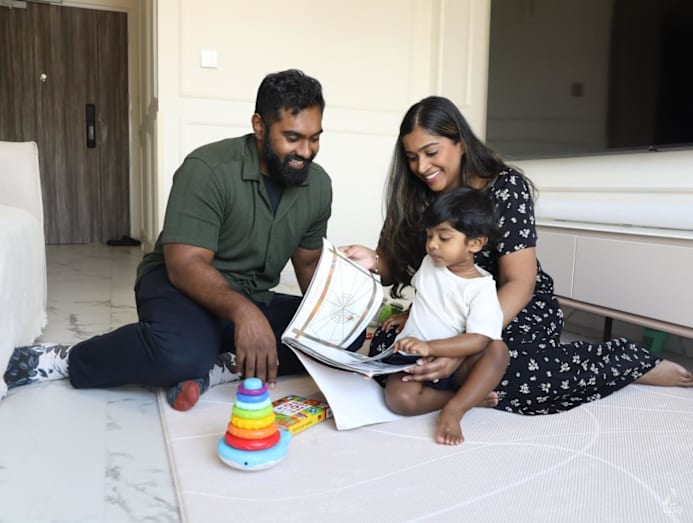
Mr Yuvaraj Uthaman at his home in Ang Mo Kio with his wife, Ms Asvini Durka, and their son, on Jan 29, 2026. (Photo: CNA/Mak Jia Kee)

This audio is generated by an AI tool.
I used to think that life could be neatly mapped out on a spreadsheet, with things unfolding in a clear sequence: We would get our BTO (Build-to-order) flat, move in and live there for at least a year to settle down properly.
It was a logical, linear plan that felt safe, as we wanted to find our rhythm as a couple in our own space before even considering the next step. Based on the stories I heard from friends and colleagues, it also seemed like the standard sequence of events for the average Singaporean – get a home, get wed and have kids.
And yet, life has a way of ignoring even the most carefully thought-out plans.
In 2024, the arrival of the keys to our new flat coincided with a much louder, more demanding one: my son. And what happened next was utter chaos.





There was no easy transition or "honeymoon phase" of homeownership, no time to choose the right curtains or invite friends over for housewarmings.
Instead, the echo of our empty, freshly painted flat was quickly replaced by the cries of my newborn.
But if there is one thing I have learnt over the last two years, it is that reality does not care about your ideal timeline.
When life decides to accelerate, your only choice is to move with it, learning as you go, even when you're still trying to find your footing.
WHEN REALITY OVERLAPS
The fundamental problem with planning life's milestones is that they operate on ranges rather than fixed dates.
When you apply for a BTO flat, you are given a ballpark estimate of when the keys might be ready. Then, you factor in the renovation period, which is notorious for delays and unexpected hiccups.

Similarly, conceiving a child is not something you can schedule for a Tuesday afternoon to perfectly align with your furniture delivery.
Because both of these timelines were so uncertain, despite what we thought was careful planning, the house and the baby ended up happening almost simultaneously. We were still figuring out how to set up the kitchen while also learning how to change nappies in the middle of the night.
Suddenly, I was not just managing a physical move but a life-changing collision of two different worlds that were never supposed to meet – or at least, not so soon.
We viewed it as a blessing, but I will not sugarcoat the experience. It was an incredibly intense shock to the system that forced us to grow up much faster than we had originally intended.
THE GAP BETWEEN HAVING A PLAN AND REAL PLANNING
In my social circles, my wife and I were among the first to navigate a move into a BTO flat and a newborn at the same time. This meant that we couldn't lean much on local guidance.
I quickly realised there is a massive difference between knowing what you want and truly planning for it.
The surface-level costs are easy to see coming. Anyone can look up the price of a down payment or the estimated cost of a hospital bill.
It is the hidden "death by a thousand cuts" that catches you off guard.
For me, the true expenses only became obvious when I was already in the thick of the situation.
I'm talking about the things you never had to think about when you were living with parents, like recurring monthly conservancy charges.
I'm talking about the surcharges you didn't account for, like when you need more packing boxes than the initial quote suggested to the movers.
Then there are the tiny household items you realise you are missing at 11pm, or the brand-new appliances that simply do not work the way the salesperson promised.
No amount of surface-level planning could have predicted the sheer volume of these small, never-ending costs that were rapidly mounting up.
THE FINANCIAL PIVOT
When costs started stacking up, my first instinct was to go on the defensive.
I realised very quickly that if I could not control the timing of my life events, I had to control my cash flow. There was no room left for "going with the flow".
My wife and I had to make a conscious – and sometimes difficult – choice to cut back on all discretionary spending.
The lifestyle we used to take for granted was the first to go. No more buying new clothes for the weekend, upgrading shoes or frequent travel.
We gave up long-haul dream vacations in favour of modest short-haul trips within the region. We had to reprioritise the essentials over the nice-to-haves.
The biggest game-changer was our decision to stop eating out and start cooking at home. It sounds simple, but it's much easier said than done in a food paradise like Singapore. However, it gave us significantly better value for every dollar spent.


Beyond the money, it was about regaining a sense of control. In a time when my house and family life were changing at a rapid pace, knowing exactly what we were spending on our groceries felt like a small but vital victory.
Cutting expenses worked because it had an immediate impact on our bank balance, but the long-term benefit was the shift in my mindset.
The process forced me to become hyper-aware of where every single dollar was actually going.
I had to separate what was truly necessary for our survival and happiness from what had simply become a habitual spending pattern.
I realised that a lot of my previous spending was not even bringing me joy – it was just something I was used to.
Even now, as finances have become more comfortable, I plan to maintain these habits. I do not see them as restrictions anymore.
Instead, I see them as a way to ensure that more of our savings are channelled directly toward my son's future and his education.
HOW DO WE EXPECT THE UNEXPECTED?
If you are standing where I was a year ago, here are some hard-earned lessons I have learnt from the front lines of colliding timelines.
First, always expect that you can't expect everything. There will always be hidden costs and surprise expenses.
Now, if a renovation quote says S$50,000, I make sure I have S$60,000 ready before I commit. That 20 per cent buffer is your safety net.
Next, always plan in black and white.
Do not keep your finances in your head or try to do mental math. Write everything down clearly.
Seeing the numbers on a screen or paper helps you spot blind spots before they turn into financial crises.
You also need to be radically honest – not just with yourself, but with those most closely affected, such as your partner.
Talk openly with your spouse about your timing and readiness. You need to be in total sync because when the collisions happen, you are each other's only support system.
Finally, look for cost-saving steps you can personally take. Whether it is moving smaller boxes yourself or handling minor household fixes, those small wins add up to big savings over time.
Even in a country famed for planning, we cannot always rely on our plans to hold us up. Some things happen in their own time, not when we want them to.
It's important to have a well-written script, but life may not always follow it. What matters most is always being ready to take the stage.
Yuvaraj Uthaman is a marketing manager at an international business school and a father of one.