







Asia Pacific can ‘no longer be classified as fully at peace’ amid growing security threats: IISS report
The security environment has become more volatile, with conflicts increasing not only in number but also in intensity, the report's editor told CNA ahead of this weekend's Shangri-La Dialogue.
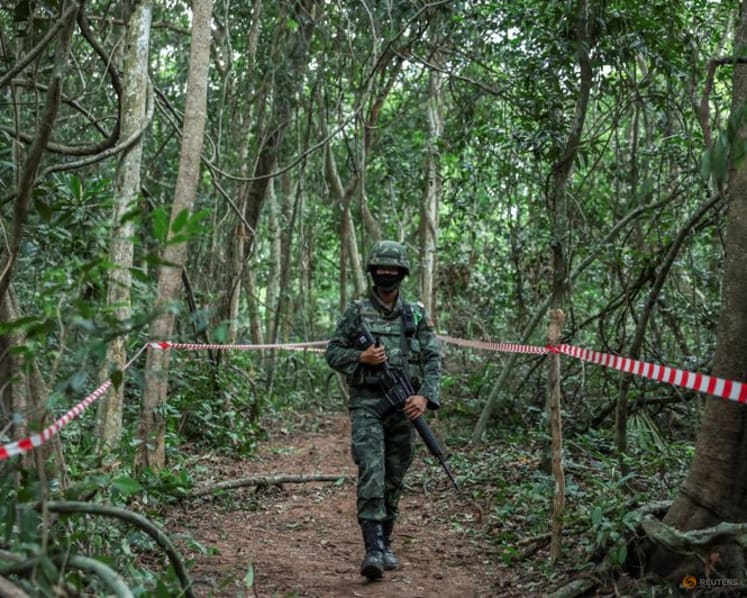
A Thai military personnel walks near the Thai-Cambodian border at Chong Chub Ta Mok area, in Surin Province, Thailand, on Aug 20, 2025. (File Photo: Reuters/Chalinee Thirasupa)

This audio is generated by an AI tool.


SINGAPORE: The Asia Pacific can “no longer be classified as fully at peace”, said a report by the International Institute for Strategic Studies (IISS) on Thursday (May 28).
Growing security threats have dramatically raised the strategic stakes, the dossier warned, adding that policymakers can “no longer pass on the responsibility to respond”.
The Asia-Pacific Regional Security Assessment analyses the underlying factors, emerging trends, and future direction of the security challenges and policies currently shaping the region.
Evan Laksmana, senior fellow at the IISS and editor of the report, said the security environment has become more volatile, with conflicts increasing not only in number but also in intensity.





While the Asia Pacific has long experienced tensions and security flashpoints, the past year alone has seen a troubling escalation – from border clashes between Thailand and Cambodia to a brief armed conflict between India and Pakistan, he told CNA on Wednesday.
REGION GROWING MORE VOLATILE
The publication was released ahead of the Shangri-La Dialogue, held annually by the IISS.
The forum, which runs from Friday to Sunday, is widely regarded as Asia’s leading defence summit and brings together government officials, business leaders, and security experts to discuss pressing regional security issues.
Asia Pacific is confronting a “challenging and combustible mix” of long-standing internal security problems, unresolved flashpoints and a declining sense of restraint, Laksmana said.
"That lack of restraint is now fraying, and in fact states are no longer seeing conventional war as something that's far-fetched."
The IISS report examined issues including how military doctrines shape the way armed forces prepare for warfare, the modernisation of Asian militaries, nuclear competition, the rise of quantum technology, key Indian Ocean chokepoints, and the challenges Thailand faces in responding to Myanmar’s post-coup conflict.
Military doctrines still framed by historical rifts are creating new security challenges, said the report.
These influence how countries prepare for war and can ultimately heighten tensions, cautioned Laksmana, who leads the IISS' Southeast Asian security and defence research programme.
"A military doctrine can almost become a self-fulfilling prophecy, because the idea is that you train how you want to fight, and part of how you train is developing scenarios and exercises as real as you can," he added.
Laksmana pointed to increasingly sophisticated military exercises conducted by the United States and its allies, as well as by China around the Taiwan Strait, saying the scale and realism of such drills could raise risks if miscalculations or misinterpretations occur.
While these doctrines cannot predict when war will break out, they can give a sense of how states choose to deter threats.
"So the doctrinal documents, force development exercises – these are all important signs of how serious we should be anticipating a future conflict, how that future conflict might be fought, and to what extent we can find ways to mitigate those risks," he added.
Laksmana also noted that geography remains a key driver of military planning and strategic competition, pointing to unresolved maritime and land disputes – including those in the South China Sea and along the Thai-Cambodian border – as continuing potential flashpoints.
"That creates the kind of opportunities and challenges for the military to maintain the security of the country, how they intend to develop their forces, what capabilities to buy, what exercises they have to do," he said.
"These are all tied to how they view the forces of geography in shaping their military thinking."
RISING SECURITY CHALLENGES
The report also warned of a growing nuclear arms race, fuelled by weakening arms control frameworks and expanding arsenals.
Laksmana said global arms control and non-proliferation regimes had been “slowly decaying” in recent years, even as nuclear-armed states continue to modernise and expand their capabilities.
These developments could undermine nuclear deterrence, he added.
"This is where I think you start to see countries responding to each other's force modernisation and nuclear development. Hence, the beginning of an arms race."
The report also identified emerging technologies such as artificial intelligence as another risk fuelling the flames of war, with its battlefield applications already evident in conflicts such as those in Ukraine and the Middle East.
Observers have said it remains unclear how far militaries are prepared to integrate AI into operational decision-making, including whether systems could eventually move beyond assisting with target identification to making autonomous strike decisions.
"The extent of the use is somewhat still up for debate ... have they reached the point where AI is part of the command and control system?" said Laksmana.
"In other words, have we reached the point where man is no longer in the loop when it comes to pulling the trigger?"




