Court ruling against Trump's use of tariffs offers little respite for global economy, analysts say
A long list of uncertainties remains - including what new tariffs Trump will seek to impose, the possibility of refunds and whether countries that entered bilateral deals with the US will see those pacts reopened for review.
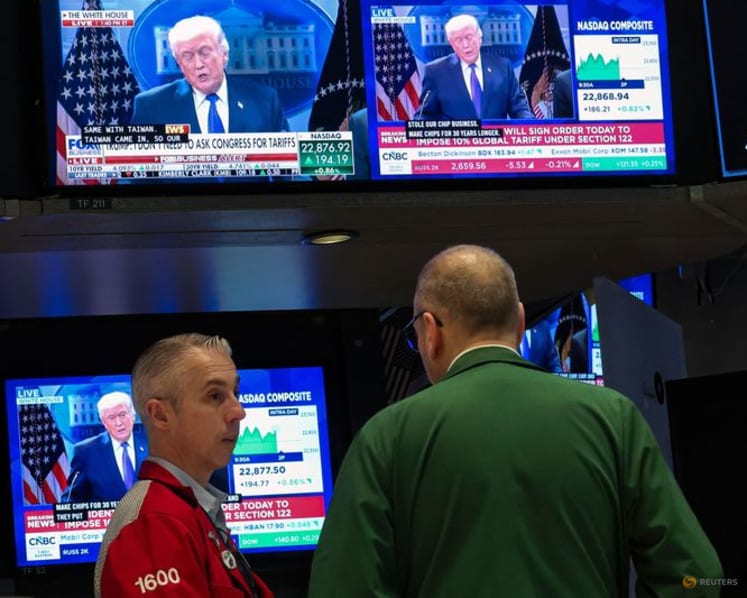
Traders work on the floor as screens display US President Donald Trump during a press briefing at the White House following the Supreme Court's ruling on tariffs, at the New York Stock Exchange on Feb 20, 2026. (Photo: Reuters/Brendan McDermid)
LONDON: While the US Supreme Court's ruling on Friday (Feb 20) against President Donald Trump's use of tariffs marks a clear setback for his use of trade levies as an economic weapon, analysts say it offers little immediate relief for the global economy.
Instead, they expect another bout of activity-crimping confusion combined with near-certainty that Trump will seek other means to replace the raft of global tariffs now struck down as unlawful.
In the meantime, a long list of uncertainties remains - including what new tariffs Trump will seek to impose, whether the funds from the annulled levies will have to be refunded, and whether territories that entered deals with the US to mitigate their impact will see those pacts reopened for review.
Responding to the ruling, Trump announced new global tariffs of 10 per cent for an initial 150-day period and acknowledged it was not clear if or when there would be any refunds.





"In general, I think it will just bring in a new period of high uncertainty in world trade, as everybody tries to figure out what the US tariff policy will be going forward," said Varg Folkman, analyst at the European Policy Centre think-tank.
"In the end it's going to look pretty much the same."
Economists at ING bank agreed. "The scaffolding has come down, but the building remains under construction. No matter how today's ruling reads, tariffs are here to stay."
Friday's ruling concerns only the tariffs launched by Trump on the basis of the International Emergency Economic Powers Act, or IEEPA, intended for national emergencies. So far, they are estimated to have brought in over US$175 billion in funds.
By itself, the ruling chops the trade-weighted average US tariff almost in half from 15.4 per cent to 8.3 per cent, trade policy monitor Global Trade Alert estimated.
For those countries on higher US tariff levels, the change is more dramatic. For China, Brazil and India, it will mean double-digit percentage point cuts, albeit to still-high levels.
BILATERAL DEALS WITH US COULD NOW "UNRAVEL"
Yet no one expects this to remain the status quo. The Trump administration has served notice long before the ruling that it can and will use other legal vehicles to reimpose tariffs.
At the same time, the couple of dozen countries which entered bilateral deals with the US to set tariffs and in some cases invest in the US will now assess whether the Supreme Court ruling gives them leverage to renegotiate.
The lawmakers who must ratify the European Union's pact with the US will do that as soon as Monday, said Bernd Lange, chair of the trade committee of the European Parliament.
"The era of unlimited, arbitrary tariffs ... might now be coming to an end," Lange said on X. "We must now carefully evaluate the ruling and its consequences."
Britain meanwhile expects its privileged trading position with the US to continue, the government said on Friday of the baseline 10 per cent tariff it agreed with Washington.
Indeed, many countries were learning to live with Trump's tariffs, the bulk of which were being shouldered by Americans, according to a Federal Reserve Bank of New York report released this month.
In the most recent update of its regular World Economic Outlook, the International Monetary Fund forecast global growth at a "resilient" 3.3 per cent in 2026.
China even reported a record trade surplus of nearly US$1.2 trillion in 2025, led by booming exports to non-US markets as its producers adapted to the Trump onslaught.
Thus, some countries may choose to stick with their existing bilateral deals with the US rather than "inviting the kind of uncertainty we saw in the spring in 2025", EPC's Folkman said of the chaos caused by Trump's so-called "reciprocal" tariffs.
Conversely, Niclas Poitiers, research fellow at the economic think-tank Bruegel, noted there were a lot of political question marks over the EU-US trade deal, in which Europe was seen to have backed down and got the short end of the stick.
"There could be circumstances in which the deal unravels," he noted.
TARIFF RULING CLOUDS FED'S RATE PATH
The Supreme Court's ruling also poses new questions for Federal Reserve policymakers who have spent the last year trying to understand how Trump's sharply higher import taxes would affect inflation and the economic trajectory.
Many of them only recently gained confidence that last year's tariff-driven price increases would soon wane.
Now, they are forced to wonder whether the process might be thrown into reverse, or put on hold while the Trump administration looks for workarounds to reimpose the same taxes under other authority.
All the while, the Fed is left guessing about the outcome, facing a more complicated decision on when or if to resume cutting interest rates.
"Is there a requirement to pay back the firms that have paid in? ... If so, that's a lot of disruption," Atlanta Fed president Raphael Bostic said at an appearance in Birmingham, Alabama.
"Does this cause businesses to revert back to old business models about where they are getting their supplies? ... Will there be another vehicle to put all those tariffs in at the same level or are there constraints?"
The fresh uncertainty around the Fed's outlook was evident in interest rate futures markets, where traders wager on the direction of borrowing costs.
Those markets seesawed on Friday between bets that the Fed would start cutting rates again in June or would wait until July, reflecting the complications the court ruling has introduced.
Treasury Secretary Scott Bessent said the legal fight over refunds of the invalidated taxes could take "weeks, months, years" to be resolved.
Meanwhile, the Trump administration will impose alternative import levies under what Bessent called "well-tested" authorities to fill the tariff gap left by the court's 6-3 ruling.
"No one should expect that the tariff revenues will go down," Bessent told the Economic Club of Dallas.
If the Trump administration's new tariffs are essentially one-for-one replacements of the old tariffs imposed under emergency powers known as the International Emergency Economic Powers Act (IEEPA), St Louis Fed president Alberto Musalem told Fox Business Network that his own economic forecast would not change much.
Still, he said, he plans to talk directly with CEOs to find out how they plan to manage the switch.
"It is possible that as companies begin to think of how they're going to transition from paying IEEPA tariffs to paying a different kind of tariffs, that could introduce a period of uncertainty there for companies," Musalem told Fox Business Network's Edward Lawrence.
For Dallas Fed president Lorie Logan, the ruling also means a fresh lack of clarity.
"It's something we'll be paying attention to, but I don't have any specific perspective," she said in New York.