EU looks to rebalance China trade as global economic uncertainty grows
Trade between the European Union and China makes up more than 30 per cent of global gross domestic product, but the relationship is heavily skewed.
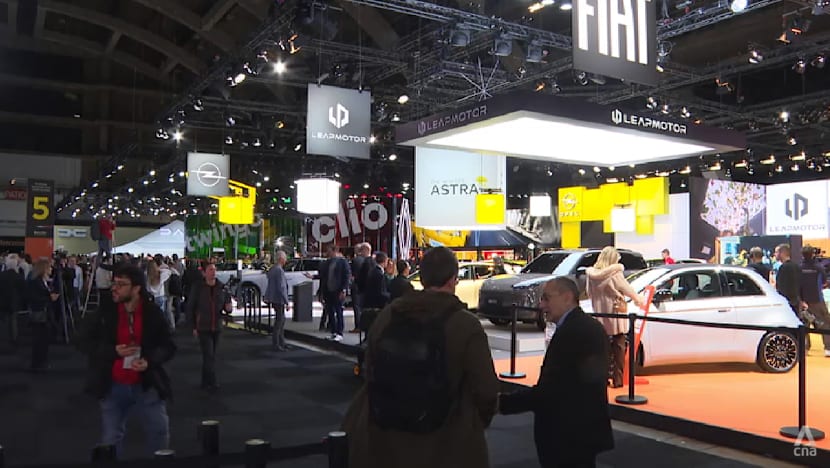
Chinese manufacturers are expanding their footprint across Europe, accounting for roughly 7 per cent of market share in the first half of last year, up from around 2 per cent in 2022.

This audio is generated by an AI tool.


BRUSSELS: Europe is trying to walk a tightrope in its relationship with China – seeking closer economic ties even as trade tensions persist, and at a time when relations with the United States grow increasingly uncertain.
Trade between the European Union and China accounts for more than 30 per cent of global gross domestic product, but the relationship remains heavily skewed.
China exports far more to Europe than it imports, leaving the EU with a goods trade deficit that exceeded US$350 billion in 2024 – a gap European leaders say is unsustainable.
EV IMPORTS DISPUTE
That imbalance is becoming especially visible in the electric vehicle sector.
Chinese manufacturers are expanding their footprint across Europe, accounting for roughly 7 per cent of market share in the first half of last year, up from around 2 per cent in 2022.
Zeekr Europe’s acting CEO Lothar Schupet said the Chinese EV maker has expanded its presence to 12 European countries, adding roughly one new market every two months.
But the expansion has been anything but smooth.
In 2024, the EU imposed additional import duties of up to 35.3 per cent on Chinese-made EVs, citing unfair state subsidies.
Beijing responded by launching anti-subsidy investigations into European dairy, pork and brandy, and slapped tariffs of up to 42.7 per cent on some European dairy products – moves widely seen as retaliatory.
Negotiations are now under way to ease tensions, including talks on minimum import pricing mechanisms to soften the impact of the EV tariffs.

GROWING GLOBAL TRADE UNCERTAINTY
Despite progress, Brussels says key concerns remain unresolved
“There are issues and concerns the EU has had going back many months and even years that we would require China to address,” said European Commission deputy chief spokesperson Olof Gill.
He added that these include industrial overcapacity, the unfair use of trade instruments and the persistent trade deficit.
Rather than cutting ties, the EU is pursuing a strategy of “de-risking” – safeguarding critical supply chains while continuing economic engagement with China.
French President Emmanuel Macron has echoed calls for rebalancing the relationship, urging fewer imports and greater Chinese investment in Europe.
Meanwhile, Beijing has signalled it wants deeper cooperation with the bloc amid rising global trade uncertainty.
However, new EU proposals on cybersecurity could complicate that push. Measures under consideration would restrict “high-risk” suppliers like Chinese technology giant Huawei from Europe’s critical telecommunications networks.
Linlin Liang, director of communications and research at the China Chamber of Commerce to the EU, warned that such steps could undermine business confidence.
She argued that competition cannot be considered fair if the Commission seeks to bar particular companies from certain countries without clear evidence, noting that such moves would seriously undermine fair competition within the EU.
Caught between an increasingly assertive China and an unpredictable US, the EU is stepping up efforts to diversify its trade partners.
However, recent deals with India and the Mercosur bloc of South American nations could take years to fully materialise, and are unlikely to match the scale of Europe’s economic relationship with China and the US.