Japan’s new PM Takaichi seeks to rebrand US ties in symbolic first meeting with Trump: Analysts
The outcomes of the meeting were largely symbolic and light on substance, aimed at reassuring Washington that Tokyo remains firmly in its corner, said observers.
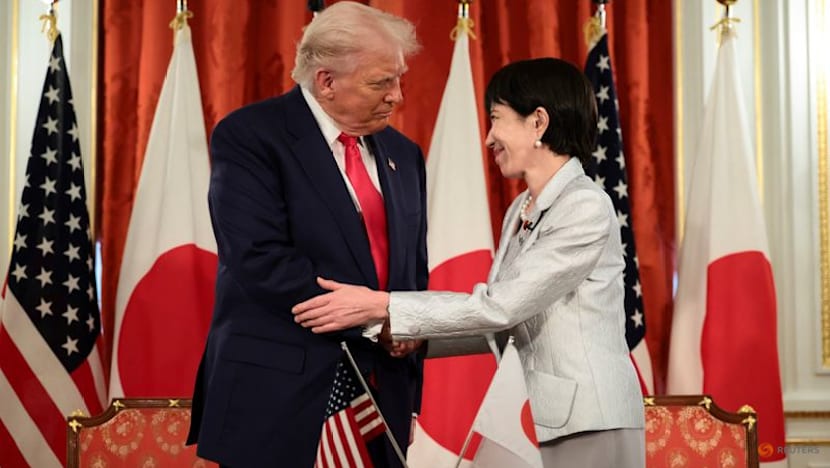
US President Donald Trump shakes hands with Japanese Prime Minister Sanae Takaichi during a bilateral meeting at Akasaka Palace in Tokyo, Japan, Oct 28, 2025. (Photo: Reuters/Evelyn Hockstein)

This audio is generated by an AI tool.


Japan’s new Prime Minister Sanae Takaichi may have vowed a “new golden era” in ties with the United States, but analysts told CNA her first meeting with President Donald Trump signalled a rebranding rather than a reset of the alliance.
They said the meeting’s outcomes were largely symbolic and light on substance, aimed at reassuring Washington that Tokyo remains firmly aligned with its interests.
Trump, who is on a five-day visit to Asia, lavished praise on Takaichi during their talks in Tokyo on Tuesday (Oct 28), welcoming her pledge to accelerate Japan’s military buildup and signing agreements on trade and rare earth cooperation.
Takaichi, a protege of Trump’s late friend and former Prime Minister Shinzo Abe, in turn applauded the US leader’s efforts to resolve global conflicts.
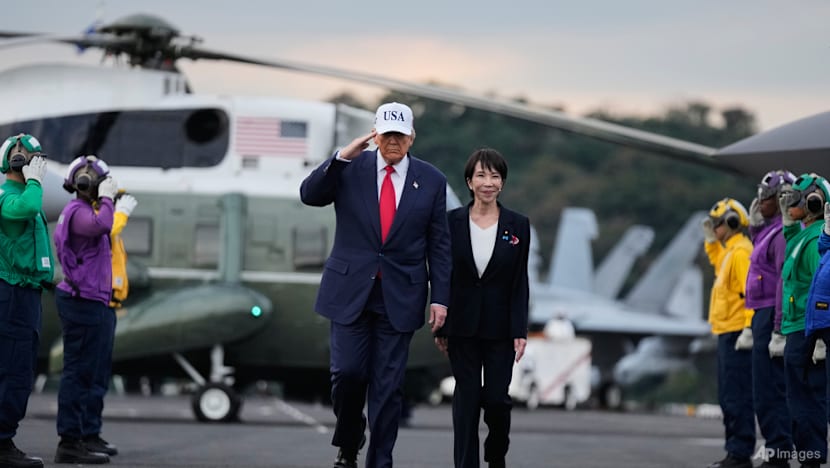
TAKAICHI’S CHARM OFFENSIVE
Economist Jesper Koll, global ambassador at financial services company Monex Group, said the bilateral meeting is Takaichi's “grand entry onto the global stage”.
He said she projected professionalism and poise, flattering Trump while emphasising that Japan remains America’s “unsinkable aircraft carrier” in Asia, with the industrial muscle to help power America’s economic revival.
Takaichi also invoked Abe’s friendship with Trump and presented symbolic gifts including Abe’s putter encased in glass.
Abe, who was assassinated in 2022, was the first foreign leader to meet Trump after his 2016 election win. The two shared a close bond over several rounds of golf in both the US and Japan.
In her first diplomatic test just days after taking office, Japan’s first female prime minister was “remarkably comfortable” despite the high stakes, said Sheila Smith of the Council on Foreign Relations, an American think tank.
Hosting Trump in Tokyo rather than visiting Washington worked to her advantage, she added.
“It was a very comfortable setting and it looked like they had time to develop a little bit of a rapport,” she said.
Observers said Takaichi’s bid to build personal chemistry with Trump could help buoy her political standing at home and navigate his unpredictable diplomatic style.
Takaichi started her term with high approval ratings, according to a Kyodo News survey last week.
Koll noted that her popularity reflects the public’s appetite for a decisive, action-oriented leader rather than another product of the ruling Liberal Democratic Party’s old guard.
“They want decisions to be made,” he added. “They love the fact that Takaichi is a fighter who does not come from a rich and established political family, but is actually a self-made woman.”
UNCERTAIN POLITICAL LANDSCAPE
Still, Takaichi faces an uphill battle to push through her agenda, said Masahiro Matsumura, a professor of international politics and national security at St Andrew's University.
“Verbal commitment is easy, but to carry out what is committed is not easy,” said Matsumura, noting that her minority government must negotiate with opposition parties in an uncertain political landscape.
“Takaichi faces a growing, huge obstacle in implementing what she has promised to Trump,” he said. “We don't know yet whether she'll be able to go through this difficult political process.”
One major challenge is the US$550 billion in strategic US investments, loans and guarantees pledged by Tokyo earlier this year to ease Trump’s tariff pressure.
Both sides have since released a list of energy, artificial intelligence and critical minerals projects in which Japanese firms are eyeing investments of up to US$400 billion.
Smith believes it will be more complicated than that, adding: “These are deals that have yet to get full clarity, and I think we will watch that unfold.”
Both sides also signed a deal to bolster supplies of critical minerals and rare earths, aiming to curb China’s grip on key tech components.
China is the world’s largest supplier of rare earth elements and critical minerals.
The Japan-US deal underscores Washington’s broader strategy to diversify critical mineral supply chains and counter China’s dominance, said Smith.
It comes ahead of Trump’s widely anticipated meeting with Chinese President Xi Jinping in South Korea on Thursday.
“It was a real statement by both leaders on the importance of the alliance,” said Smith.
“I think there's a lot of signaling going on there, and I think it (will be) very helpful for Trump as he goes into that meeting (with Xi).”