







Israel, Lebanon agree to direct negotiations after 'productive' talks: US
The announcement came after Israeli and Lebanese envoys held more than two hours of talks mediated by US Secretary of State Marco Rubio.
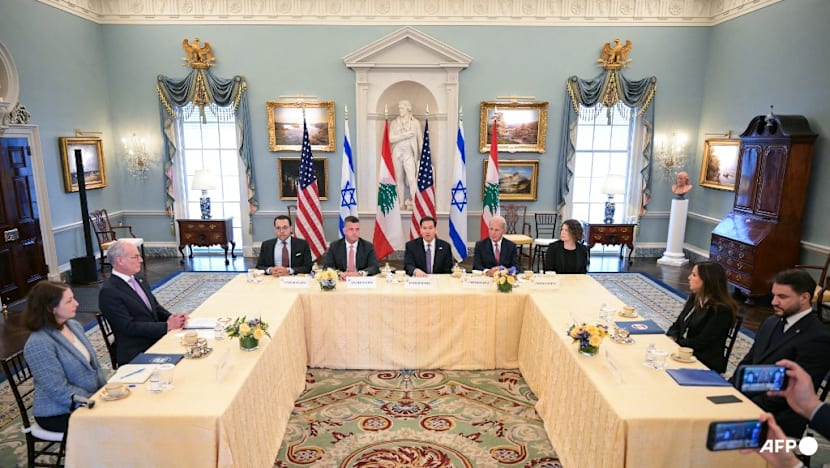
US Secretary of State Marco Rubio speaks during a meeting with Lebanon's Ambassador to the US Nada Hamadeh Moawad and Israeli Ambassador to the US Yechiel Leiter at the State Department in Washington, DC on Apr 14, 2026. (Photo: AFP/Oliver Contreras)
WASHINGTON: Israel and Lebanon agreed to hold direct negotiations after "productive discussions" between the two sides in Washington, the United States said on Tuesday (Apr 14).
"The participants held productive discussions on steps toward launching direct negotiations between Israel and Lebanon," State Department spokesperson Tommy Pigott said in a statement.
"All sides agreed to launch direct negotiations at a mutually agreed time and venue," he said.
The announcement came after Israeli and Lebanese envoys held more than two hours of talks mediated by US Secretary of State Marco Rubio.





"The United States congratulated the two countries on this historic milestone and expressed its support for further talks, and for the government of Lebanon's plans to restore the monopoly of force and to end Iran's overbearing influence," Pigott said.
And it "affirmed that any agreement to cease hostilities must be reached between the two governments, brokered by the United States, and not through any separate track", he added.

Lebanon was pulled into the region-wide Iran war on Mar 2 after pro-Tehran Hezbollah attacked Israel.
Since then, Israeli strikes have killed more than 2,000 people and displaced more than one million, despite international calls for a ceasefire, and Israeli ground forces have invaded south Lebanon.
‘LESS FIRE’, NOT CEASEFIRE LIKELY OUTCOME: ANALYST
Speaking to CNA’s Asia First, David Schenker, Taube senior fellow at the Washington Institute and former US Assistant Secretary of State for Near Eastern Affairs, described the talks as “a good start” after years without direct negotiations.
He noted that under a November 2024 ceasefire agreement, Lebanon had committed to preventing Hezbollah from carrying out attacks on Israel, but added it had not fully followed through and had done a “relatively poor job” in southern Lebanon, where much of the cross-border fighting has taken place.
Schenker said the current talks signal a willingness by Beirut to assert sovereignty despite Hezbollah’s continued influence and the lack of major action against the group.
On what comes next, Schenker said a full ceasefire is unlikely for now.
Instead, he expects a “less fire” scenario, with reduced fighting, continued Israeli presence in parts of southern Lebanon, and further talks on security, borders and Hezbollah’s disarmament.




