







Powell says Fed can 'wait and see' how war affects inflation
The Fed can “wait and see how that turns out” before acting on inflation from the Iran war, said Federal Reserve Chair Jerome Powell
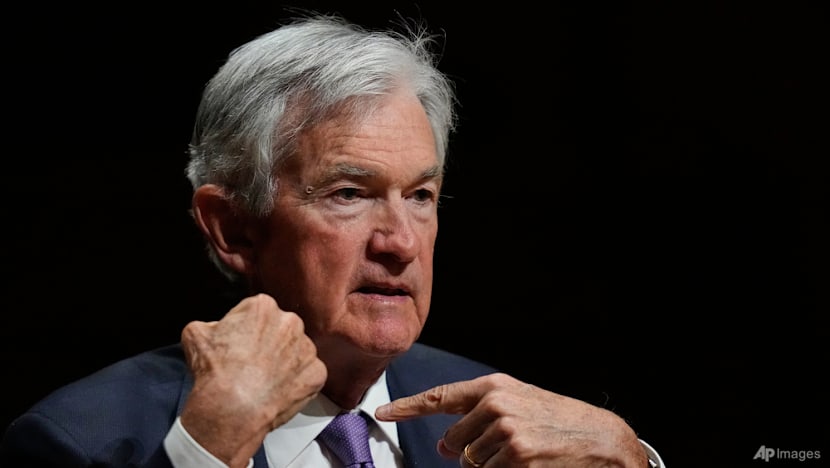
Federal Reserve Chair Jerome Powell gestures while addressing students at Harvard University, Monday, Mar 30, 2026, in Cambridge, Mass. (Photo: AP/Charles Krupa)
CAMBRIDGE, Massachusetts: Federal Reserve Chair Jerome Powell on Monday (Mar 30) said the US central bank can wait to see how the Iran war affects the economy and inflation, noting that policymakers typically look through shocks such as those from higher oil prices.
"We feel like our policy's in a good place for us to wait and see how that turns out," Powell said during a question-and-answer session held as part of a macroeconomics class at Harvard University.
His remarks appeared to calm financial markets that last week had reflected rising expectations the Fed may try to head off higher inflation by raising rates. Those rate hike bets have all but disappeared.
As the Iran war enters its fifth week and US gasoline prices rise to around an average of US$4 a gallon, Powell acknowledged the potential squeeze between the Fed's two mandates of full employment and price stability.
"There's sort of downside risk to the labour market, which suggests keep rates low, but there's upside risk to inflation, which suggests maybe don't keep rates low," Powell said. "You've got tension between the two objectives."
But for now, he said, the Fed does not have to act even as policymakers watch carefully for signs of deteriorating inflation expectations that could signal a need to respond.
"Inflation expectations do appear to be well anchored beyond the short term," Powell said.
The Fed left its overnight benchmark interest rate steady in the 3.50 per cent-3.75 per cent range earlier this month after the end of a two-day policy meeting.
In a press conference after that meeting, Powell said he would want to see tariff-driven inflation in goods prices subside before even getting to the question of whether the central bank ought to ignore any rise in inflation stemming from the war, or to respond to it with tighter monetary policy to keep inflation from accelerating.
Powell noted on Monday that inflation has been running above the central bank's 2 per cent target for about five years, boosted by a series of shocks: the collision of strong demand and constrained supply as the world reopened from the COVID-19 pandemic shutdowns, and more recently by what the Fed chief called the "much smaller" shock from tariffs.
"We're getting now an energy shock: no one knows how big it will be. It's way too early to know," Powell said. Oil prices were mixed on Monday, with Brent futures trading around 0.7 per cent lower at US$111.81 a barrel and US West Texas Intermediate futures gaining 2.7 per cent to US$102.36. Both benchmarks have surged since the conflict began on Feb 28.
"STICK TO WHAT WE'RE DOING"
A survey released by the University of Michigan last week showed a jump in household price expectations in the coming year.
Other measures, including a widely watched market-based gauge, have been more sanguine.
Powell's remarks were "quite textbook and quite in line with what he said before," said Oliver Allen, senior US economist at Pantheon Macroeconomics. "The Fed is kind of in a holding pattern until we find a little more about the shape and scope and size of this energy shock that's ahead of us."
Powell gamely fielded a range of questions from the course's two professors - David Laibson and Jason Furman - as well as from students in the audience, touching on concerns about private credit, the Fed's balance sheet, the impact of artificial intelligence and his optimistic medium-term view of the US economy despite a low-hire labor market that has made it especially difficult for new college graduates to find jobs.
Asked to give advice to former Fed Governor Kevin Warsh, US President Donald Trump's nominee to succeed him as head of the central bank when Powell's leadership term ends May 15, the current Fed chief demurred in the specifics.
Powell, however, did offer the observation that the Fed should resist any temptation to use its tools for anything beyond meeting its congressionally mandated goals of keeping prices steady and maximizing employment.
"We're not trying to work against any politician or any administration, but we have to be careful to stick to what we're doing," said Powell, whom Trump has repeatedly attacked for keeping borrowing costs too high.
Warsh has indicated he would support cutting interest rates.
One student asked how a rate cut would affect the Fed's ability to keep doing both of its jobs, given that inflation remains elevated amid the tariffs imposed by the Trump administration and the recent oil shock.
Powell observed that the student who lobbed the question was wearing a Boston Red Sox baseball jersey.
"That's not something I'm going to swing at, that pitch," Powell said.




