







Iran supreme leader vows revenge for father's killing
"Vengeance is the will of our nation and must inevitably be carried out," Mojtaba Khamenei said in a written message.
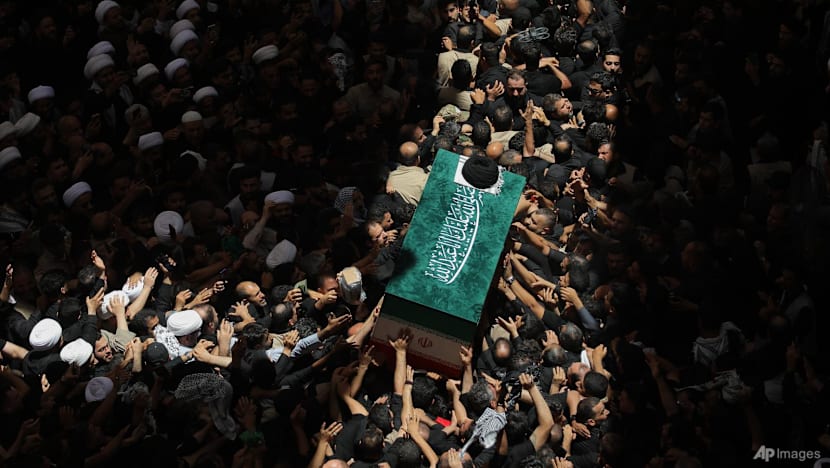
The coffin of the late Iranian Supreme Leader Ayatollah Ali Khamenei is carried by mourners to the Imam Ali Shrine in Najaf, Iraq, Jul 8, 2026. (Photo: AP/Anmar Khalil)
TEHRAN: Iran's supreme leader on Saturday (Jul 11) vowed revenge for the US-Israeli killing of his father and predecessor, hours after President Donald Trump warned against any attempt to assassinate him.
Both sides dialled up the rhetoric after exchanges of fire this week rocked an interim agreement aimed at ending their war, which broke out in late February with massive US-Israeli strikes.
Trump has declared their ceasefire over, while mediators have been trying to salvage diplomacy, with Iranian media reporting that a delegation from Qatar travelled to Iran on Friday.
"Vengeance is the will of our nation and must inevitably be carried out," Mojtaba Khamenei said in a written message.





He became Iran's supreme leader after his father Ali Khamenei's killing in late February by US-Israeli strikes, but has not been in public since before the war.
"This matter depends neither on my personal existence nor on that of other officials. Whether we are present or not, it will come to pass," he wrote in his first message since his father's funeral this week.
He said Iran had compiled a list of individuals to be targeted.
Hours earlier, Trump had posted on his Truth Social platform that any attempt to assassinate him would lead the United States to "completely decimate" Iran.
"1000 Missiles are Locked and Loaded and aimed at the Islamic Republic of Iran, with thousands of more to immediately follow, should the Iranian Government act on its threat, pronounced in many corners of the Globe, to assassinate, or attempt to assassinate, the sitting President of the United States of America, in this case, ME!," Trump wrote.
"Orders have already been given, and the US Military is ready, willing, and able, for a one year period of time, subject to extension, to completely decimate and destroy all areas of Iran."
With both nations stepping up their threats, mediators have been working to bring diplomacy back on track. Iran's Tasnim news agency reported on Friday that a Qatari delegation was visiting Iran to "try to reinforce Qatar's role as a mediator".
Trump has said talks with Iran will continue but has labelled them "a waste of time".
Iran's Foreign Minister Abbas Araghchi meanwhile insisted Tehran had stuck to its end of the bargain after the two sides signed a memorandum of understanding last month.
Tehran "has so far kept its word", he said. "Reality check: There can only be mutual compliance."

HORMUZ DEADLINE
US and Iranian delegations have held one round of direct talks in Switzerland since the signing of their memorandum of understanding, as well as indirect negotiations in Qatar, but there has been no sign of diplomatic progress since.
A key roadblock to a final deal is the future of the Strait of Hormuz, which Iran closed to commercial shipping during the war in retaliation for US-Israeli strikes.
The waterway is a key conduit for oil and gas exports out of the energy-rich Gulf countries, and its closure has heavily impacted the world economy.
Iran insists on controlling the passage of ships and has announced plans to charge fees, saying there will be no return to the free navigation of the pre-war era, which Washington has rejected.
Under customary international law, states are not generally permitted to charge tolls on straits used for international navigation.
Araghchi on Saturday arrived in Oman, which sits on the other side of Hormuz, for talks on administering the strait.
News outlets Axios and Politico reported that Washington has given Tehran until Saturday to stop firing on commercial ships transiting Hormuz and acknowledge the waterway is open.
This week's exchange of strikes was sparked after Iran was accused of targeting three vessels it said had deviated from its approved route.
The attacks prompted Washington to launch a heavy round of bombing in Iran, hitting around 90 targets across the country, according to the US military.
The US strikes killed 17 people, Tehran's health ministry said Saturday, and injured 115 more. They also triggered a wave of reprisals by Iran against US-allied countries in the Gulf that host American military bases.

"HARD-EARNED PEACE"
Despite being one of the Gulf nations targeted during the war, Qatar has spearheaded efforts to get diplomacy back on track.
Aside from the Qatari delegation visiting Iran, Qatar's emir on Friday held a call with Prime Minister Shehbaz Sharif of Pakistan, which has also been mediating, according to Sharif's office.
The Pakistani leader said he had also spoken with Iran's President Masoud Pezeshkian, urging him to safeguard the "hard-earned peace" in the region.
But Iran's chief negotiator in talks with Washington, Mohammad Bagher Ghalibaf, struck a defiant tone.
"Ending the war is a priority for the countries of the world, but everyone must know that this confrontation will never end with Iran's surrender," Iran's ISNA news agency quoted him as saying.
Iranians, he said, were "fully prepared to defend ourselves".




