







US House to vote on deal to end longest government shutdown in history
Eight Senate Democrats on Monday broke with party leadership to pass the funding package, which would extend funding through Jan 30.
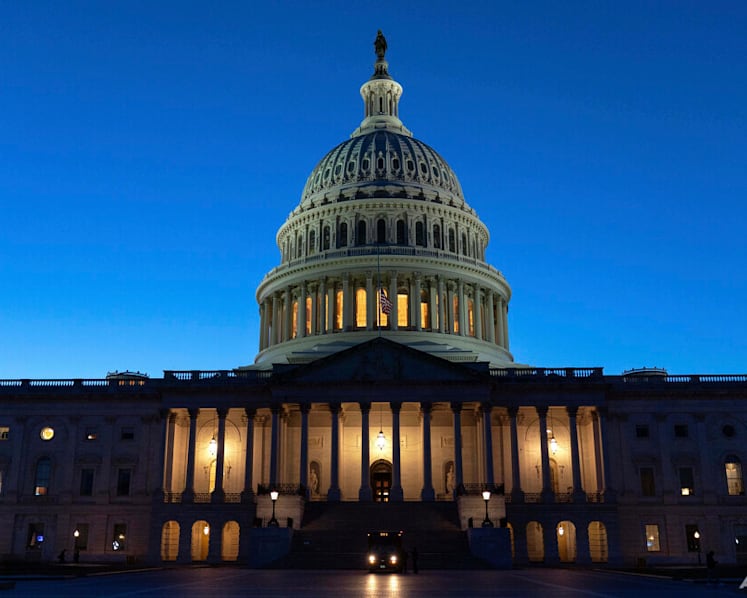
The US Capitol is seen on a sunset a day before the House prepares to vote on a Bill to reopen the government, Nov 11, 2025. (Photo: AP/Jose Luis Magana)
WASHINGTON: The House of Representatives took a procedural step toward ending the longest government shutdown in United States history on Wednesday (Nov 12), advancing a stopgap funding package to restart disrupted food assistance, pay hundreds of thousands of federal workers and revive a hobbled air-traffic control system.
The Republican-controlled chamber voted 213-209 to move towards a final vote on the measure, with President Donald Trump's support largely keeping his party together in the face of vehement opposition from House Democrats, who are angry that a long standoff launched by their Senate colleagues failed to secure a deal to extend federal health insurance subsidies.
Eight Senate Democrats on Monday broke with party leadership to pass the funding package, which would extend funding through Jan 30, leaving the federal government on a path to keep adding about US$1.8 trillion a year to its US$38 trillion in debt.
"I feel like I just lived a Seinfeld episode. We just spent 40 days and I still don’t know what the plotline was,” said Republican Representative David Schweikert of Arizona, referring to a popular 1990s US sitcom.





“I really thought this would be like 48 hours: people will have their piece, they'll get a moment to have a temper tantrum, and we'll get back to work.”
He added: “What’s happened now when rage is policy?”
House Democrats remain adamantly opposed, angered by the Senate deal that came less than a week after Democrats won high-profile elections in New Jersey, Virginia and New York City that many thought strengthened their odds of winning an extension of health insurance subsidies.
While the deal sets up a December vote on those subsidies in the Senate, Johnson has made no such promise in the House.
Democratic Representative Mikie Sherrill, who last week was elected as New Jersey’s next governor, spoke against the funding Bill in her last speech on the US House floor before resigning from Congress next week, encouraging her colleagues to stand up to Trump's administration.
“To my colleagues: do not let this body become a ceremonial red stamp from an administration that takes food away from children and rips away healthcare,” Sherrill said.
“To the country: stand strong. As we say in the Navy, don’t give up the ship.”

NO CLEAR WINNER FROM SHUTDOWN
Despite the recriminations, neither party appears to have won a clear victory. A Reuters/Ipsos poll released on Wednesday found that 50 per cent of Americans blamed Republicans, while 47 per cent blamed Democrats.
A final vote on passage is expected later on Wednesday. If approved by the House, the funding package would have to be signed into law by Trump. The White House said he supports the Bill.
The vote came on the Republican-controlled House's first day in session since mid-September, a long recess intended to put pressure on Democrats in the shutdown standoff.
The chamber's return also set the clock ticking on a vote to release all unclassified records related to the late convicted sex offender Jeffrey Epstein, something Johnson and Trump have resisted up to now.
Johnson on Wednesday swore in Democrat Adelita Grijalva, who won a September special election to fill the Arizona seat of her late father, Raul Grijalva. She provided the final signature needed for a petition to force a House vote on the issue, hours after House Democrats released a new batch of Epstein documents.
That means that after performing its constitutionally mandated duty of keeping the government funded, the House could once again be consumed by a probe into Trump's former friend, whose life and 2019 death in prison have spawned countless conspiracy theories.
The funding package would allow eight Republican senators to seek hundreds of thousands of dollars in damages for alleged privacy violations stemming from the federal investigation of the Jan 6, 2021, attack on the US Capitol by Trump's supporters.
It retroactively makes it illegal in most cases to obtain a senator's phone data without disclosure and allows those whose records were obtained to sue the Justice Department for US$500,000 in damages, along with attorneys' fees and other costs.




