







Wall Street ends higher as hopes of Iran war resolution offset inflation fears
Wall Street bounced back after the US president said the US-Israeli war on Iran is “very far ahead” of schedule, despite rising oil prices from disruptions at the Strait of Hormuz.
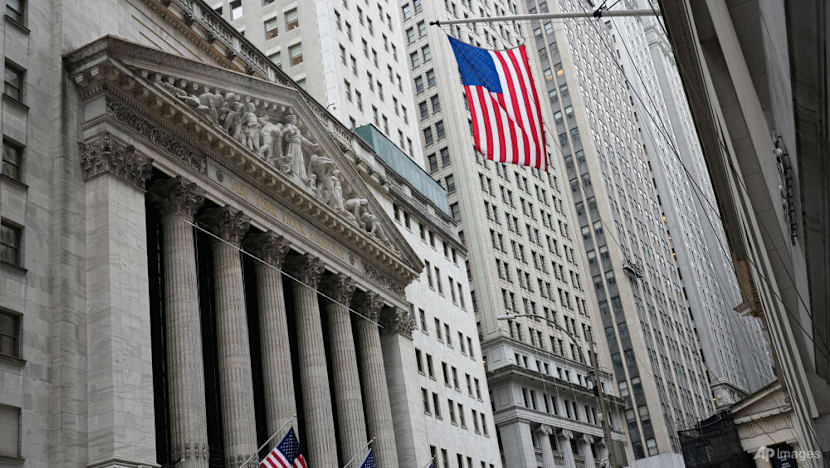
The New York Stock Exchange is seen in New York, Friday, Mar 6, 2026. (Photo: AP/Seth Wenig)
NEW YORK: Wall Street stocks clawed their way back from a steep selloff to close higher on Monday (Mar 9), notching a final-hour rebound after US President Donald Trump suggested that the US-Israeli war on Iran could be close to ending.
All three indexes staged a late comeback after Trump said the war was "very far ahead" of his initial four-to-five-week estimated time frame.
Early in the session, oil prices reached their highest levels since mid-2022 due to constricted supply arising from shipping disruptions as the war on Iran entered its 10th day. Ballooning energy prices could metastasise into a broader inflation spike at a time when many US consumers are struggling with affordability.
Crude prices fell, however, after sources said the Trump administration is considering easing oil sanctions against Russia.
In post-settlement trade, US crude was last down 5.32 per cent to about US$86 a barrel and Brent fell to US$90 per barrel.
The stock market's intraday swings as investors digest headlines have added volatility to the trading day in recent weeks.
"There is still an awful lot of uncertainty out there regarding the duration of the conflict, as well as the duration of the closure of the Strait of Hormuz," said Sam Stovall, chief investment strategist of CFRA Research in New York.
"Again today, seeing such a relative reversal in price movements indicates that investors are looking for any opportunity to jump back into the equity markets."


Those mounting worries, combined with Friday's weaker-than-expected employment report, raise the possibility of economic stagflation, which would trap the US Federal Reserve between the two sides of its dual mandate - price stability and full employment.
Still, financial markets largely expect the central bank to keep its key interest rate unchanged through the first half of the year, according to CME's FedWatch tool.
"That weak employment report along with rising energy prices ... speaks to potential stagflation," said Robert Pavlik, senior portfolio manager at Dakota Wealth in Fairfield, Connecticut. "The Federal Reserve is going to be stuck between a rock and a hard place."
Hopes of de-escalation of the widening Middle Eastern conflict had earlier dimmed after Iran selected Mojtaba Khamenei to succeed his father as supreme leader, a choice Trump, who has called for Iran's unconditional surrender, deemed unacceptable.
The Dow Jones Industrial Average rose 239.25 points, or 0.50 per cent, to 47,740.80, the S&P 500 gained 55.97 points, or 0.83 per cent, to 6,795.99 and the Nasdaq Composite gained 308.27 points, or 1.38 per cent, to 22,695.95.
Nine of the 11 major sectors in the S&P 500 ended green, with tech shares enjoying the largest percentage gains. Financials and energy shares were the only two sectors to end the session in negative territory.
The Philadelphia Semiconductor Index bounced back, with chipmakers SanDisk, Broadcom and Nvidia advancing between 2.7 per cent and 11.7 per cent.
Homebuilders, banks, and aerospace/defence stocks were clear underperformers.
On the economic front, later this week, the Labor Department's Consumer Price Index, the Commerce Department's second take on fourth-quarter GDP and its broad Personal Consumption Expenditures report all have the potential to move markets.




