Bangladesh’s democratic reset? Voters back reforms but return old guard to power
As voters in Bangladesh back reforms in a referendum, the return of a familiar political force raises questions about whether real change is coming, say analysts.
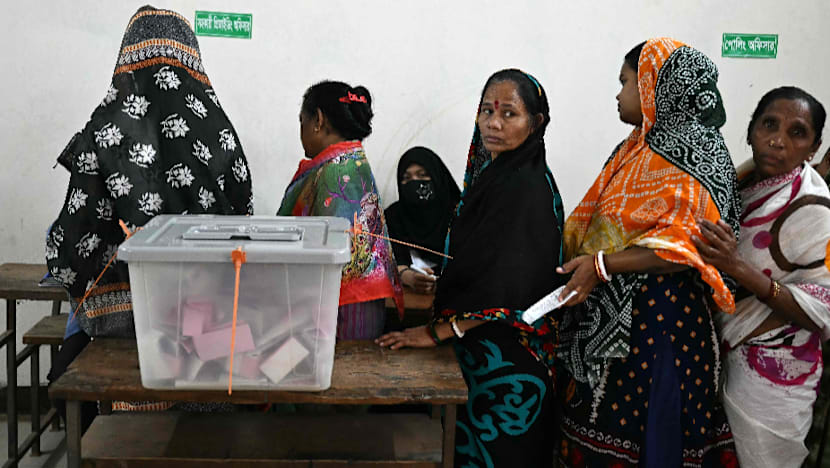
People queue up cast their ballots at a polling station during Bangladesh's general election in Dhaka, Feb 12, 2026. (Photo: AFP/Sajjad Hussain)

This audio is generated by an AI tool.


Bangladesh appears to have turned a democratic corner, holding what observers describe as its most free and credible election in recent memory on Thursday (Feb 12).
The Bangladesh Nationalist Party (BNP) secured a landslide victory, while a parallel referendum on constitutional reforms also looks set to pass.
Yet, analysts say the outcome underscores a paradox: voters endorsed change, but returned a familiar political dynasty to power.
A DECISIVE MANDATE
For much of Bangladesh’s young democracy, only a handful of its elections have been widely regarded as free and fair. Others were overshadowed by violence and claims of electoral fraud.
But Thursday's polls appear to signal a break from that troubled past.
Latest counts in a vote seen as the South Asian nation's first truly competitive election in years gave the BNP and its allies at least 212 of the 299 seats up for grabs, according to local TV channels.
The opposition Jamaat-e-Islami and its allies won 70 seats.
“This is the first free and fair election in Bangladesh since 2008 and that's really significant,” said Vishnu Padmanabhan, Asia correspondent at publication The Economist.
“The fact that there were no major incidents … the voter turnout was solid at around 60 per cent … and that Jamaat has accepted defeat … are all signs suggesting that people, on the whole, are ready to embrace democracy in Bangladesh.”
Michael Kugelman, senior fellow for South Asia at the Atlantic Council, called it “a resounding victory for the BNP”.
“It certainly reflects a situation where the party appears to have earned a very strong, resounding mandate from the Bangladesh public,” he added.
But the scale of the win surprised some observers, given expectations of a tighter race with Jamaat-e-Islami.
The Islamist party had gained prominence after aligning itself with protestors’ demands during the 2024 uprising that ousted former Prime Minister Sheikh Hasina. Her Awami League, which ruled for 15 years, has since been barred from political activities.
Jamaat-e-Islami led an alliance into the polls that included the National Citizen Party (NCP), formed by youth activists who were instrumental in toppling Hasina.
Though defeated, Jamaat-e-Islami secured its highest-ever tally of 70 seats, positioning itself as what analysts describe as a “very robust opposition” capable of influencing parliamentary debate.
VOTING FOR CHANGE – BUT NOT FOR ITS AGENTS
Held alongside the election was a referendum on sweeping constitutional reforms.
Proposals include the creation of a neutral interim government system, a bicameral legislature, greater representation for women, stronger judicial independence and a two-term limit for the prime minister.
The measures stem directly from anti-corruption and pro-democracy demands that fuelled the mass protests.
Yet, despite Jamaat-e-Islami projecting itself as a vehicle for change, voters ultimately placed their trust in the BNP – a party rooted in Bangladesh’s political establishment.
“It's a bit contradictory,” Kugelman told CNA’s Asia First programme.
“It appears the referendum is going to pass by a large margin supporting the change ideas that galvanised the mass movement. Yet, parties most associated with change are set for significant election losses.”
Naomi Hossain, global research professor at SOAS University of London, suggested familiarity and experience may have outweighed revolutionary appeal.
BNP is headed by Tarique Rahman, 60, who spent 17 years in self-imposed exile before returning to lead the campaign.
The party was founded in 1978 by his father and ex-Bangladesh President Ziaur Rahman. It was last in power between 2001 and 2006 under Tarique’s mother, former Prime Minister Khaleda Zia.
“Probably, the BNP looks like the safest pair of hands,” Hossain said. “The party has a track record of governance … presiding over relatively robust growth. Its record on the economy and development was reasonable.”
Still, she cautioned that economic challenges loom large.
“The manifestos have been a shopping list of nice things to have, but without any kind of costing or sense of how they will be paid for,” Hossain said.
Bangladesh’s tax-to-GDP ratio remains among the lowest in the world. Domestic revenue mobilisation is weak and public services are underfunded – structural constraints that will test the new government, she added.
REFORM PROMISES AND SCEPTICISM
BNP leaders have pledged to eliminate corruption, follow through on reforms initiated by the interim government and honour the spirit of the 2024 revolution.
But analysts warn that the party’s past complicates those promises.
Kugelman noted that the BNP “reflects the very political system that those behind the protests deplored,” having previously faced accusations of repression, suppression and corruption while in power.
But at the same time, he said the party faces intense pressure – particularly from younger voters – to deliver genuine reform.
Hossain agreed the BNP must prove it has “cleaned up its act.”
One early test will be how it handles the referendum.
The Economist’s Padmanabhan said moving quickly to pass the reforms would demonstrate a genuine commitment to change.
“(It’s) a good opportunity to show that (the BNP) is committed to reforms and ensuring that the failures of the past are not repeated,” he said. “So, if they can get that package passed, that'd be a very good sign.”
Still, Hossain said it remains unclear how meaningful the referendum vote can be, and its success ultimately depends on political will.
“The reform agenda is proposing to shore up democracy to prevent a return to the backsliding that we saw under the Awami League government,” she said.
“But there are lots of questions about the legal status of the reforms … and the practicality of getting constitutional amendments or new laws passed.”
FOREIGN POLICY AND STABILITY
Former Bangladeshi Foreign Minister Iftekhar Ahmed Chowdhury struck an optimistic note, saying Bangladesh may now be set for “a long spell of normal elected politics”.
“One initially thought there’d be a lot of instability in the months following … the overthrow of Hasina. That wasn’t the case,” he said, adding that the restoration to mainstream politics was swifter than expected.
Chowdhury expects the BNP to revive an active foreign policy, stabilising relations with neighbours – especially India, with which Bangladesh shares nearly its entire land border.
“Weaker countries in the international system like Bangladesh need to link up and build a web of interactions with other actors in order to strengthen itself and obtain prosperity, stability and security,” he told CNA’s Asia Now.
Analysts say Bangladesh’s election marks a reset with a credible, peaceful vote and a decisive mandate, but also marks a return to a familiar party with a dynastic leadership and to a political system long defined by rivalry between the BNP and Awami League.
Bangladesh’s politics, Kugelman added, has long been deeply polarised and retributive.
“Whichever party’s in power goes after the opposition hard – the Awami League and BNP never got along,” he said.
“Will we see the BNP take actions that crack down against what remains of the Awami League? Or will it simply step back and call for national unity? That will be an important first test to get a sense if politics in Bangladesh is going to be more of the same, or something different and better.”