Private donations in India on the rise amid growing wealth, but funding gaps remain: Report
Experts warn that funding would need to grow at twice the pace of charitable contributions in order to meet India’s vast social needs.
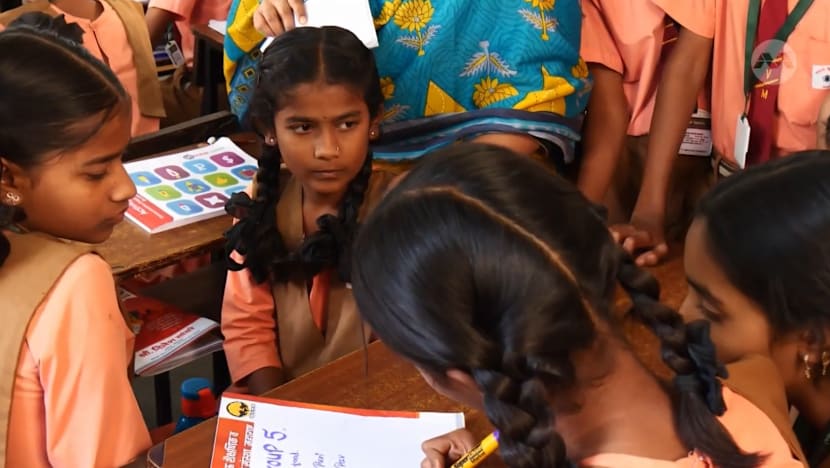
Students at Matoshri Vidyamandir Secondary School in Mumbai, India, where private donations are essential to daily operations.

This audio is generated by an AI tool.


MUMBAI: At Matoshri Vidyamandir Secondary School in Mumbai, private donations are essential to daily operations.
The government-aided school, which is privately managed and receives limited state funding, educates more than 700 children, mostly from nearby slum communities.
Support comes in various forms. One of India’s largest financial conglomerates, the Kotak Mahindra Group, provides English lessons, while a local non-governmental organisation has donated shipping containers converted into classrooms.
Contributions are vital to keeping the school running, said its headmaster Vivek Patil.
“Some people come here and they donate some money. With the help of that money, we are trying to continue with this school,” he added.
The school is just one example of how charitable giving helps plug funding gaps across India, particularly in education and healthcare.
According to a new report by global consultancy Bain & Company and non-governmental organisation Dasra, private giving in India is expected to grow by more than 9 per cent annually up to 2030, driven by rising wealth.
The latest India Philanthropy Report estimates private giving reached 1.4 trillion rupees (US$16 billion) in 2025.
Donations have grown roughly 8 per cent per year since 2020, and that rate is expected to accelerate to between 9 and 11 per cent annually over the next five years.
FUNDING STILL LACKING
But while charitable contributions are on the rise, experts warn that funding would need to grow at more than twice that pace to meet the vast social needs of the world’s most populous nation.
According to the report, private funding would need to grow by around 25 per cent a year to meet demand in a country of more than 1.4 billion people, where tens of millions still live in extreme poverty.
The scale of India’s development challenges remains immense, said Dasra co-founder and partner Neera Nundy.
“The size is quite overwhelming, and therefore you see a pretty significant gap in what's required to solve some of our development issues. The role of philanthropy is to come in and provide innovation,” she noted.
“But I think institutionalising (and) having a lot more infrastructure to unlock this philanthropy can maybe really move the needle eventually.”

LEADING BY EXAMPLE
India’s rapid wealth creation has also produced prominent philanthropists.
Amit Chandra, managing director of investment firm Bain Capital, is among the country’s leading donors. Inspired by scholarships he received as a boy for his own education, he estimates he has given away about 70 to 80 per cent of his wealth.
He and his wife Archana donated more than US$5 million in the last financial year alone, according to a philanthropy report by research, media and investments group Hurun.
He said he believes rising wealth should translate into greater responsibility.
“We have the opportunity to do an incredible amount of work, to partner with the government to really change the fortunes of hundreds of millions of people. I think that's where philanthropy comes in,” he added.
“It's both an opportunity to make a difference and a responsibility to make a difference.”
India's government has been working to put more wealth back into the community.
Since 2014, companies meeting certain financial thresholds in India have been required to spend 2 per cent of their profits on social development initiatives.
Still, Bain & Company’s philanthropy report noted that Indian families remain the cornerstone of private charitable giving in the country.
For schools like Matoshri Vidyamandir, wherever the contributions come from, the impact can be life-changing – helping ensure that hundreds of children continue their education despite limited public resources.