Indonesia expects preferential US market access under new tariff deal, says presidential trade envoy
Indonesia’s Presidential Special Envoy for International Trade and Multilateral Cooperation Mari Pangestu told CNA the deal reflects a more balanced approach to trade and investment ties.
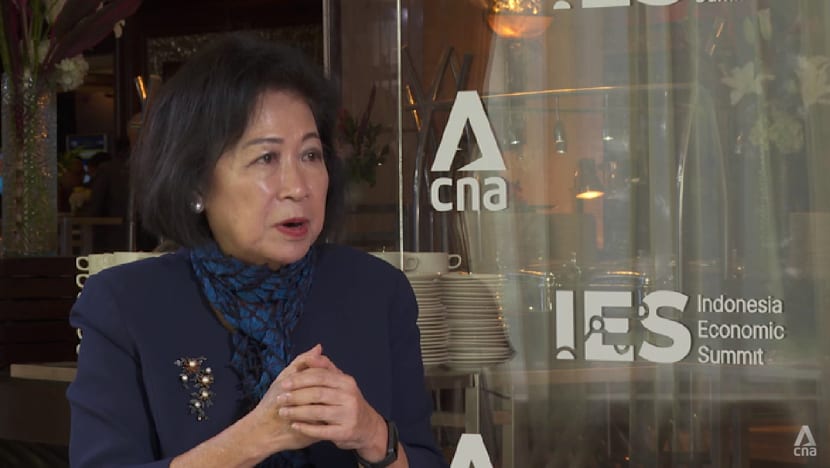
Indonesia’s Presidential Special Envoy for International Trade and Multilateral Cooperation Mari Pangestu speaks with CNA's Saifulbahri Ismail on the sidelines of the Indonesia Economic Summit 2026 in Jakarta.

This audio is generated by an AI tool.




JAKARTA: Indonesia expects to secure preferential access to the United States market below the proposed 19 per cent reciprocal tariff, following the conclusion of trade negotiations between the two countries.
Indonesia’s Presidential Special Envoy for International Trade and Multilateral Cooperation Mari Pangestu told CNA the deal reflects a more balanced approach to trade and investment ties, allowing Indonesia to gain greater access to the US market while addressing long-standing concerns over trade imbalances.
“Some of the issues that we had to try to deal with in the negotiations was to make sure there's balance, that it was not just unilateral,” she said on Tuesday (Feb 3).
“That's been, I think, somewhat achieved. So, it's not just us giving market access and agreeing to purchase US goods, which is to address the issue of the deficit, but to also get market access to the US for the products that are important to us.”
The former Indonesian trade minister spoke to CNA on the sidelines of the Indonesia Economic Summit 2026 in Jakarta.
DEAL AWAITS SIGNING
On Tuesday, Indonesia’s Coordinating Economy Minister Airlangga Hartarto said negotiations on the tariff deal with the US have been completed, with only the signing by the two presidents pending scheduling.
Speaking after a keynote address at the summit, Airlangga said talks were “fully complete”, but declined to reveal details, citing a nondisclosure agreement following a preliminary handshake deal reached last July.
Indonesia was among the first countries to secure a framework tariff deal with Washington, cutting the proposed import duty on Indonesian exports from 32 per cent to 19 per cent.
Beyond trade, Mari said the deal is also about attracting investments by fostering strategic partnerships with the US and encouraging deeper American involvement in the region, particularly in sectors of shared strategic interest including critical minerals and pharmaceuticals.
Her comments came against a backdrop of growing uncertainty in the global economic outlook, driven by what she described as a “rupture in the multilateral order”.
“(The uncertainty’s) here to stay. So, it's not like it's going to go back to anything that we knew before,” said Mari, who is vice chair of Indonesia’s National Economic Council.
“We should accept that this time it's different and our response cannot be business as usual,” she added. “Therefore, you've got to be more agile, you've got to diversify.”

ADAPTING TO INSTABILITY
For Southeast Asia’s largest economy, the strategy would centre on building domestic resilience through reforms and deregulation, allowing Indonesia to remain agile in a more volatile environment, she noted.
Mari also played down concerns over Indonesia's US$80 billion stock market rout last week, saying market shocks were not unprecedented.
The sell-off began after global index provider Morgan Stanley Capital International flagged concerns about market transparency and governance.
“Shocks in the stock market happen every now and then,” said Mari. “This time, it was in a way linked to issues that we knew had to be addressed related to transparency and liquidity of the market. I think what has happened in response has calmed down the stock market.”
Stocks with strong fundamentals either rebounded or remained stable, she noted, adding that Indonesia’s broader economic fundamentals remain “sound and robust”.
She pointed to continued fiscal discipline, with the government committed to maintaining a budget deficit of no more than 3 per cent of gross domestic product, alongside improving indicators such as rising consumer confidence and a pickup in manufacturing activity.
“The issue is how do we maintain the growth,” she said, highlighting ongoing reforms across financial markets and the wider retail sector as central to the government’s strategy.