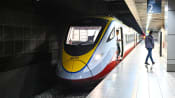
Completion of ‘modern’ Electric Train Service line to Johor Bahru key to Malaysia’s development: PM Anwar
Checks by CNA showed that train tickets for services between Johor Bahru and Kuala Lumpur have been selling fast, with only a handful left for the first three days it is operating between Friday (Dec 12) and Sunday.
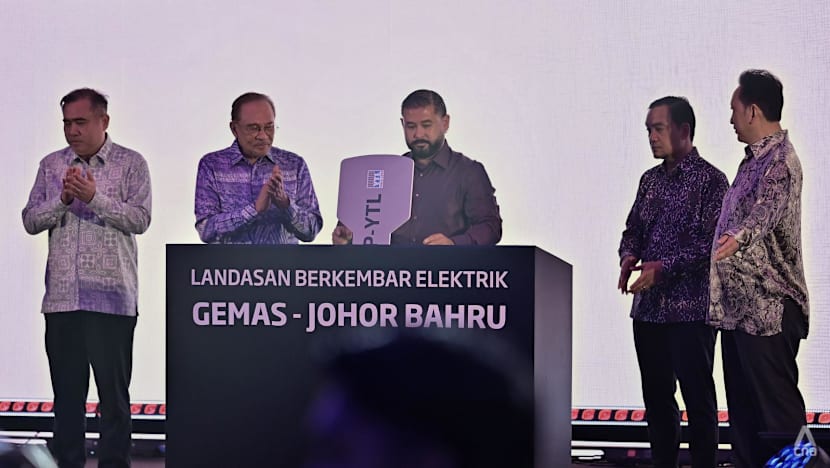
Regent of Johor Tunku Ismail Sultan Ibrahim (centre) launches the Gemas-Johor Bahru Electrified Double-Track Project (EDTP) at Kempas Baru station in Johor on Dec 11, 2025. (Photo: CNA/Zamzahuri Abas)

This audio is generated by an AI tool.


JOHOR BAHRU: The completion of Malaysia’s Electric Train Service (ETS) line to Johor Bahru is a key milestone for the country as it represents a significant infrastructure project which could have a “trickle-down” economic impact on locals, said Malaysian Prime Minister Anwar Ibrahim.
“Today, as we have also informed Singapore’s prime minister, we have completed a key chapter by finishing a transport network which is key for Malaysia’s development.
“In the context of Johor state’s development, we need an airport, port … and modern public transportation. We have almost finished providing these basic infrastructure needs,” said Anwar, who spoke in Kempas on Thursday (Dec 11) at the launch of the completion of the ETS line connecting Kuala Lumpur and Johor Bahru.
He added that the challenge now was to ensure that “trickle-down” benefits of the ETS are enjoyed by those who live and work at rural stations along the line.
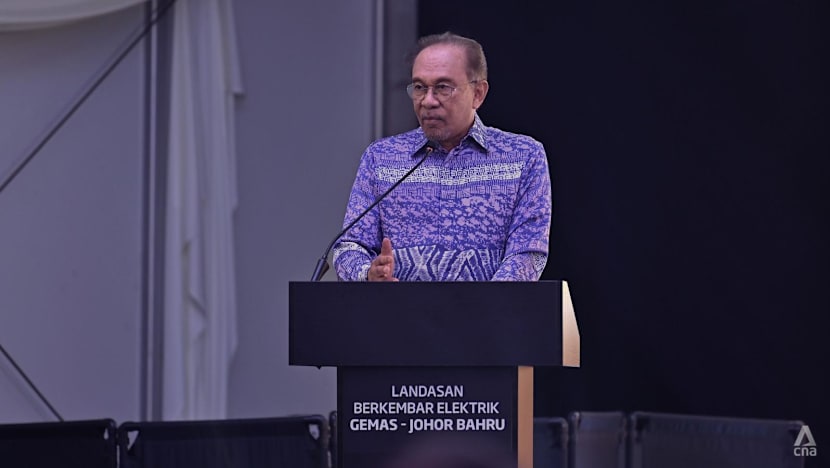
“This requires assistance from state and federal government players to ensure that there’s good housing and other amenities adjacent to these ETS stations. Johor has solidified itself as a strong economy but we must ensure these benefits are translated to the common folks,” said Anwar.
“I’m thankful and proud the project is completed and it can be a model for development for Johor and the entire country.”
The event was also attended by Johor Regent Tunku Ismail Sultan Ibrahim, Transport Minister Anthony Loke and Johor Chief Minister Onn Hafiz Ghazi.
Speaking at a press conference during the same event, Loke said the completion of the electric double-track system connects commuters living across the length of peninsular Malaysia.
“Hopefully it will improve the way of life for people and encourage the use of public transport,” he added.
Loke added that there are also plans in place to connect the ETS line to the East Coast Rail Link (ECRL). The ECRL is an RM50 billion (US$12.17 billion) megaproject linking the Klang Valley in Selangor to the east coast states of Pahang, Terengganu and Kelantan.
He also said that within Johor Bahru town, there are plans to integrate the ETS with the upcoming Rapid Transit System Link which is connected with Singapore, bus services and ultimately the elevated Autonomous Rapid Transit (ART) system which is still in the discussions stage.
An ART system is typically an autonomous train-bus hybrid network running on roads. Its carriages, which run on rubber wheels, use sensors that enable the vehicle to follow a route defined by a virtual track.
While the ETS service aims to eventually connect commuters travelling from Johor Bahru to northern Malaysian cities like Butterworth, Ipoh and Padang Besar, Loke said in November that initial operations will focus primarily on connecting Johor Bahru and Kuala Lumpur.
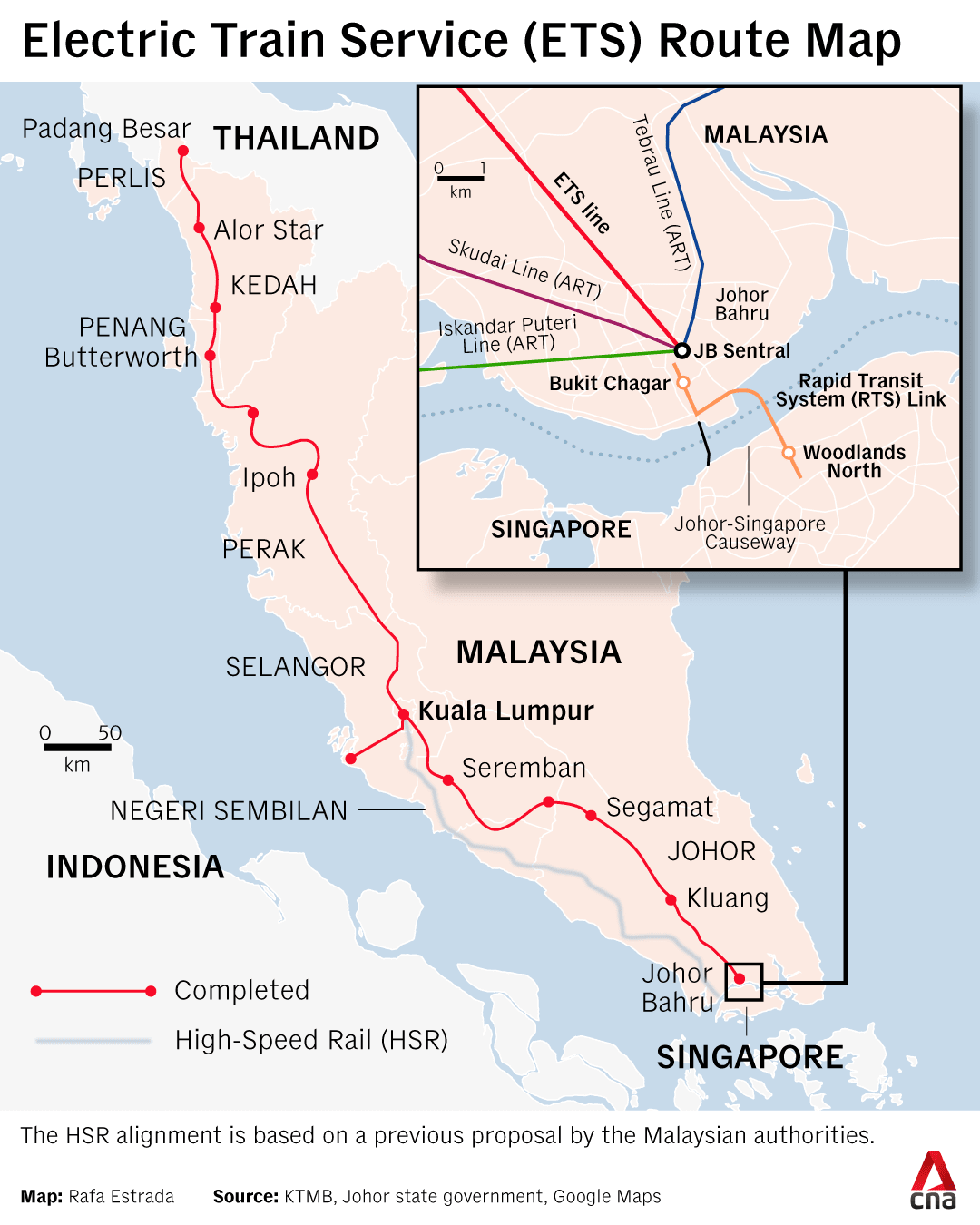
He also encouraged passengers travelling to states in northern Malaysia to use transit connections to continue their journeys.
Loke said on Thursday that there will be two trains operating the route when it is launched on Friday, and that this will be increased by two more trains in January, and another two trains in February, to accommodate commuters ahead of the Chinese New Year and Hari Raya festive period.
First announced in 2011 by Malaysia’s national rail operator Keretapi Tanah Melayu Berhad (KTM), construction on the RM8.9 billion project began in 2016, covering the districts of Segamat, Kluang and Kulai and Johor Bahru.
It has seen significant delays, with travel experts citing how commuter confidence in the line’s reliability could erode.
The ETS service between Johor Bahru and Kuala Lumpur is expected to take between 3.5 and 4.5 hours, depending on the type of service the passenger takes - silver, gold, platinum or express.
This is similar to journeys by car or buses, but unlike road transport, the ETS is not subjected to traffic congestion delays. Diesel KTM train journeys between Johor Bahru and Kuala Lumpur takes around seven hours.
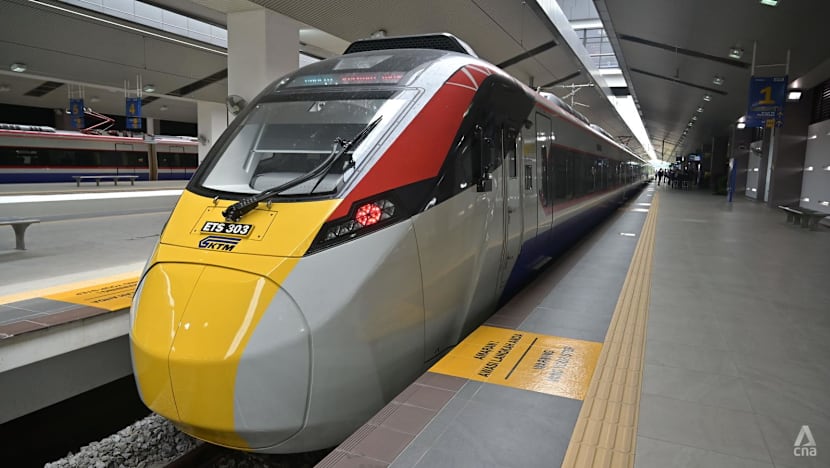
Each has different numbers of stops and varying levels of comfort, acting KTMB group chief executive officer Ahmad Nizam Mohamed Amin told CNA in an interview in September.
“In terms of cost, it is more economical compared to flying because we save on ticket prices,” he said, adding that it could “revolutionise” transport options in the peninsula and offer passengers a greener and potentially cost-effective way to travel between key cities.
“Compared to driving, we save time. Therefore, I believe it is an attractive choice for users to choose to travel by (ETS),” he added.
On Monday, KTMB announced that Malaysian citizens can enjoy a special 30 per cent discount to mark the launch of the ETS connecting to Johor Bahru. The discount is applicable for travel between Dec 12, 2025 and Jan 11, 2026 via a promotional code.
Checks by CNA on KTMB website showed that train tickets for services between Johor Bahru and Kuala Lumpur have been selling fast, with only a handful left for the first three days it is operating between Friday and Sunday.
A one-way fare between Johor Bahru and Kuala Lumpur starts from RM82. Ticket prices ranged between RM82 and RM99 for standard fares, while business tickets ranged from RM153 to RM169.
The six-coach train seats 312 passengers: Five are standard coaches and the remaining a business-class coach.
The ETS is expected to boost economies and businesses in smaller satellite towns such as Kluang along its route and will also benefit Malaysians travelling locally between key stops in the peninsula.
But transport experts previously told CNA that travellers from Singapore would benefit too.
Coupled with the expected completion of the Johor Bahru-Singapore Rapid Transit System (RTS) Link by the end of next year, those heading to Kuala Lumpur from Singapore, and vice versa, will be able to do so within four hours via rail, they said.
“By road, travellers might be forced to encounter traffic jams - both at the Causeway and on the highways in Malaysia. By using RTS and ETS trains, they can sit back and relax and not have to worry about congestion,” said Rosli Azad Khan, a transport planning expert who heads Selangor-based consultancy firm MDS.