What is behind 60% spike in Malaysia court cases and can judges keep up?
Lawyers and experts weigh in on why both civil and criminal court cases have shot up - and the implications for Malaysia’s justice system.
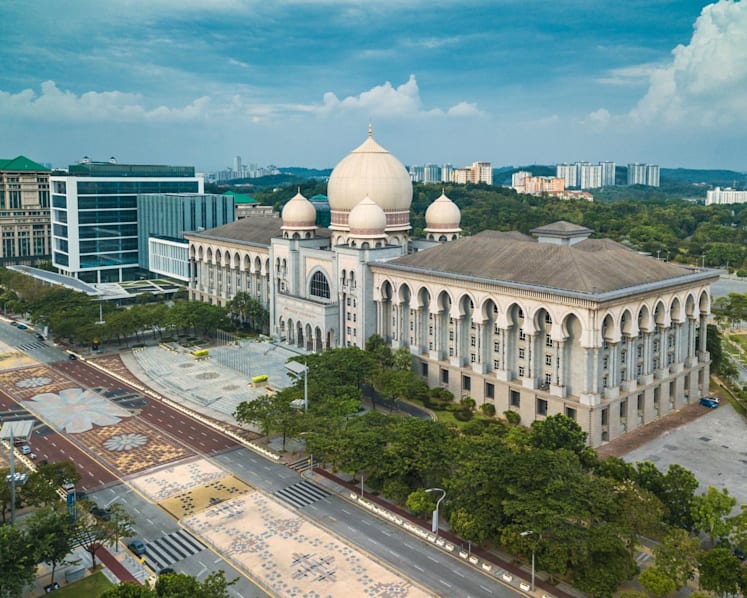
Malaysia's Palace of Justice which is located in Putrajaya (Photo: Perbadanan Putrajaya)

This audio is generated by an AI tool.


KUALA LUMPUR: For 11 years, Nurul Nashua Baharuddin has painstakingly built her reputation as a makeup artist painting one face at a time. But today, the 33-year-old - who hails from Tangkak in the southern Malaysian state of Johor - is swapping her makeup brushes for a legal brief.
Fed up with what she described as "irresponsible statements" by a photographer that have led to a wave of client cancellations, Nurul has started to take legal action.
She has spent time collecting screenshots of purportedly defamatory messages that form the backbone of a letter of demand (LOD) served to the photographer, whom she alleged questioned her professionalism and quality of service as a makeup artist.
An LOD is a letter setting out a list of demands for the recipient to comply with and is typically sent by lawyers on behalf of their clients. It usually threatens legal action if the demands are not satisfied within a period of time.
“When my livelihood is threatened and the trust I’ve built with my clients is compromised, I have to act,” Nurul told CNA.
“I don’t want to go to court as it’s a drain on time and money, but I feel I have no choice but to seek justice through the legal system. I’m not sure if I will get it, but I will try.”
For now, Nurul is waiting for a response to her LOD from the other party. If she proceeds to file a suit - which she believes might be highly likely at this point of time - she will join a rapidly growing number of Malaysians turning to the judiciary to settle personal and professional disputes.
In his speech at the opening of the legal year on Jan 12, Chief Justice of Malaysia Wan Ahmad Farid Wan Salleh noted that the country’s economic development and evolving societal dynamics have led to a sustained increase in case filings.
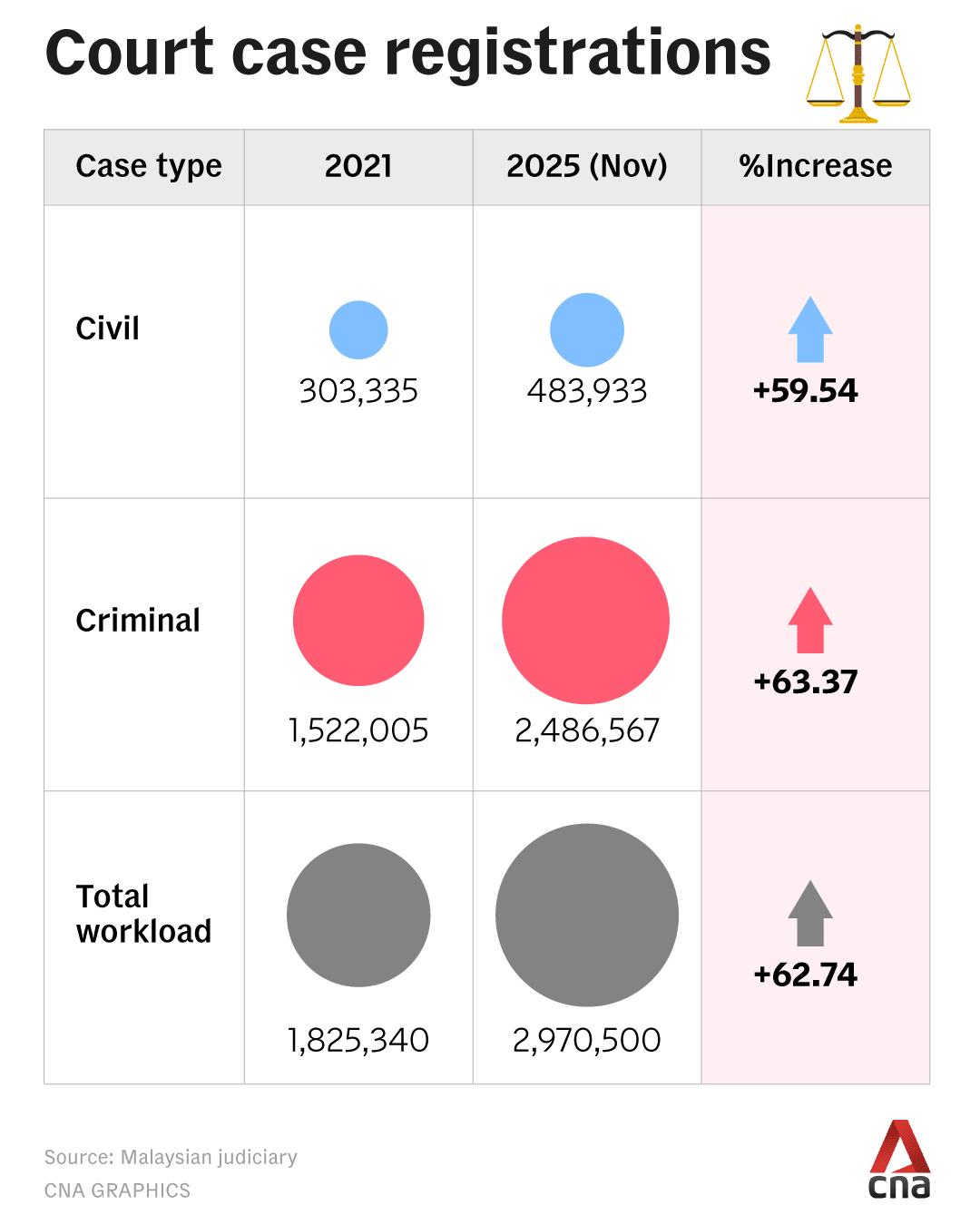
He said that between 2021 and November 2025, civil case registrations rose from 303,335 to 483,933 cases - an increase of 59.54 per cent over the period. At the same time, criminal case registrations rose from 1,522,005 to 2,486,567 cases, representing an increase of 63.37 per cent.
“These figures reflect a structural trend rather than a temporary surge. Looking at it positively, a more litigious society is a society that has faith in its judiciary,” Wan Ahmad had said then.





Those in the legal field whom CNA spoke to said that the surge in the number of cases is unsurprising, with former Court of Appeal judge Mah Weng Kwai saying that this was a common development seen in most developing countries.
“As the standard of education increases, more people know their rights. If there is a dispute, they don't fight in the street; they know where they stand legally, and that naturally leads them to the courtroom,” said Mah, who retired from the bench in 2015.
He added that the rise in caseloads also meant that the number of courts and judges in the country should be increased proportionately, echoing the statement that had earlier been made by Wan Ahmad who called for more institutional support from the government.
WHY THE INCREASE IN CIVIL SUITS
Beyond a heightened awareness of legal rights, those in the legal field attribute the surge in civil litigation to a combination of economic and societal factors, among others.
Malaysian Bar president Ezri Abdul Wahab said that as Malaysia’s economy diversifies - including in areas such as digital commerce, fintech, and cross-border transactions - contractual relationships in turn have become more layered and sophisticated.
“With that complexity comes a greater likelihood of disagreements requiring adjudication or resolution,” he said.
Ezri added that the after-effects of economic uncertainty, including financial distress, insolvency, employment disputes, and restructuring, often manifest in increased civil litigation.
He also pointed out that commercial defaults, landlord–tenant disputes, shareholder disagreements, and debt recovery actions tend to rise during and after periods of economic strain.


In Malaysia, civil jurisdiction is determined by the scale of the claim.
The Malaysian judiciary is organised into a two-tier hierarchy: the Subordinate Courts and the Superior Courts. The Subordinate Courts consist of the Magistrates’ Court and the Sessions Court, which handle the bulk of daily civil and criminal filings.
Above them sit the Superior Courts - comprising the High Court, the Court of Appeal, and the Federal Court - which deal with high-value disputes, constitutional matters, and final appeals.
The Magistrates’ Court presides over disputes involving sums up to RM100,000 (US$25,600), while the Sessions Court manages more substantial litigation valued at up to RM1 million.
For cases exceeding that threshold, the High Court maintains unlimited monetary jurisdiction.
Ezri observed that, anecdotally, the surge in case registrations alongside vacancies in the superior courts has created a judicial bottleneck.
“This shortage of judges has generally pushed hearing dates further into the future,” he said.

Lawyer Salim Bashir told CNA that as much as litigation is healthy in resolving disputes maturely and legally through judicial avenue, an overly litigious culture can have adverse effects.
“It can put pressure on individuals, companies and organisations due to prolonged legal battles, and litigation can be costly and not prudent for business growth and reputations. It can also be emotionally draining for the parties involved,” he said, adding that some of the delays in the court are bewildering.
A lawyer who requested anonymity told CNA that as the number of lawyers in the country grew, many have allegedly acted unethically and advised their clients to take matters to court, even if there was not a need to do so or the chances of winning were slim.
“If a firm is based on pure litigation practice, they don’t get paid much if they don’t take matters to court. Some of the claims can be frivolous and have a very low chance of success.
“Are lawyers giving the right advice to their clients or taking them for a ride?” he said, adding that some lawyers were not transparent about their fees, which could later shock their clients.
“It comes down to ethics,” he added, noting that some of his cases registered last year were scheduled to be heard only in 2027.
Separately, lawyer Edmund Bon believed that the rise in the number of cases sometimes meant that justice served may be too rushed.
“Judges do not have sufficient time to delve deeply into the cases and stakeholders will be limited to succeeding or failing on only a few issues,” he said.
In his speech on Jan 12, Wan Ahmad had remarked that while case filings rose, the number of judges had barely changed, creating an imbalance of workload capacity.
Wan Ahmad said the caseload “places immense and growing pressure on the justice system”, even as he stressed the “urgent and pressing” need to increase the number of judges.
Mah, drawing from his experience on the bench as a former justice at the Court of Appeal, noted that a judge’s work does not end when the court adjourns for the day. He said judges are forced to spend their off time drafting the legal decisions required to clear their dockets.
“Writing grounds takes time and judges use their weeknights and weekends,” he said, adding that the earning potential for a private practitioner significantly outstrips the salary of a judge.
While judges deliver their oral rulings immediately, they have an eight-week window to produce the formal written grounds of judgment if there is an appeal.
Malaysia operates on a two-tier appeal system, ensuring that every litigant has the right to have their case reviewed twice by higher authorities.
For instance, a suit originating in the High Court can be appealed first to the Court of Appeal, and should a further grievance persist, a final appeal may be pursued at the Federal Court - the nation's apex judicial body.
“Judges also have to go through written submissions of lawyers, many of which are hundred pages long and are convoluted. A lot of time is spent reading it. Life can be eased a little if the lawyers are brief,” said Mah.

CRIMINAL CASES ON THE RISE
Parallel to the surge in civil cases, criminal case registrations have seen an even sharper trajectory.
Salim expressed concern over this trend saying that the rise of criminal cases could be due to socio-economic factors such as poverty, unemployment, rapid urbanisation, technological advancement and corruption.
Ezri echoed Salim’s views and said that while a rise in prosecutions may reflect effective enforcement, it may also signal deeper social issues such as economic hardship or systemic challenges.
“This requires broader policy responses beyond the courts,” he said.
Criminologist Haezreena Begum Abdul Hamid of Universiti Malaya told CNA that property crimes such as housebreaking and theft as well as drug cases have generally gone up in recent years.
According to the Department of Statistics, Malaysia’s crime index - which includes assault and property crimes - in 2024 rose by 11.1 per cent with 58,255 cases reported compared to 52,444 cases in 2023.
The number of cases refers to the number of investigation papers opened for the respective offence, according to the department.
The statistics showed that the increase was largely driven by property crimes, which surged by 12.4 per cent to 47,188 cases.
Drug-related cases involving drug supply and possession increased by 10.6 per cent to 81,090 cases, reflecting intensified enforcement and possibly increased substance use.
It is unclear if all these cases were prosecuted in the courts or otherwise. CNA has reached out to the attorney-general's chambers for comment.
Haezreena said that the increase of cases was most likely caused by socio-economic factors such as the need to make ends meet.
“An easy way of making money could be selling drugs, even though people know it's wrong … but they still take the risk. The state would have to put in a lot of investment on security measures such as the police making more rounds,” she said.
Haezreena added that the increase of cases in the court would mean a backlog that grew every day.
“There are a limited number of courts and magistrates in the country. How many cases are they able to hear every day? This is sure to lead to burnout,” she said.
Meanwhile, Mah said that the sheer volume of cases also has a human cost: Individuals charged with non-bailable offenses - such as murder - may languish in remand for years, only to be eventually acquitted.
“It could be a few years before the cases are dealt with and if they are acquitted, it could mean time spent behind bars while awaiting trial. Those who are convicted would usually have their imprisonment backdated from the time they were arrested and remanded,” he said.


THE WAY FORWARD
As court filings continue to climb, a comprehensive and forward-looking strategy is essential to ensure that access to justice remains timely, fair, and effective, say legal experts.
They are unanimous: the first and most critical step must be the significant strengthening of judicial capacity.
Ezri said that the appointment of an adequate number of judges and judicial officers at all levels of the courts should be supported by well-trained registrars and court staff members.
“The timely filling of vacancies and the expansion of judicial resources are essential to prevent backlogs and reduce delays,” he said.
He, however, said that while the rise in cases reflects confidence in the justice system, it also underscores the need for efficient, proportionate dispute-resolution mechanisms.
“Litigation should not always be the first or only resort,” said Ezri.
He noted that the Bar has consistently promoted alternative dispute resolution, particularly mediation, as a constructive, cost-effective and time-efficient means of resolving disputes.
“Mediation preserves relationships, reduces legal costs, ensures confidentiality, and allows parties to craft practical, mutually acceptable solutions that a court may not be able to provide,” he said.

He added that practitioners bear a heightened responsibility to promote professionalism, discourage frivolous claims, and advise clients on proportionate and constructive dispute resolution strategies.
“Lawyers are increasingly expected not only to litigate effectively, but also to guide clients toward mediation, negotiation, and settlement where appropriate.
“The profession must therefore cultivate both advocacy and problem-solving skills,” he said.
Mah, the former judge, proposed the recruitment of specialised contract judges from the legal field such as experienced lawyers to specifically target the mounting backlogs in civil litigation.
He suggests that these appointments should focus on commercial and corporate disputes rather than criminal matters.
He said that ultimately, those who want to serve as judges have to deal with heavy caseloads and drafting grounds of judgments.
“At the end of the day, judges are doing public service in the interest of dispensing justice,” said Mah.
As for Nurul - the makeup artist - she is unsure of what the future holds, but vowed to give it a fight if her legal matter does indeed go to court.
"This is something that I have to do for myself," she said.