Malaysia’s curb on non-AI data centres seen as ‘strategic throttle’, but challenges remain
Late last month, Prime Minister Anwar Ibrahim said the federal government has been turning away applications for new data centres that are unrelated to artificial intelligence over the past two years or so.
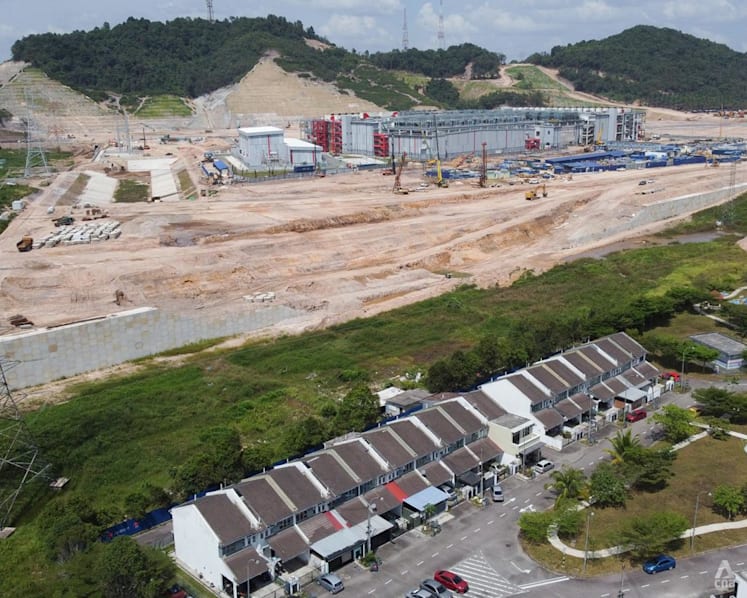
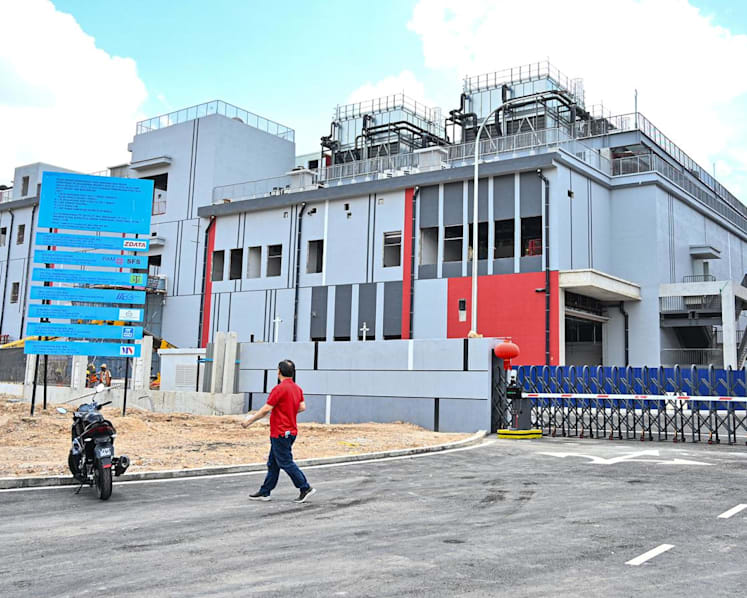
A housing area is located just 100m from the ZData construction site. (Photo: CNA/Zamzahuri Abas)

This audio is generated by an AI tool.


GELANG PATAH, Johor: When retiree Ramli Paiman bought his double-storey terrace in Taman Nusa Bayu in Iskandar Puteri more than a decade ago, the backyard opened to lush greenery.
Today, just 150m from his back door, a 15ha construction site - roughly the size of 29 football fields - buzzes with activity, as cranes swing and piling machines hammer into the ground.
The land was initially owned by Malaysian real estate subsidiary Tropicana Firstwide and was partly sold to data centre firms, Chinese-headquartered ZData and Japanese-headquartered NTT Data Group, in 2025.
The project area is close to a residential zone where around 20,000 people live.





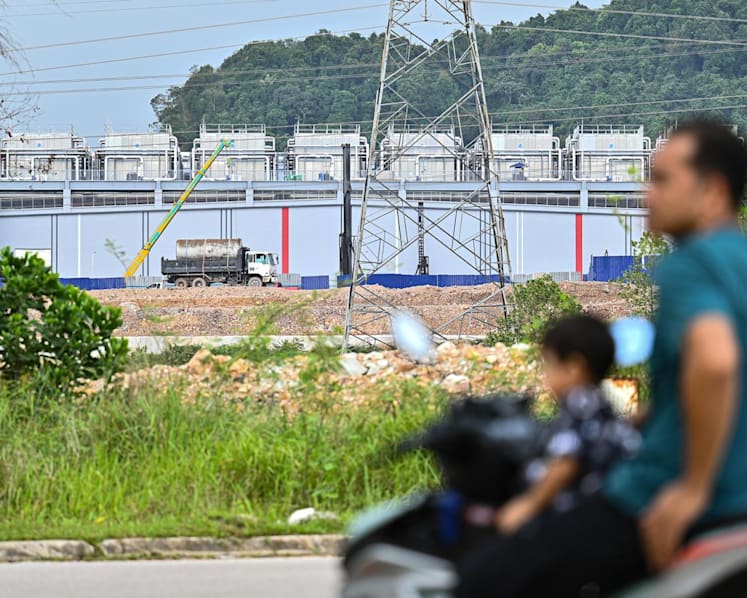
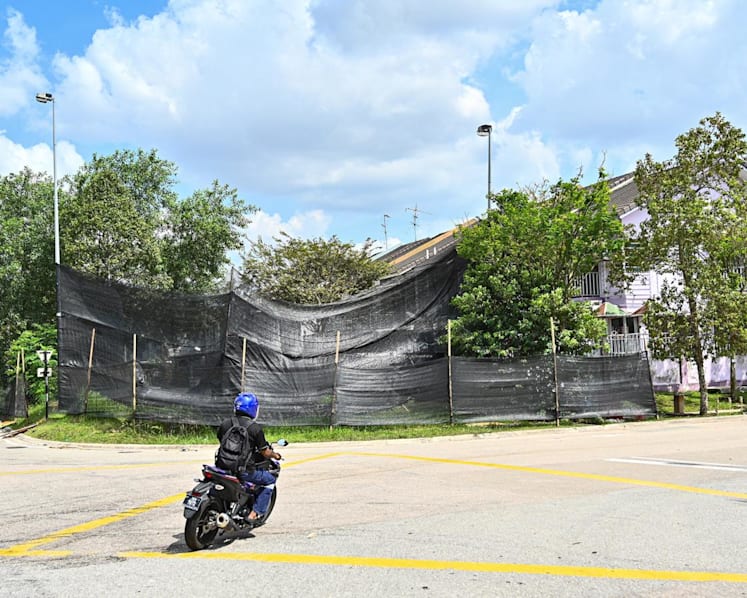
Ramli and several neighbours said that the transformation has come at a cost. When CNA visited the neighbourhood on Wednesday (Mar 11), there was thick dust coating on cars and windows. Residents also claimed this has led to health concerns.
Ramli, 65, claims his daughter, a student, has experienced breathing difficulties due to the dust, causing her to restrict herself to indoors.
“The dust causes coughing. My own child, when she comes back home (from her outstation work commitments), can’t stay out of the house, because the polluted air makes it hard for her to breathe,” said Ramli.
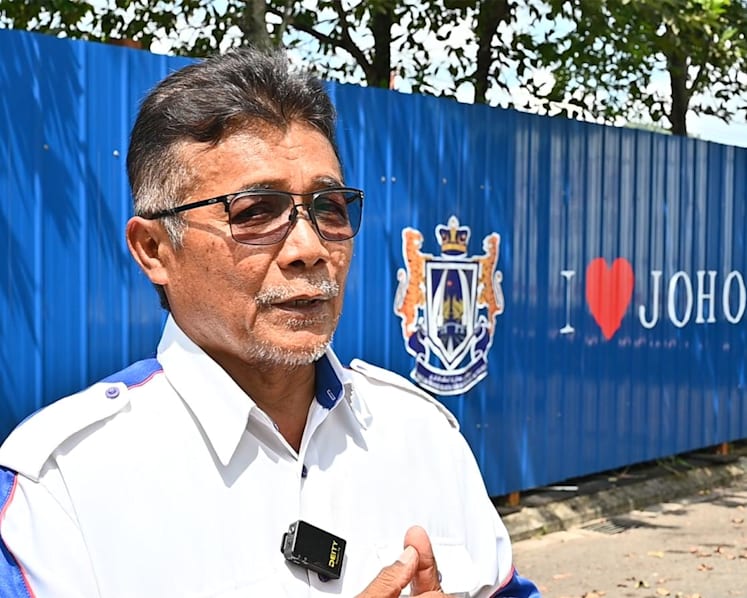
Ramli and his family have been swept up in the effects of Malaysia’s data centre boom. The surge has been swift, especially in Johor which has benefitted from spillover demand from southern neighbour Singapore.
According to a report by consultancy firm IPM, there were roughly two dozen data centre sites across Malaysia in 2020. By 2025, that number had nearly doubled to 46 operational facilities, with another 48 in the pipeline, according to market data firm Arizton.
The federal government has hailed this as a boon for foreign investment and Malaysia’s digital ambitions. But residents and some experts say infrastructure planning is struggling to keep pace.
Ramli, who previously worked in construction, now heads a residents’ action committee negotiating with state authorities and project representatives. Among their demands are compensation for medical bills linked to the data centre construction and higher electricity costs, as families rely heavily on air-conditioners and fans to dry clothes indoors.
He maintained that he is supportive of Johor’s data centre boom as it would bring jobs and prosperity to the state.
“We are supportive of the state’s efforts to bring in data centres, you never know one day my children or grandchildren might get a job with these companies,” he said.
But he expressed hope that the issues plaguing residents in the construction phase are managed better.
Elsewhere, complaints have surfaced in Johor’s Iskandar Puteri, Senai and Pasir Gudang districts, as well as in Selangor’s Elmina Park.
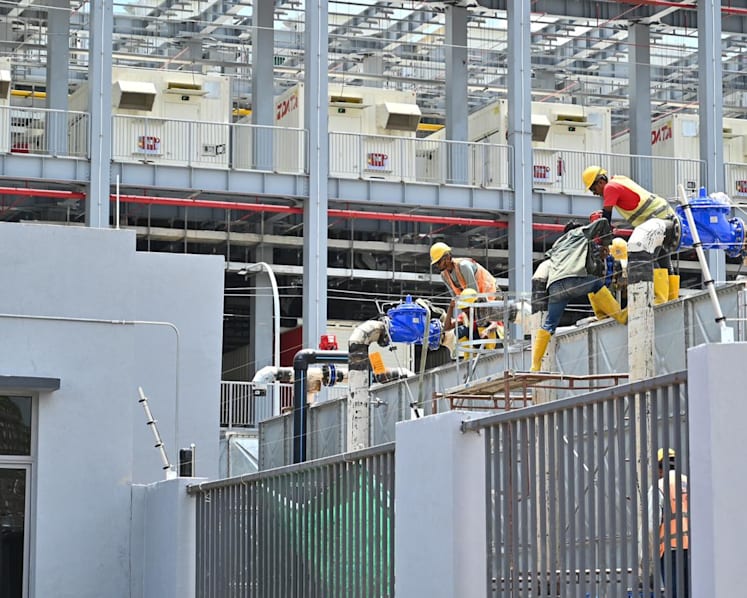
Concerns from residents and experts range from pollution and construction disruption to the strain on water and electricity supplies.
This has prompted the government to be more discerning of upcoming projects, with the Johor state saying it no longer approves Tier 1 and Tier 2 data centre projects as these consume up to 50 million L of water a day, roughly 200 times the volume consumed by Tier 3 or 4 sites.
Late last month, Prime Minister Anwar Ibrahim confirmed that for the last two years or so, the federal government has turned away data centre applications not related to Artificial Intelligence (AI).
This move has been largely lauded by experts, local residents and industry players, as it is viewed as a recalibration rather than a retreat.
Johor-based urban planning consultant Samuel Tan told CNA: “Anwar’s announcement is a strategic throttle rather than a full brake.
“He is signalling to the global market Malaysia’s shift from an ‘open-door’ policy to a ‘selective-priority’ model reflects a maturing market that is no longer just chasing capital, but resource efficiency and high-value tech,” added Tan, who is CEO of Olive Tree Property Consultants.
Still, some observers questioned whether the policy will significantly curb the pace of development, given the volume of projects already approved or under construction.
Others pointed to the lack of clarity around what qualifies as an AI-centric project.
Without a clear definition, they warned that companies could reclassify projects to meet approval criteria, a practice some describe as regulatory arbitrage.
“Without clear policy definitions, Malaysia risks absorbing the water, power and land footprint of hyperscale infrastructure without necessarily capturing the deeper technological benefits,” said conservation finance policy analyst Shaqib Shahril.

LOOSE DEFINITION COULD RENDER POLICY REDUNDANT
Of the 48 known upcoming data centres in Malaysia, most are reportedly AI-ready or cloud centric.
According to online financial reports, these include cloud-oriented projects by multi-national corporations such as Microsoft, AirTrunk and Google, as well as a facility by YTL Power which is powered by global chipmaker Nvidia’s Blackwell architecture.
In his speech in parliament, Anwar did not specify how the government distinguished AI and non-AI projects.
While the policy to pivot to AI data centres is prudent, analysts stressed that it was important the authorities be transparent on the definition of what constitutes AI-centric facilities.
For instance, experts pointed out that an upcoming data centre project in Johor’s Senai airport city by China-based EPG is on paper a non-AI facility.
The project broke ground in March 2025, and according to reports, is a “modular data centre manufacturing facility”.
CNA has reached out to the Johor state government and EPG on whether it has fulfilled conditions to be AI-ready.
Tan stressed that the definition and specification is the “most contentious part of the policy”.
“The risk of a loose definition: If ‘AI’ is defined simply by rack density or the presence of a few GPUs, every operator will claim to be an ‘AI’ DC,” he told CNA.
Rack density refers to the amount of power used by equipment in a single server rack. A graphics processing unit (GPU) is an electronic circuit that can perform mathematical calculations at high speed.
Meanwhile, Shaqib outlined that the definition must strike a balance of not being too loose, but also not “overly technical”.
“What matters from a policy perspective is not the exact chip architecture inside the facility, but whether the infrastructure meaningfully contributes to Malaysia’s digital capability relative to the scale of resources it consumes,” he said.
In response to queries from CNA, Eric Fan, the CEO of the Singapore-headquartered Bridge Data Centres (BDC) which has multiple data centres in Johor and Cyberjaya, told CNA that it is continuing "to work closely with the Malaysian government" to ensure its AI-ready data centre developments align with regulatory requirements.
However, he did not elaborate on what these requirements were.
CNA has reached out to the Ministry of Trade and Industry on what specifications there are to define if a facility is an AI data centre.

PIVOT TO AI DATA CENTRES: LESSONS AND SOLUTIONS
A spokesperson for ZData Yeo Yong Hwang told CNA that the firm supports Malaysia’s move to emphasise AI-ready centres.
“Our projects are AI-ready and (because they are AI-ready) our servers now require less power. It is more efficient and has a lower (carbon) footprint,” he added.
On allegations that construction for ZData data centres have impacted residents in Gelang Patah, Yeo acknowledged that the company is partly responsible, even though he stressed that “not 100 per cent of the dust generated” is due to them.
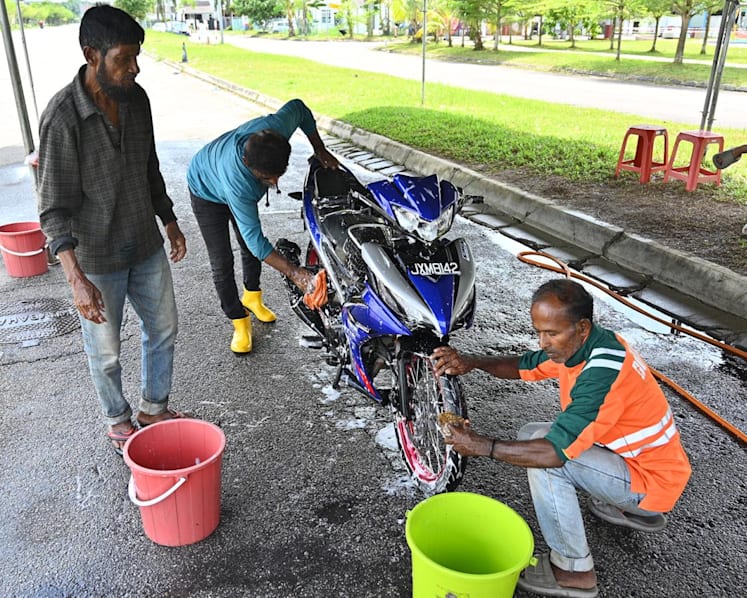
Yeo told CNA that the company has also splashed out on funds to provide residents with free car wash services, installed hoardings to block dust and a hammering system that would minimise noise.
“We are committed to solving the problem. Whatever (issue) arises from our side, we definitely clear (the problems). We even do more than what our residents have (asked for),” he added.
Experts CNA spoke to also suggested other measures Putrajaya may implement to better manage the proliferation of data centres vis-a-vis allocation of water and power supply.
Shaqib proposed a Johor infrastructure zoning blueprint which will identify zones where hyperscale facilities may be concentrated.
Shaqib added that this is key, especially with the huge volume of projects expected via the Johor-Singapore Special Economic Zone (JS-SEZ).
“A structured digital zoning framework would allow the state to coordinate electricity provisioning, water treatment capacity, and cooling-water flows in a more systematic way, rather than reacting to demand after projects are already approved,” said Shaqib.
A case in point is Sedenak Tech Park near Kulai Johor, which is around 50km from Johor Bahru. The park has at least three confirmed data centre campuses.
Analysts said that this would help prevent clashes with residential zones, like in the case of Gelang Patah.
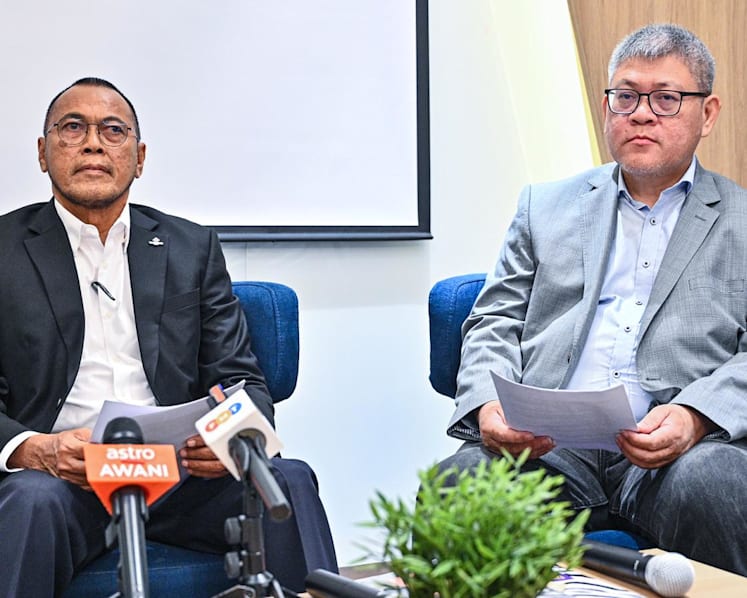
During a joint press conference on Tuesday held with ZData, Kota Iskandar assemblyman Pandak Ahmad acknowledged that data centres should not be built “too close to residential areas” and that this is a lesson for the state government to learn from.
Shaqib added that data centres should also largely rely on transportable water, especially in regions where supply is limited.
Data centres require large volumes of water for their cooling systems.
Shaqib suggested that Johor state in particular align its data centre projects with improving its water infrastructure systems.
He noted that Johor has seen recent water disruptions in Simpang Renggam and Benut and he noted that the chief minister Onn Hafiz Ghazi has denied that they were linked to data centres, pointing to dry weather instead.
However, he pointed out that these incidents sharpen the argument that the southern state has structural issues in water management.
Shaqib told CNA: “If Johor is already vulnerable to drought-linked stress and source-level constraints, then the appropriate policy response is not to dismiss future industrial demand but to ensure that resource allocation frameworks are strengthened before the system is pushed further.”
For example, Zdata's Yeo pointed out that the firm uses reclaimed water. He said the firm processes them at a treatment plant nearby their data centre facility and this ensures that Zdata does not draw on Johor's water supply meant for residents.
But others say overall the policy to pivot to only-AI data centres means that Malaysia is prioritising quality over quantity.
“This prevents companies from building massive shells under the guise of AI and then filling them with low-tech, low-value generic cloud storage that doesn't contribute to the local tech ecosystem (via jobs),” said Tan.
“By freezing the ‘non-AI’ projects, the government is effectively clearing the queue to ensure that the most advanced projects (like those from Microsoft, Google, or YTL-Nvidia) have the power and water they need without delay,” he added.
Shaqib echoed similar sentiments, outlining how the policy is an example of capital screening and signals that Malaysia only wants projects that would benefit the country in the long term.
“What the federal government is now making explicit is that Malaysia no longer wants to intermediate digital infrastructure merely on the basis of cheaper land, power and water,” he said.
“The state is trying to discriminate between facilities that deepen Malaysia’s position in the digital value chain and those that mainly arbitrage utility costs. That is a qualitatively different industrial-policy posture,” the analyst added.