Myanmar election offers little change to political reality, analysts say
The military-backed USDP has claimed a landslide in Myanmar’s post-coup election, but observers say the vote is unlikely to ease conflict or revive the economy.
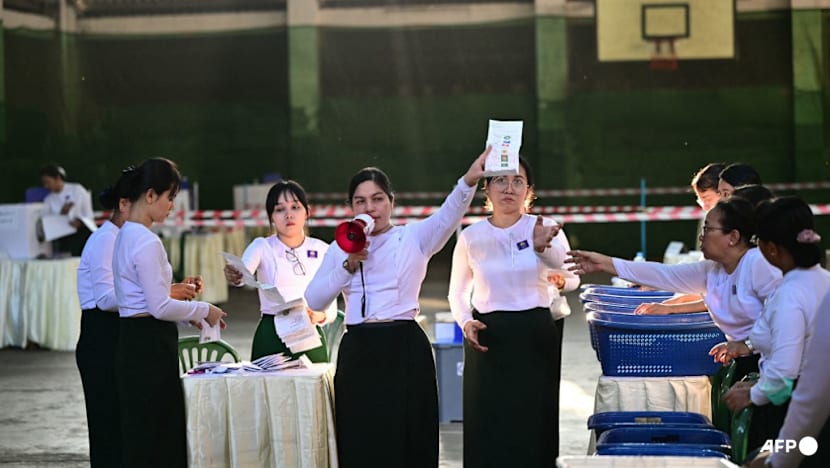
Members of Myanmar’s Union Election commission count ballots after the closing of polls at a polling station in the third phase of Myanmar’s general election in Yangon on Jan 25, 2026. (Photo: AFP/Sai Aung Main)

This audio is generated by an AI tool.


A month-long election concluded in Myanmar on Sunday (Jan 25) with the military-backed Union Solidarity and Development Party (USDP) claiming a landslide victory.
Despite some hopes that the tightly controlled polls could stabilise the country or revive its battered economy, analysts say the vote does little to alter Myanmar’s political reality.
The election – the first since the 2021 coup – comes amid widespread conflict, economic decline and international scepticism.
Under Myanmar’s 2008 constitution, the military is guaranteed 25 per cent of parliamentary seats and control of key ministries, ensuring it retains significant power regardless of the outcome.
Malaysia, last year’s chair of the Association of Southeast Asian Nations (ASEAN) – of which Myanmar is a member – has already said it will not endorse the results, citing the lack of inclusive and free participation.
Resistance groups inside Myanmar have also dismissed the vote as illegitimate.
Former United States ambassador to Myanmar Scot Marciel was blunt in his assessment.
“Sham is not even strong enough to describe these elections,” he told CNA’s Asia First programme.
TIGHTLY CONTROLLED POLLS
Since the February 2021 coup, Myanmar’s military has ruled the country through a combination of force and repression.
In the run-up to the election, the junta dissolved the party of democratic icon Aung San Suu Kyi, the National League for Democracy (NLD).
It also detained many pro-democracy leaders and barred public criticism of the electoral process.
Marciel, who served as ambassador from 2016 to 2020, said the vote simply formalises what already exists.
“This is really just going to be a bunch of generals and their allies and the USDP party taking off their uniforms and putting on civilian clothes.”
Rather than rebuilding domestic legitimacy, Marciel said he believes the election is aimed outward, adding that the junta is seeking engagement from regional and international partners, particularly China.
For most people inside Myanmar, especially those in conflict-affected regions, the election is unlikely to bring any relief, he added.
“They will go from a military in uniform governing them badly and brutalising them, to generals and their allies in civilian clothes governing them badly and brutalising them,” Marciel said.
ECONOMIC CHALLENGES REMAIN
For Myanmar’s struggling economy, some local businesses had been optimistic that the election might bring a measure of predictability or policy reform.
“There's a hope that somehow this new government will be in some way trying to demonstrate a change,” said Vicky Bowman, senior adviser at the Institute for Human Rights and Business and former director of the Myanmar Centre for Responsible Business.
Bowman, who also served as the British ambassador to Myanmar from 2002 to 2006, told CNA’s Asia First that businesses now hope that the election will open up space for dialogue.
“They’re hoping … there'll be a parliament of sorts, which will take some policymaking out of the black box that has sat with the military regime for about five years since the coup,” she said.
She noted that authorities have begun reaching out to local businesses to ask what changes they want to see.
However, Bowman stressed that the election does not resolve Myanmar’s core economic problems.
Power shortages, deteriorating internet connectivity and infrastructure decline continue to weigh on growth.
“Fundamentally, it’s the political problem that hasn’t been fixed with this election,” she said.
Bowman said the ongoing violence continues to disrupt trade and undermine personal security, pushing many young people to leave the country in search of work, safety or education abroad.
“And that's something which businesses are also really concerned about,” she added.
Bowman also pointed to years of policy mismanagement that have held back the economy.
These include import restrictions, foreign exchange controls and regulatory uncertainty, which have fuelled corruption and discouraged investment.
As a result, foreign businesses remain wary.
“People are not really looking at Myanmar as a place that they want to invest,” she added, noting that the optimism seen during Myanmar’s political opening in the early 2010s has not returned.
CHINA’S ROLE LOOMS LARGE
China’s growing influence over Myanmar is unlikely to deliver lasting stability, analysts added.
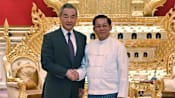
Beijing in 2024 stepped up economic ties with the junta, helping to shore up the regime at a time of intense pressure.
Marciel noted that while Beijing has exerted pressure on some ethnic armed groups, such groups “have a long history of accommodating that pressure in the short term, but then reverting back to opposition to the military”, he said.
He said neither China’s involvement nor the election itself offers a credible path to stability, given the junta’s deep unpopularity.
After nearly five years in power, he added, the military has “shown no ability to run the economy or to otherwise govern the country”.
China’s prominent role also has regional implications.
While many ASEAN governments, including Thailand, have said that Myanmar’s election is not free or fair, frustration is growing over the bloc’s Five-Point Consensus.
The post-coup framework for ending violence and restoring dialogue has “failed utterly”, Marciel noted, “mostly because of the unwillingness of the military in Myanmar to compromise”.
That, he added, could lead some ASEAN members to favour renewed engagement, driven by concern about China’s growing influence, despite the “sham nature of this election”.
From an economic perspective, Bowman warned that Naypyidaw’s dependence on Beijing may come at a long-term cost.
“One of the worries that many in the country have is that, in order to get China's help in clamping down on some of the ethnic armed groups … the regime has effectively promised China a free range on things like Myanmar’s mineral resources,” she said.
Myanmar’s resources have long flowed across the border to China, she noted.
“Whether it’s been teak … jade, and nowadays it’s antimony, it’s tin, it’s light and heavy rare earths – all of which are going out at an incredibly low value in return to Myanmar and making big profits and giving China a big strategic position,” Bowman said.
“What’s most important is that Myanmar works to maximise the value of those resources for the country and also ties that into a federal political settlement,” she added.
GAMBLE ON WANING GLOBAL ATTENTION
Singapore Institute of International Affairs chairman Simon Tay said the election reflects a broader gamble by Myanmar’s military on domestic and international fatigue.
Tay noted that global attention is stretched by crises elsewhere, including in places like Ukraine and Gaza.
“This election … could be something (Myanmar’s) military is gambling on that some countries will make a change of position,” he told CNA’s Asia Now, noting that Russia, China and North Korea have already shown signs of opening up ties with Myanmar.
Tay added that holding elections does little to demonstrate real governing capacity.
“This is more (about) papering over,” he said, noting that voting took place mainly in areas under military control.
Voter participation, Tay added, has also fallen, raising further doubts about the vote’s legitimacy.
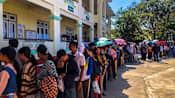
Voting was held over three phases. Turnout in the first and second phases was just over 50 per cent, official figures said, compared to roughly 70 per cent in 2020 – when Aung San Suu Kyi’s NLD won a decisive victory.
Voting was also cancelled in several conflict-affected townships.
Related:
Official results are expected later this week, but Tay added that the election’s outcome should not be read as an endorsement of the regime.
“Many people I’ve spoken to think they’ve got no choice but to go along,” he said.
Tay also framed the situation as a clash between principles and realism.
“Nobody wants a Syria, a sort of collapsing state … China does not want this problem on the border. Neither does Thailand.”
For ASEAN, he added, the priority is not the election itself. “Stopping the violence is the first thing, not democracy,” Tay said.
“And if that can be delivered by the military in some sort of compromise domestically, I think ASEAN can be pragmatic. Otherwise, Myanmar is going to the arms of China or Russia, and ASEAN will play itself into a corner.”