Rising oil prices amid Iran war renew focus on sustainable aviation fuel
What if the answer to volatile oil markets lies not in oil fields, but in food waste? This alternative could make airlines much less susceptible to fluctuations in oil prices.

This audio is generated by an AI tool.



HONG KONG: Oil markets have been thrown into turmoil as conflict in the Middle East intensifies, sending crude prices spiraling and rippling across global industries, including aviation.
Multiple airlines have begun raising ticket prices and travellers are already feeling the squeeze as jet fuel costs surge.
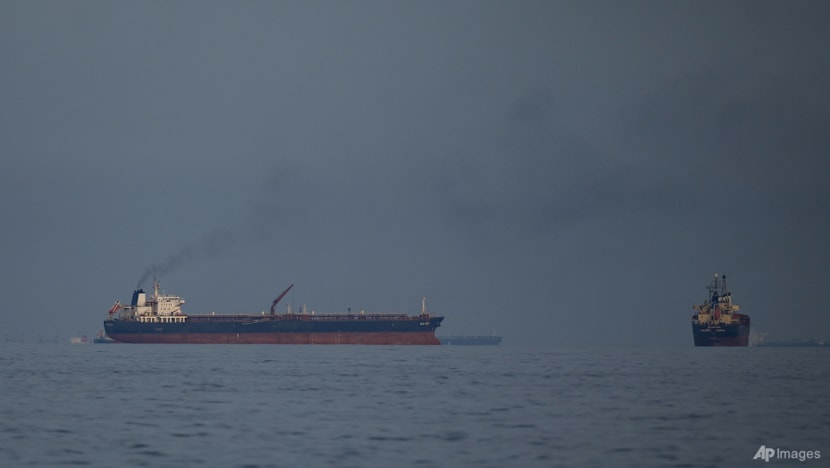
Since the United States and Israel launched strikes on Iran two weeks ago, Tehran has responded with attacks on oil infrastructure in the Gulf and disrupted shipping through the Strait of Hormuz – a critical chokepoint through which one-fifth of the world’s oil supply passes – sending energy markets into upheaval.
As airlines once again confront the volatility of fossil fuel markets, attention is turning to a viable alternative: sustainable aviation fuel (SAF).
And the raw material may be closer than most people think.
FROM FOOD WASTE TO JET FUEL
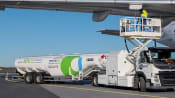
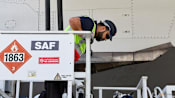
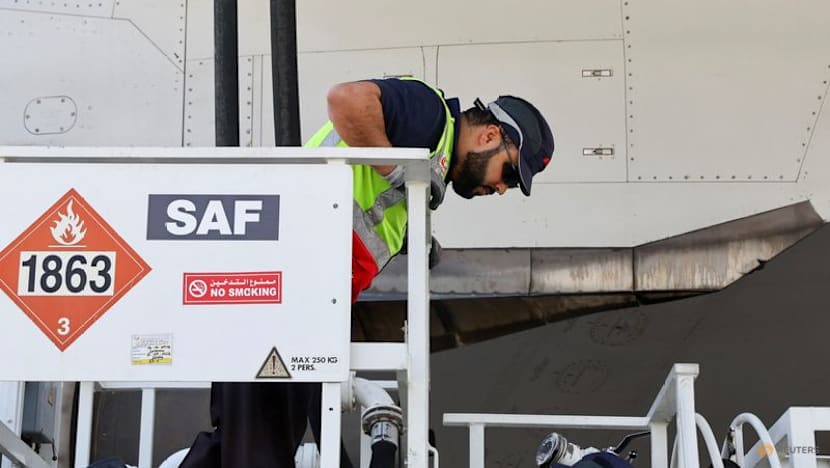
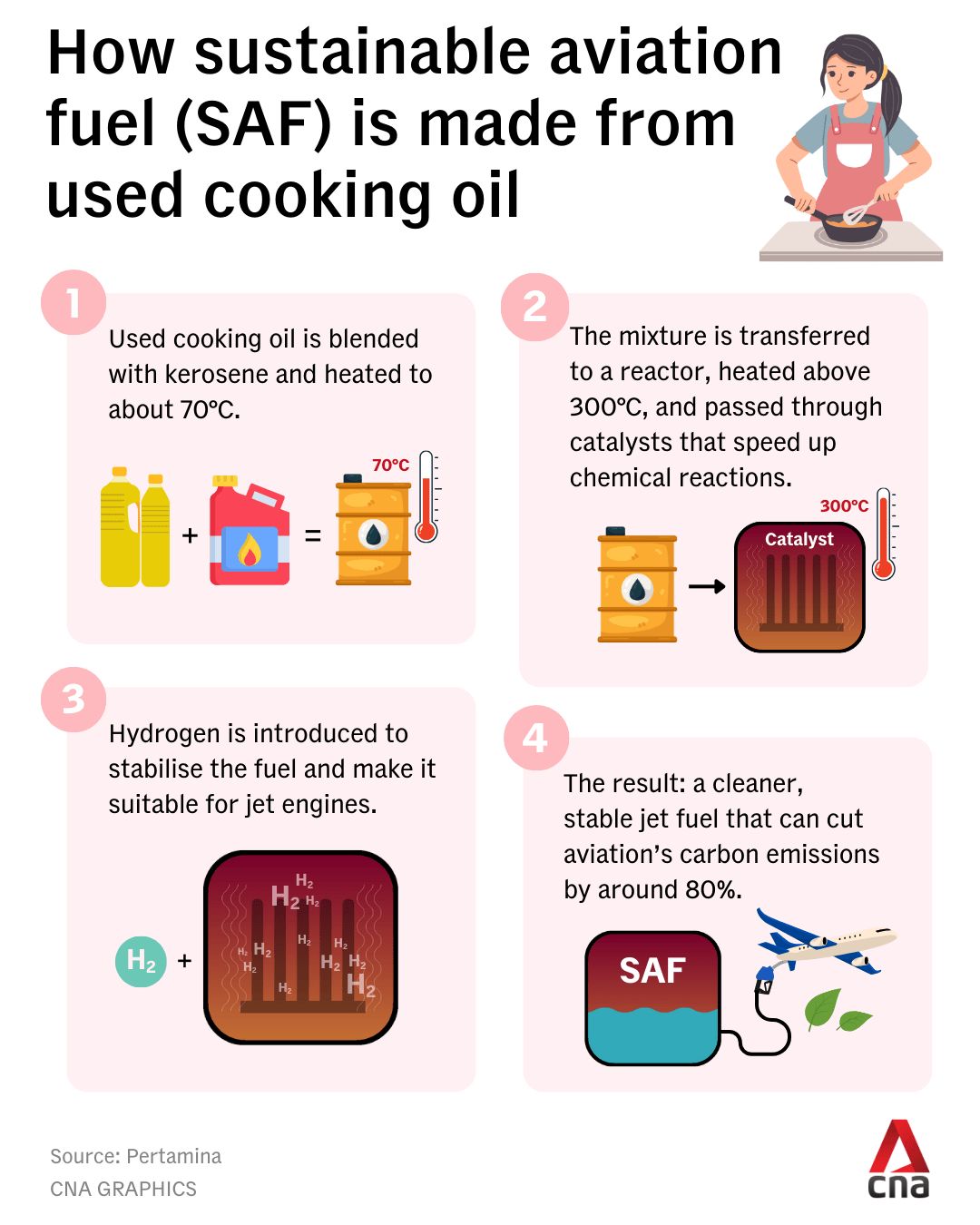
SAF is a cleaner, non-petroleum-based jet fuel produced from unwanted waste and residue generated by various industrial and food processes.
Feedstocks include used cooking oil, agricultural residue and municipal waste.
These materials are refined into a low-carbon fuel that can be blended with conventional jet fuel and used in existing aircraft engines without modification.
At EcoCeres, a Hong Kong-based biofuels producer, feedstock is primarily sourced from China and Southeast Asia.
Among the materials it processes are animal fats, palm oil mill effluent – a highly polluting thick liquid waste from palm oil production; and brown grease – a waste byproduct collected from grease traps in kitchens and sewer lines.
"Feedstock collection is important. We have our own ... traceability system. So, we trace all the restaurants, when and where all the waste is coming and how much," said the firm's CEO Matti Lievonen.
"Today we have in China around 350,000 restaurants supplying feedstock to us. And we have expanded our (tracing system) to now outside of China."
By repurposing waste streams that would otherwise be discarded, SAF produced reduces reliance on crude oil while lowering lifecycle emissions.
CUTTING AVIATION’S CARBON FOOTPRINT
The environmental case for SAF is compelling. Industry estimates suggest it can reduce lifecycle carbon dioxide emissions by up to 80 per cent compared with conventional jet fuel.
That reduction is significant, especially as analysts project that aviation emissions could more than double by 2050 if left unchecked.
Aircraft engines account for the overwhelming majority of airport-related emissions, according to Ken Lau, head of sustainability at ACI Asia-Pacific and Middle East, which represents over 600 airport members across the two regions.
“The carbon emission from engines accounts for more than 95 per cent of overall airport emissions. That’s why it's very important for airports to facilitate SAF,” he said.
“SAF is the main solution for now, at least for this decade, to ensure that carbon emissions from engines remain as low as possible.”
The push aligns with the Intergovernmental Panel on Climate Change’s (IPCC) calls for global net-zero emissions by 2050 to limit global warming.
For long-haul aviation in particular, SAF is widely seen as the most viable near-term decarbonisation pathway, as battery and hydrogen alternatives remain technologically challenging.
CAN SAF BUFFER OIL PRICE SHOCKS?
However, SAF is not yet a silver bullet, especially when it comes to insulating airlines from oil price spikes.
“(SAF) as a tool to buffer the industry against jet fuel price fluctuations … is significantly more challenging because it's still going to be more expensive in general,” said Ji Yang Lum, biofuels analytics associate director at S&P Global Commodity Insights.
Currently, SAF costs three to five times more than traditional jet fuel and production capacity is limited as refineries are much fewer and smaller than those for their fossil fuel counterparts. Feedstock supply is another bottleneck.
“In general, investments have not been quite at pace in order to meet these really aggressive decarbonisation targets,” Lum told CNA’s Asia First programme.
MANDATES & GLOBAL MOMENTUM
The development and use of SAF have so far been led by Europe and the US, where blending mandates and policy incentives have accelerated adoption.
Mandates legally require airlines to mix a minimum percentage of renewable fuel into total jet fuel consumption, creating guaranteed demand and encouraging investment.
"Europe is the biggest market for us, as there is a mandate," said EcoCeres' Lievonen,
"Europe is a forerunner in (SAF) but others are following. Asian markets (are also) increasing, based on announcements of what governments are doing in different countries."
In Asia-Pacific, Japan, Malaysia and Singapore are among the more advanced players, while the rest of the region needs to catch up with government intervention, experts say.
“It usually starts out with individual state pledges and making mandates,” said Lau.
China, the world’s second-largest civil aerospace and aviation services market after the US, has yet to introduce a national blending mandate.
However, Beijing is accelerating its efforts and positioning itself as a future heavyweight in SAF production.
“China has a very clear line of sight and direction,” Lum said. “It's still in transition, but it has the ability to scale renewable energy in order to tackle more advanced and expensive technologies.”
Beijing recently announced the establishment of a National Low-Carbon Transformation Fund, signalling stronger state support for investments in hydrogen energy and green fuels, including SAF.
Lum believes China could eventually become a significant global SAF supplier. However, near-term challenges remain, including high costs, limited waste-based feedstocks and export quota controls.