







Gold hits second record high in three days as US, EU lob fresh salvos over Greenland
Gold crossed US$4,800 per ounce on Wednesday (Jan 21) as fears of a trade war between US and Europe caused a surge in safe-haven demand.
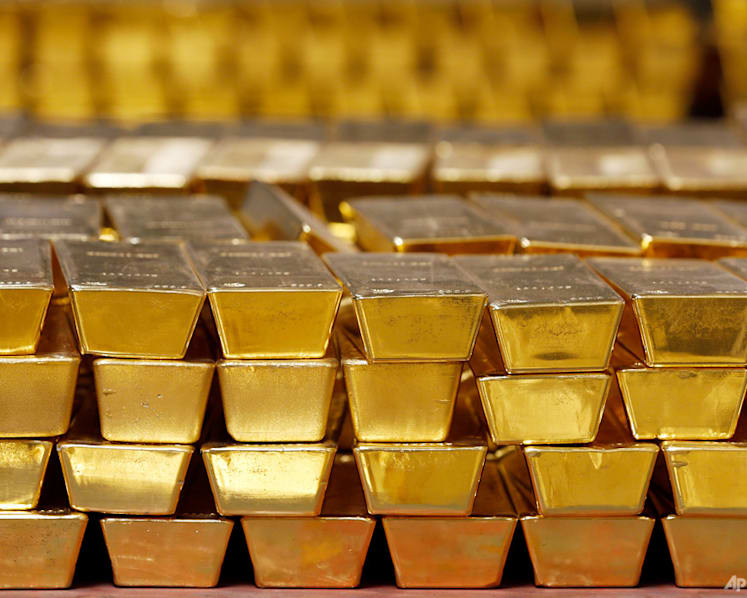
Gold bars are stacked in a vault at the United States Mint on Jul 22, 2014, in West Point, NY. (File photo: AP/Mike Groll)
SYDNEY: Gold prices surged to a record high above US$4,800 per ounce on Wednesday (Jan 21), buoyed by safe-haven demand and a softer dollar as United States President Donald Trump's pursuit of Greenland threatened to reignite a trade war with Europe and upend the NATO alliance.
Spot gold rose 1.2 per cent to US$4,821.26 per ounce by 2.26am GMT (10.26am, Singapore time), after scaling a record US$4,843.67 earlier in the session.
US gold futures for February delivery climbed 1 per cent to US$4,813.50 per ounce.
The precious metal, a key go-to in times of turmoil, has now surpassed a record high it reached on Monday when it peaked at US$4,690.59.





"It's the loss of trust in the US caused by Trump's moves over the weekend to tariff European countries and increase his coercion in trying to take Greenland. (The move in gold) reflects fears about global geopolitical (tensions)," said Kyle Rodda, a senior market analyst at Capital.com.
On Tuesday, Trump said there was "no going back" on his goal to control Greenland, refusing to rule out taking the Arctic island by force and lashing out at NATO allies.
He later said: "We will work something out where NATO is going to be very happy and where we're going to be very happy."
Meanwhile, French President Emmanuel Macron said Europe would not give in to bullies or be intimidated, in a scathing criticism of Trump's threat of steep tariffs at Davos if Europe does not let him take over Greenland.

"Obviously, investors are selling the dollar, they're selling treasuries, particularly at the long-end, and buying gold instead because there is greater confidence in gold than in the US (currency) right now," Rodda said.
The dollar languished near three-week lows against the euro and Swiss franc while Asian markets were mostly down in afternoon trading after a rough start to the week.
Tokyo, Singapore, Taipei, Jakarta, Manila and Hong Kong were in the red around noon in Singapore, while Shanghai was up slightly. US futures advanced.
All eyes are now on the World Economic Forum in Davos, where Trump is due to deliver a speech on Wednesday.
"Traders continue to monitor the prospects for an agreement around Trump's claim on Greenland, alongside the ongoing pricing of risk that Trump subsequently raises tariffs on European imports ... and whether Europe responds with impactful tariffs of its own," wrote Chris Weston at Pepperstone.
"The focus from traders now turns to Trump's scheduled speech in Davos, but prior to that, the reaction and the ensuing price action through the Asian session."
PAUSE IN JAPAN'S BOND ROUT
The global bond market was still reeling from a brutal selloff, having been caught up in a perfect storm of worries over exposure to US assets and a surge in Japanese government bond yields.
Market worries over increased government spending under Japanese Prime Minister Sanae Takaichi sent bond yields there skyrocketing to record highs.
Investors were trying to catch their breath in early trading.
Providing some relief to frayed debt market nerves, the 40-year Japanese government bond yields retreated 6 basis points on Wednesday to 4.145 per cent after surging 26 basis points a day earlier to a record high of 4.215 per cent. Liquidity in other tenors remains thin.
Listen:
US Treasury yields were also steady on Wednesday. The benchmark 10-year yield slipped 1 basis point to 4.285 per cent, having jumped 7 basis points overnight to a five-month high of 4.313 per cent amid the "Sell America" fears.
Danish pension fund AkademikerPension said on Tuesday it would sell off its holding of US Treasuries, worth some US$100 million, by the end of this month, blaming weak US government finances.
In the currency markets, the US dollar held steady at 98.56 against its major peers, having dropped 0.5 per cent overnight - the biggest daily fall since early December.
The yen was steady at 158.19 per dollar, but lost out on a number of crosses, with the Swiss franc hitting a record high of 200.19 yen.
The Bank of Japan meets on Friday, and though no rate hike is expected this time, policymakers could flag a tightening as soon as April.
Oil prices fell as pressure from geopolitical tensions and an expected build-up in US crude inventories outweighed a temporary halt in output at two large fields in Kazakhstan.
West Texas Intermediate crude oil prices for March fell 1.31 per cent to US$59.57 a barrel.





