







Commentary: Europe is pushing back harder against Trump over Greenland - here’s why
Given Europe’s latest response over Greenland, it seems clear that the strategy of placating US President Donald Trump has reached its use-by date, says international security professor Stefan Wolff.
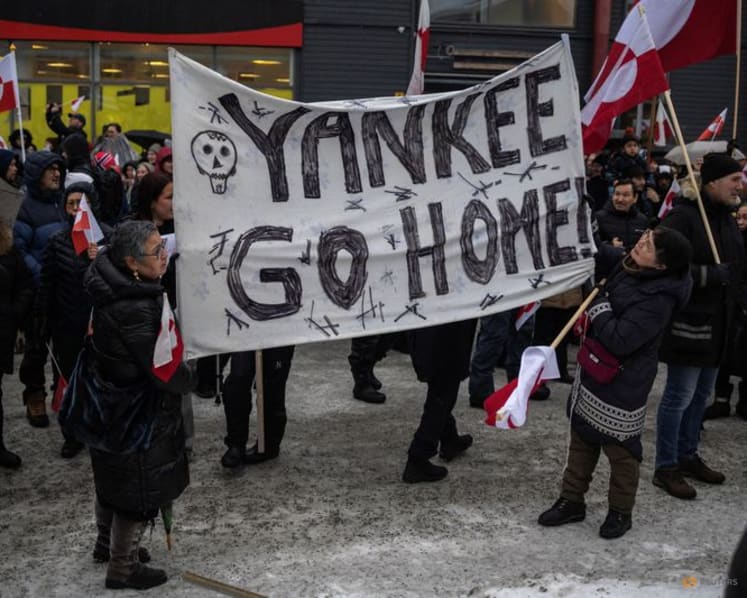
People attend a protest against U.S. President Donald Trump’s demand that the Arctic island be ceded to the U.S., calling for it to be allowed to determine its own future, in Nuuk, Greenland, January 17, 2026. REUTERS/Marko Djurica

This audio is generated by an AI tool.


BIRMINGHAM, England: United States President Donald Trump has doubled down on his bid to take over Greenland, warning on Monday (Jan 19) that being snubbed for the Nobel peace prize last year has made him no longer obliged to think “purely of peace”.
Buoyed by what he sees as a successful military operation in Venezuela and the subsequent apprehension of a Russian-flagged oil tanker in the North Atlantic, the US president seems determined to annex the world’s largest island - a move he has claimed is essential to US national security - no matter the consequences.
And these consequences are now beginning to look more serious than ever.
A meeting of officials from the US, Denmark and Greenland on Jan 14 failed to reach any breakthrough. The following day, European countries deployed small contingents of their armed forces to Greenland, an autonomous territory of Denmark.





The public message attached to this was that the Europeans were serious about their commitment to Arctic security – allegedly one of Mr Trump’s key concerns. But combined with combative rhetoric about Danish sovereignty and Greenlandic self-determination, Europe also sent a message to Mr Trump that he has crossed a line that it will no longer ignore.
WHAT THIS MEANS FOR THE US-EUROPE ALLIANCE
Europe’s tougher stance on Greenland’s future does not mean that war between the US and its erstwhile European NATO allies is imminent or that the end of the transatlantic alliance is near, although the latter now seems a much more realistic possibility. Before it comes to that, however, Europe still has other options to push back against Mr Trump.
For now, the US president has threatened to impose an additional 10 per cent levy on all goods imported from the eight European countries that he sees as the main obstacle between him and his ambitions in Greenland. These new tariffs will take effect on Feb 1, before an increase to 25 per cent in June.
The European response, at least rhetorically, was swift and clear: Europe will not be blackmailed. Even Italy leader Giorgia Meloni, who is relatively close to Mr Trump, has said the tariffs "would be a mistake".
The European Union (EU) is definitely a more formidable opponent when it comes to a potential trade war. It still has some €93 billion (US$109 billion) worth of tariffs on US goods at the ready which Brussels drew up in response to Mr Trump’s so-called “Liberation Day” tariffs last April.
The EU took a pause on the implementation of these retaliatory tariffs when it managed to iron out a trade deal with the US last August. That six-month pause is running out on Feb 7.
An EU retaliation could quickly lead to an escalating tariff war. Given European dependence on the US for exports and imports of US-made weapons, Mr Trump, in all likelihood, has escalation dominance in a transatlantic trade war. This could then force the EU to deploy its ultimate trade weapon or the “big bazooka” – the so-called anti-coercion instrument.
Initially devised to deal with China, the powerful but never-used-before instrument gives the European Commission powers in various areas, including restricting US access to EU public contracts, investment and even trade in services, one of the few areas where the US runs a surplus.
Brussels might have stronger cards in an economic war with the US, but if push came to shove, it would probably still lose.
But a win for Washington also comes at a high cost for the US, never mind the irreparable damage to the West as we know it.
WHY EUROPE IS PUSHING BACK
So, given these likely and unpleasant outcomes, why is Europe pushing back so hard, and why now?
First, it seems clear that the strategy of flattering and placating Mr Trump has reached its use-by date. Europe is unlikely to be able to prevent a determined American president from taking Greenland, but it clearly also no longer wants to pretend that these are just cultural misunderstandings among friends that can be magically fixed.
Second, part of the European strategy is playing for time. Mr Trump is keen on Greenland now, but who is to say that he might not think of an easier win elsewhere that would be less controversial domestically, say taking on cartels in Colombia or Mexico, or pushing for regime change in Cuba?
The closer the US gets to the mid-term elections in November, the more Mr Trump, and key parts of the Make America Great Again (MAGA) establishment, will want to avoid debates that are difficult to sell as "America First".
Third, still with at least half an eye on the US mid-term elections, time that Europe now buys itself and Greenland is also time that will help already obvious bipartisan opposition to Mr Trump’s annexation plans to become more effective.
Ultimately, it may be possible to make a case that any security concerns regarding Greenland are best dealt with through NATO. And the consequences for the US for going it alone – including paralysis, if not the outright dismantling of the transatlantic alliance – would harm America in its competition with China while severely limiting its ability to project power outside the Western Hemisphere.
None of this might be enough to persuade Mr Trump to change course but it pushes Europe further down the line of learning to stand – and walk – on its own feet. And a more formidable European ally might suddenly look more alluring again to Mr Trump or whoever succeeds him in the White House in 2029.
Stefan Wolff is Professor of International Security at the University of Birmingham.




