







Commentary: China is quietly exiting its deflationary era
Are China’s latest economic growth targets a sign of stabilisation or decline? Neither framing fits, says Enodo Economics’ Diana Choyleva.
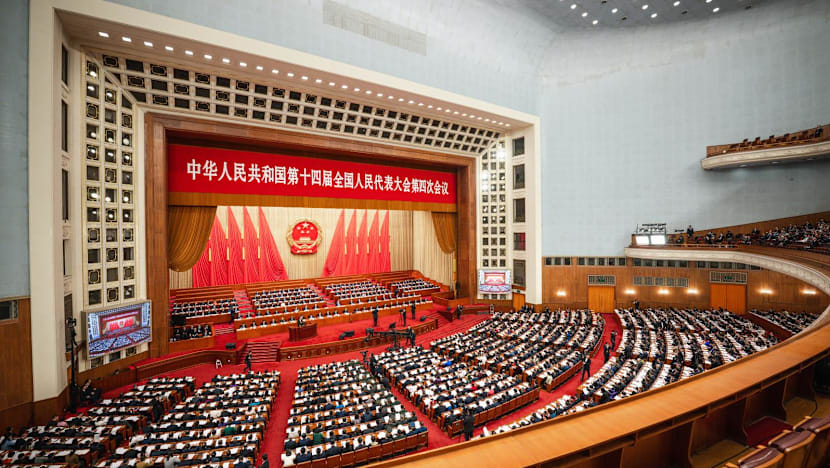
Delegates attend the second plenary session of the National People's Congress at the Great Hall of the People in Beijing, China on Mar 9, 2026. (Photo: CNA/Kenneth Lim)

This audio is generated by an AI tool.


LONDON: China’s 2026 economic growth target of 4.5 to 5 per cent is its lowest in decades, moving off the 5 per cent anchor of the past three post-pandemic years. This has been widely read as a moment of reckoning.
That the target was unveiled during the Two Sessions, China’s biggest annual political gathering, alongside details of the 15th Five-Year Plan for the world’s second-largest economy is important context. This is not just an annual calibration but the opening statement of a strategic framework.
But the number to note is actually 2 to 3 per cent. That is Enodo Economics’ estimate of China’s potential growth rate - the speed at which the economy can expand without generating inflation pressure.
The gap between that figure and the official target captures the bind Beijing is in, and how far it still has to travel.





WHY POTENTIAL GROWTH IS LOWER
Potential growth is determined by the economy’s long-run productive capacity, which depends on growth in the labour force, capital investments and productivity. In China’s case, the first two are working against growth simultaneously, which leaves everything riding on the third.
China’s labour supply is already shrinking. The working-age population has been declining since the early 2010s, and the country’s total population has now fallen for four consecutive years. As fewer young people enter the labour market and the population ages, the pool of available workers gradually contracts.
The inexorable demographic shift has reduced one of the key drivers of China’s past growth and is extremely hard to reverse in the next few years.
Capital is unlikely to provide much support to growth. Years of heavy investment in property and infrastructure have left China with a vast stock of underutilised and often low-return assets. Absorbing this excess capacity will take time.
New investment therefore adds to productive capacity only at the margin, while a large share of existing capital is becoming obsolete.
That leaves productivity growth as the only engine. Beijing knows this.


The 15th Five-Year Plan places “new quality productive forces” – technological innovation, advanced manufacturing, AI and digital transformation – at the centre of its growth framework. Investment is being directed toward semiconductors, quantum technology, embodied AI and next-generation digital infrastructure, with the core digital economy targeted to reach 12.5 per cent of GDP.
The strategic intent is clear, and China’s track record of executing industrial policy at scale means the ambition should not be dismissed. Indeed, I am more optimistic than most.
WHERE IS THE ECONOMY NOW?
But there is a difference between building world-class industries and generating productivity gains large enough to offset two simultaneous structural drags. Growth of that kind would be historically exceptional – possible, but not something to embed in a baseline forecast.
A target near 5 per cent seems a political compromise rather than a full reckoning with that reality.
It also points toward an outcome very few are expecting: inflation.
Some analysts look at three years of falling prices and conclude that China's economy must still be running well below its capacity and that Beijing therefore needs to stimulate harder to escape deflation. That reasoning is understandable but misleading.
Think of it this way: An economy emerging from a slump does not flip overnight from weak to strong. As it recovers, prices stop falling as fast – deflation becomes less severe, even before it disappears altogether.
That easing is the signal. It says the economy is approaching, or has already reached, its limits – not that it still needs more fuel.
CHINA’S DEFLATION IS QUIETLY ENDING
That is precisely what China's data has been showing. Producer prices were still falling, but by less and less. Core consumer prices were creeping higher. Deflation, measured by the GDP deflator, was narrowing. Taken together, these trends pointed to an economy already running at or close to full capacity even before February's figures arrived.
The latest data from China’s National Bureau of Statistics adds to the evidence. The key signal lies not in the level of prices but in the change in their direction. February CPI came in at 1.3 per cent year-on-year - a three-year high and a sharp jump from 0.2 per cent in January. Core inflation surged to 1.8 per cent - its highest reading since March 2019.
Producer prices fell 0.9 per cent year-on-year in February, narrowing sharply from the 1.4 per cent decline in January. Factory-gate deflation is easing. The pipeline from producer to consumer prices is beginning to fill.


Chinese New Year demand and travel played a role. But this festive season comes every year. What is different is the underlying trend it has been amplifying.
China’s deflationary era is not ending with a bang but with a gradual, almost invisible turning of the tide - visible only if you were watching the rate of change rather than the level.
The conflict in Iran is expected to keep oil prices elevated and add further upward pressure on producer and consumer prices - but the domestic dynamics were already doing the work.
STABILISATION OR DECLINE?
Amid clear signs of exiting the deflationary spiral, should China’s lowest growth target be seen as a maturing economy that is stabilising – or one that is in decline and dialing back on growth ambitions? Neither framing quite fits.
China is not in decline. Its productive capacity is being redirected, not exhausted, and the ambition embedded in the 15th Five-Year Plan is genuine.
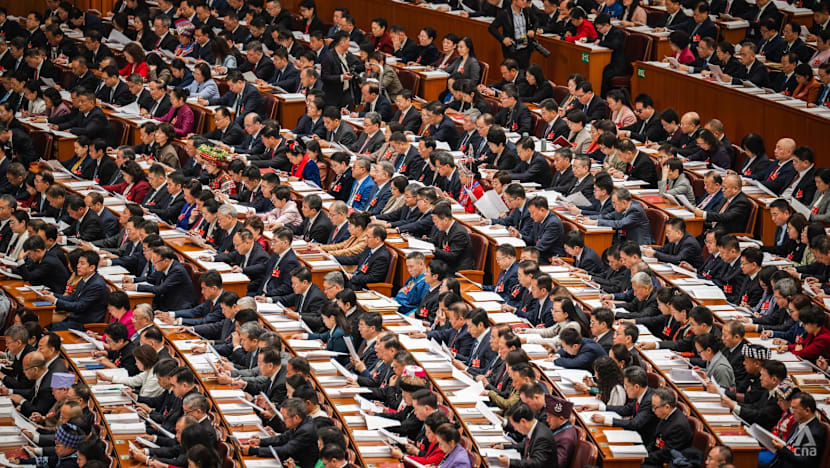
But this is not simple stabilisation either. It is the beginning of a structural transition toward slower, more balanced growth – one whose full implications Beijing has not yet fully accepted.
This is plain to see in the caveat “striving for better in practice” attached to the new target. That escape clause signals a leadership still tempted to reach for the old stimulus playbook the moment growth disappoints.
The deeper irony is that the more pressing risk is not that China’s economy slows too much. It is that it overheats.
Markets have yet to build a framework for a China that surprises on inflation rather than deflation. The February data suggests they should start.
Diana Choyleva is founder and chief economist of Enodo Economics and a keynote speaker on global macroeconomics, China, and U.S.–China strategic competition. She is also a senior fellow at the Asia Society Policy Institute’s Center for China Analysis.






